India Seeks EU Steel Scrap Access to Soften Carbon Tax Impact
Source:Indian Express ↗
Why It Matters
Demonstrates the real-world economic impacts of international climate policies like the EU's CBAM on developing economies, and highlights the geopolitical competition for critical raw materials (like steel scrap) needed for the global green transition.
Summary
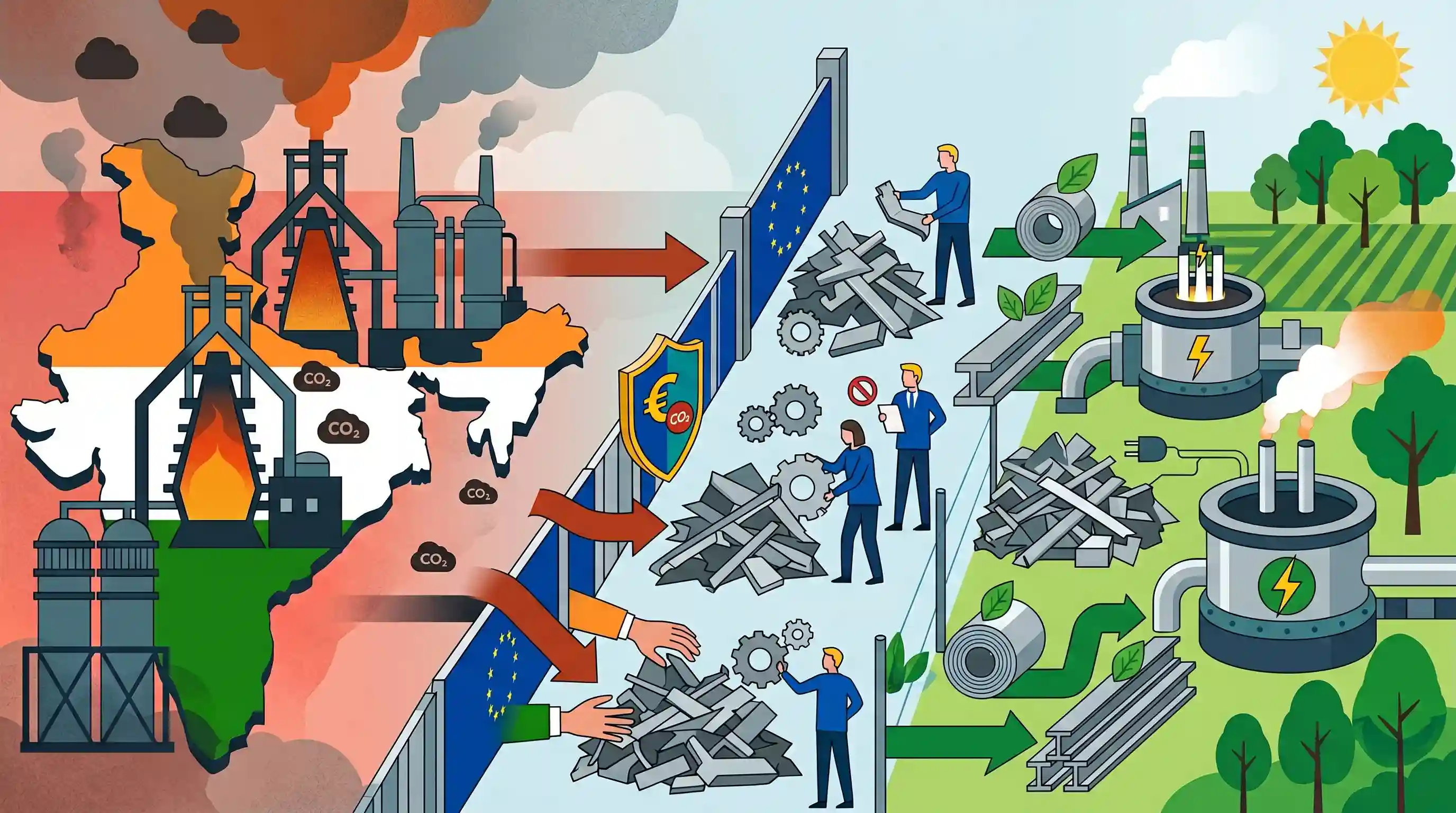
India is pressing the European Union for unhindered access to European steel scrap exports to help decarbonize its domestic steel industry and soften the upcoming blow of the EU's Carbon Border Adjustment Mechanism (CBAM). Indian steel is largely produced via the emission-intensive blast furnace route, making it highly vulnerable to the EU's upcoming carbon tax on imports. Using steel scrap in electric arc furnaces dramatically reduces the carbon footprint of steel production. However, the EU is reportedly looking to restrict its scrap exports to ensure sufficient supply for its own green transition, prompting India to seek special access as it navigates the trade challenges posed by global climate policies.
Key Points
- India is seeking easier access to European Union steel scrap to help decarbonize its domestic steel industry.
- The move is aimed at mitigating the impact of the EU's upcoming Carbon Border Adjustment Mechanism (CBAM), which imposes a carbon tax on imports like steel and aluminum starting in 2026.
- Most Indian steel is currently produced using the emission-intensive blast furnace route (relying on iron ore and coking coal), making it highly vulnerable to the CBAM levy.
- Transitioning to Electric Arc Furnaces (EAF) using steel scrap significantly lowers emissions, but the EU is reportedly looking to restrict its scrap exports to ensure sufficient supply for its own green transition.
- The issue highlights the rising tension between climate change mitigation policies and international trade, often characterized by developing nations as 'green protectionism'.
Important Terms
Carbon Border Adjustment Mechanism (CBAM)

An EU policy imposing carbon costs on imports of carbon-intensive goods (steel, aluminium, cement) to match prices paid by domestic producers under the Emissions Trading System (ETS).
UPSC context
GS Paper 3: Environment & Economy. Relates to climate-linked trade barriers and India's export competitiveness in the EU market.
Free Trade Agreement (FTA)
A comprehensive treaty between two or more countries to reduce or eliminate trade barriers, such as tariffs and quotas, to facilitate smoother cross-border exchange of goods and services.
UPSC context
GS Paper 2: International Relations. India-EU FTA negotiations are critical for bilateral trade and resolving climate-related trade disputes.
Ferrous Scrap
Recyclable iron and steel materials used as feedstock in steelmaking. It is a critical resource for reducing industrial carbon footprints compared to using raw iron ore.
UPSC context
GS Paper 3: Industrial Growth. Essential for India's 'Green Steel' transition and meeting international carbon standards.
Electric Arc Furnace (EAF)
A steelmaking furnace that uses high-voltage electric arcs to melt scrap metal. It is significantly less carbon-intensive than the coal-based Blast Furnace-Basic Oxygen Furnace (BF-BOF) route.
UPSC context
GS Paper 3: Infrastructure/Technology. A key technology for decarbonizing the hard-to-abate steel sector.
Carbon Leakage
The phenomenon where companies move production to countries with lax environmental regulations to avoid carbon costs, potentially increasing global emissions despite local climate policies.
UPSC context
GS Paper 3: Environment. The primary justification for CBAM and a central concept in global climate-trade negotiations.
Green Steel
Steel produced with minimal greenhouse gas emissions, typically through scrap recycling in EAFs or by using green hydrogen instead of coking coal as a reducing agent.
UPSC context
GS Paper 3: Economy/Environment. India's target is to increase scrap-based steel production to 50% by 2047.
Non-Tariff Barriers (NTBs)
Trade restrictions—such as quotas, export bans, or complex technical standards—that limit imports or exports through means other than direct customs duties (tariffs).
UPSC context
GS Paper 3: Indian Economy. India views EU scrap export restrictions as a non-tariff barrier hindering its green transition.
Common But Differentiated Responsibilities (CBDR)
A UNFCCC principle asserting that while all nations must address climate change, developed countries should lead due to their historical emissions and greater financial capacity.
UPSC context
GS Paper 3: Environment. India’s core diplomatic argument against unilateral climate taxes like CBAM.
Prelims Trap
"CBAM is a WTO-mandated mechanism to enforce uniform carbon pricing globally."
CBAM is a unilateral measure introduced by the European Union, not a global framework mandated by the WTO or UNFCCC. Developing nations actively contest it.
Static Concepts Connected
What is the difference between Blast Furnace and Electric Arc Furnace steelmaking?
- Blast Furnace (BF): Relies heavily on iron ore and coking coal. It is highly emission-intensive and represents the vast majority of India's current steel production.
- Electric Arc Furnace: Melts recycled steel scrap using electrical currents. It significantly lowers direct greenhouse gas emissions, provided the electricity source is relatively clean.
How does the EU's CBAM conflict with the UNFCCC principle of CBDR?
- CBDR Principle: Acknowledges that developed countries have higher historical emissions, granting developing nations different timelines and burdens for climate mitigation.
- CBAM's Conflict: Imposes a uniform carbon tax on specific imports regardless of origin, effectively penalizing developing nations for their current emission intensity and bypassing historical equity.
Cross-Topic Patterns
Green Protectionism vs. WTO Norms
The clash between the EU's unilateral climate policies (CBAM) and developing countries' trade rights highlights how climate mitigation is increasingly functioning as a non-tariff trade barrier, testing WTO rules.
Circular Economy in Heavy Industry
India's need for steel scrap connects waste management directly to industrial decarbonization, emphasizing the importance of the Steel Scrap Recycling Policy (2019) to reduce coking coal import dependency.

Expect a multi-statement Prelims question on CBAM linking unilateral trade barriers, CBDR principles, and steelmaking emission profiles.
Linked PYQs · 4
Linked PYQs · 4
- 2015PrelimsGS1
In India, the steel production industry requires the import of
- 2022MainsGS3
Discuss global warming and mention its effects on the global climate. Explain the control measures to bring down the level of greenhouse gases which cause global warming, in the light of the Kyoto Protocol, 1997.
- 2023MainsGS3
The adoption of electric vehicles is rapidly growing worldwide. How do electric vehicles contribute to reducing carbon emissions and what are the key benefits they offer compared to traditional combustion engine vehicles?
- 2025PrelimsGS1
Consider the following statements : Statement I: Article 6 of the Paris Agreement on climate change is frequently discussed in global discussions on sustainable development and climate change. Statement II: Article 6 of the Paris Agreement on climate change sets out the principles of carbon markets. Statement III : Article 6 of the Paris Agreement on climate change intends to promote inter-country non-market strategies to reach their climate targets. Which one of the following is correct in respect of the above statements?
