Wildlife Conservation in India Achievements and Challenges
Source:Indian Express ↗
Why It Matters
Provides a comprehensive overview of India's wildlife conservation model, balancing major ecological milestones against contemporary threats like habitat fragmentation and human-wildlife conflict, crucial for GS3 Environment syllabus.
Summary
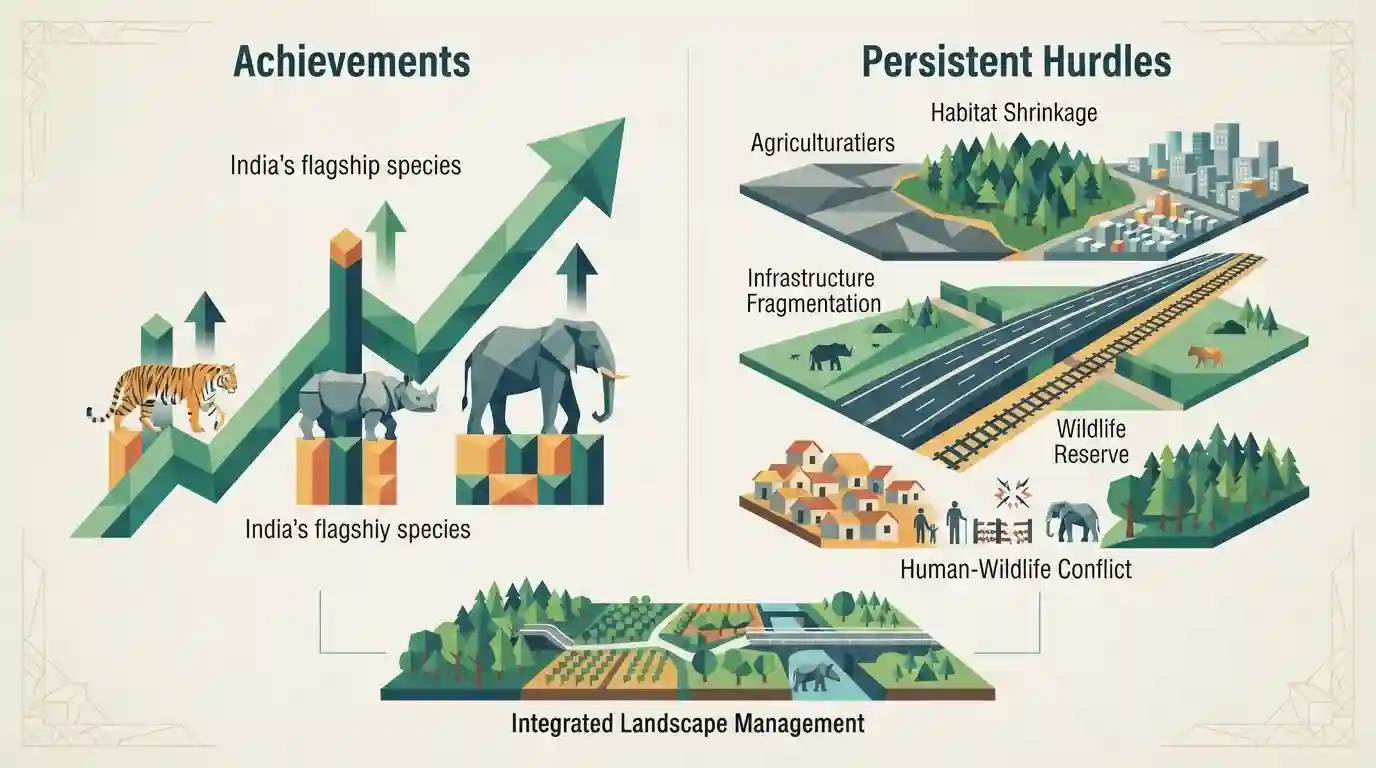
The article examines India's trajectory in wildlife conservation, detailing key achievements such as the recovery of flagship species populations through focused legal and programmatic frameworks. However, it highlights persistent hurdles including habitat shrinkage, human-wildlife conflict, infrastructure fragmentation, and the urgent need for integrated landscape management to secure long-term biodiversity outcomes.
Key Points
- India has made significant strides in wildlife conservation, marked by successful population growth in iconic species like tigers, lions, elephants, and rhinos through targeted initiatives like Project Tiger and Project Elephant.
- Despite conservation successes, India faces severe systemic challenges including habitat fragmentation, infrastructure expansion through protected areas, escalating human-wildlife conflict, and linear infrastructure barriers.
- Climate change, illegal wildlife trafficking, and the degradation of non-protected wildlife corridors continue to threaten long-term biodiversity stability.
- Balancing developmental imperatives with ecological preservation requires strengthening community-led conservation, stricter environmental impact assessments, and scientifically managed wildlife corridors.
Prelims Trap
Wildlife Protection Act continues to maintain its original six-schedule classification structure for all species protection categories.
Aspirants often assume Wildlife Protection Act schedules are static; the 2022 amendment radically streamlined schedules from six to four, altering protection architectures.
Static Concepts Connected
What are the key legal instruments and statutory bodies for wildlife conservation in India?
- WPA 1972: Wildlife Protection Act 1972 provides the core legal framework, prohibiting hunting and establishing protected area categories like National Parks and Sanctuaries.
- NBWL mandate: National Board for Wildlife (NBWL) is chaired by the Prime Minister and mandates statutory clearance for projects in and around protected areas.
- Flagship projects: Project Tiger and Project Elephant operate under the MoEFCC as centrally sponsored schemes, providing financial and technical backing for flagship species.
Cross-Topic Patterns
Infrastructure corridors vs wildlife connectivity
Linear infrastructure expansion under PM Gati Shakti intersects directly with protected area corridors, testing India's balance between rapid logistics and statutory wildlife clearances.
Eco-Sensitive Zones and Scheduled Tribes Act
Rising human-wildlife conflict brings tribal land rights under FRA 2006 and eco-sensitive zone guidelines into acute administrative friction.

Expect a multi-statement prelims question pairing Wildlife Protection Act schedule amendments with landscape-level corridor fragmentation.
Linked PYQs · 3
Linked PYQs · 3
- 2022PrelimsGS1
With reference to Indian laws about wildlife protection, consider the following statements : 1. Wild animals are the sole property of the government. 2. When a wild animal is declared protected, such animal is entitled for equal protection whether it is found in protected areas or outside. 3. Apprehension of a protected wild animal becoming a danger to human life is sufficient ground for its capture or killing. Which of the statements given above is/are correct?
- 2023PrelimsGS1
Consider the following statements: Once the Central Government notifies an area as a 'Community Reserve' 1. the Chief Wildlife Warden of the State becomes the governing authority of such forest 2. hunting is not allowed in such area 3. people of such area are allowed to collect non-timber forest produce 4. people of such area are allowed traditional agricultural practices How many of the above statements are correct?
- 2020PrelimsGS1
Which one of the following protected areas is well-known for the conservation of a sub-species of the Indian swamp deer (Barasingha) that thrives well on hard ground and is exclusively graminivorous?
