Data Centre Boom and Power Grid Challenges in India
Source:Indian Express ↗
Why It Matters
Crucial for GS3 Infrastructure and Economy, as it links emerging technologies (AI and Data Centres) with core infrastructure challenges (Power Grid, DISCOM financial health, and Energy Transition). It presents a novel structural challenge to India's energy security and climate goals.
Summary
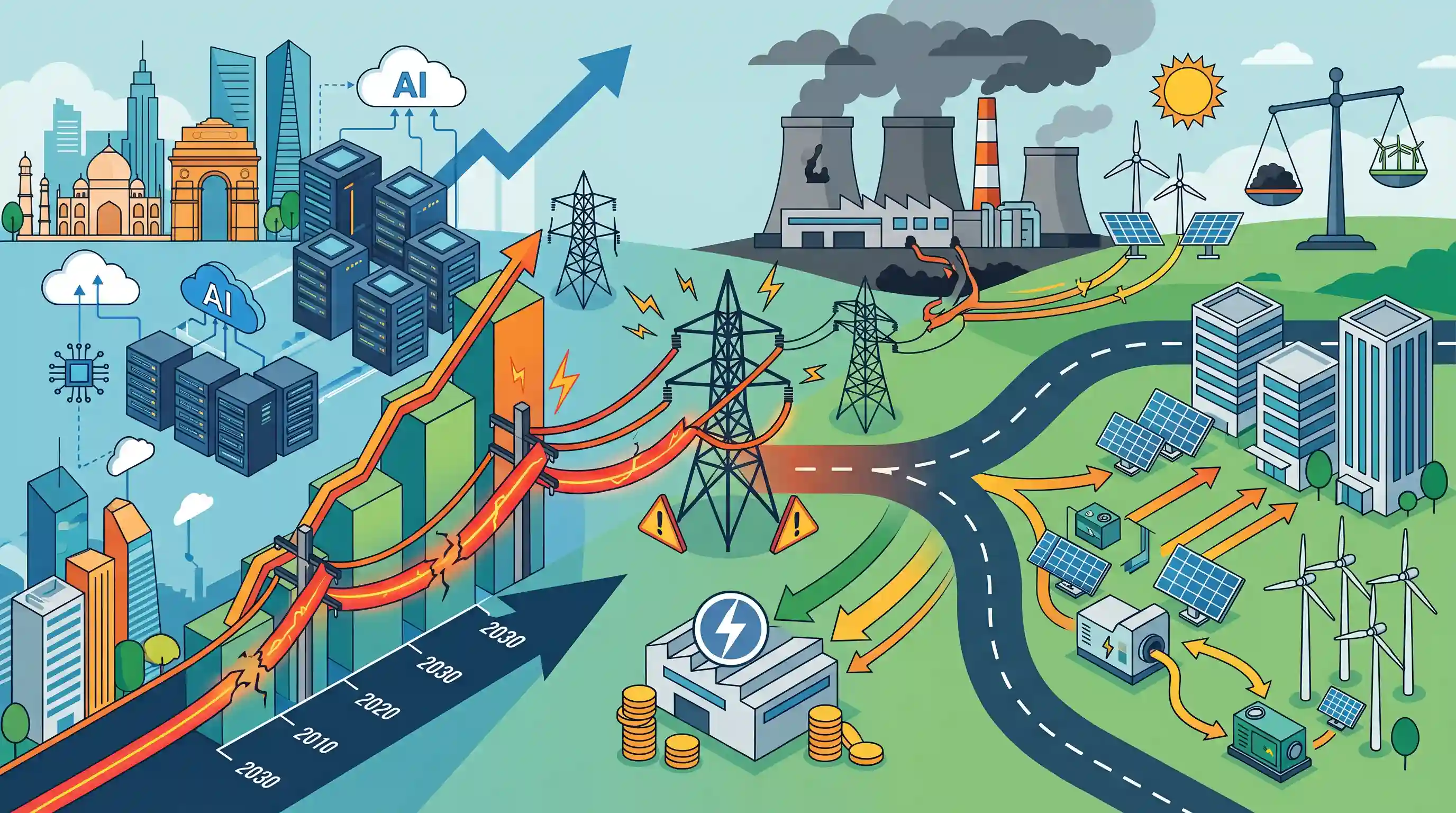
The rapid expansion of artificial intelligence (AI) and cloud computing is triggering a data centre boom in India, which is expected to quadruple capacity by 2030. This exponential growth demands massive amounts of electricity, putting immense stress on the national power grid. The article highlights the risk of a "silent exit," wherein tech companies, dissatisfied with grid reliability or the pace of the green transition, might establish their own captive power plants or off-grid solutions. This shift threatens the financial viability of state-owned power distribution companies (DISCOMs) by depriving them of high-tariff commercial consumers. Furthermore, the immense baseload power required by AI data centres poses a significant challenge to India's energy transition and climate goals, potentially necessitating continued reliance on coal power.
Key Points
- The explosive growth in Artificial Intelligence (AI) and cloud computing is projected to quadruple India's data centre capacity by 2030, drastically increasing electricity demand.
- AI computing tasks require specialized chips that consume significantly more power than traditional processors, leading to intense energy concentration in data centres.
- India's traditional power grid faces a "silent exit" risk, where tech giants may bypass state distribution companies (DISCOMs) to set up their own captive power generation or off-grid solutions to ensure uninterrupted, high-quality power.
- The departure of high-paying tech and industrial consumers could worsen the financial health of DISCOMs, challenging reforms previously attempted through schemes like UDAY.
- The immense baseload power requirement for data centres complicates India's energy transition, potentially prolonging reliance on coal and fossil fuels despite ambitious renewable energy targets.
Important Terms
DISCOMs (Distribution Companies)

Last-mile electricity utilities responsible for distributing power to end-consumers. They act as the financial interface between power generators and users, often suffering from high debt and operational inefficiencies.
UPSC context
GS-III: Infrastructure/Energy. Essential for understanding the power sector's financial 'bottleneck' and the impact of commercial consumer loss on state revenues.
Baseload Power
The minimum level of continuous electricity demand required on a grid over 24 hours. Data centres require high, stable baseload power, which currently necessitates reliance on coal or nuclear.
UPSC context
GS-III: Energy Security. Critical for discussing the 'intermittency' challenge of renewables and why a 'green transition' is technically complex for high-tech infrastructure.
Ujwal DISCOM Assurance Yojana (UDAY)
A 2015 flagship scheme for the financial turnaround of DISCOMs. It involved state governments taking over 75% of DISCOM debt to improve liquidity and operational efficiency.
UPSC context
GS-III: Government Schemes. Tests knowledge of power sector reforms and the evolution of debt restructuring frameworks like the Revamped Distribution Sector Scheme (RDSS).
Captive Power Plant (CPP)
A generation facility established by a commercial or industrial entity primarily for its own use. These allow companies to bypass grid unreliability and high commercial tariffs.
UPSC context
GS-III: Industrial Growth. Relevant to the 'silent exit' of high-paying consumers from the national grid, threatening DISCOM financial viability.
Energy Transition
The structural shift from a fossil-fuel-based energy system to one dominated by renewable sources. India aims for 500 GW of non-fossil capacity by 2030.
UPSC context
GS-III: Environment & Economy. A core topic for questions on India’s climate commitments (Panchamrit) and the 'trilemma' of energy security, equity, and sustainability.
Data Centres
Centralized physical facilities used to house computer systems and associated components. In India, their expansion is driven by AI, cloud computing, and data localization mandates.
UPSC context
GS-III: Science & Tech / Infrastructure. Linked to Digital India, AI-led growth, and the new challenges they pose to national grid stability.
AT&C Losses (Aggregate Technical and Commercial Losses)
A composite metric measuring energy lost due to technical reasons (line losses), theft, and collection inefficiencies. It is the primary indicator of a DISCOM's health.
UPSC context
GS-III: Infrastructure. A standard technical term used to evaluate the efficiency of power distribution reforms and smart metering initiatives.
Prelims Trap
Captive power plants under the Electricity Act 2003 mandate that the owner must consume 100% of the electricity generated.
The Act only requires captive users to hold at least 26% ownership and consume a minimum of 51% of the generated electricity, not 100%.
Static Concepts Connected
What qualifies as a Captive Generating Plant under the Electricity Act, 2003?
- Ownership mandate: The captive user or users must hold not less than 26% of the ownership in the generating plant.
- Consumption threshold: At least 51% of the aggregate electricity generated annually must be consumed for captive use by the owners.
- Cooperative societies: For plants set up by registered cooperative societies, the members must collectively consume the 51% minimum threshold.
How does the cross-subsidy model work for state distribution companies (DISCOMs)?
- Differential pricing: DISCOMs charge significantly higher per-unit tariffs to industrial and commercial consumers (such as data centres).
- Revenue transfer: Surplus revenue from high-paying users is utilized to offset the cost of highly subsidized power given to agricultural households.
- Financial risk: When commercial consumers migrate to captive power, DISCOMs lose this crucial cross-subsidy revenue, aggravating their debt burdens.
Cross-Topic Patterns
AI boom vs. Panchamrit climate goals
The continuous baseload power demanded by AI chips threatens India's COP26 renewable transition, likely prolonging coal dependency to prevent grid instability.
Captive power eroding DISCOM viability
As data centres adopt captive power for reliability, they drain state DISCOMs of the commercial cross-subsidies vital for funding low-cost agricultural electricity.

Expect a 2026 multi-statement question linking AI data centre baseload demands, Captive Power Plant criteria (51% rule), and DISCOM finances.
Linked PYQs · 4
Linked PYQs · 4
- 2018MainsGS3
“Access to affordable, reliable, sustainable and modern energy is the sine qua non to achieve Sustainable Development Goals (SDGs).” Comment on the progress made in India in this regard.
- 2016PrelimsGS1
Which one of the following is a purpose of 'UDAY', a scheme of the Government?
- 2023MainsGS3
Introduce the concept of Artificial Intelligence (AI). How does Al help clinical diagnosis? Do you perceive any threat to privacy of the individual in the use of Al in healthcare?
- 2024PrelimsGS1
Consider the following: 1. Battery storage 2. Biomass generators 3. Fuel cells 4. Rooftop solar photovoltaic units How many of the above are considered "Distributed Energy Resources"?
