Inter State Water Sharing Dispute and Soft Power Diplomacy in India
Source:Indian Express ↗
Why It Matters
Inter-state water disputes are recurrent friction points in Indian federalism, making them critical for GS-2 Polity. Furthermore, initiatives like International Yoga Day are prime examples of India's soft power strategy, relevant to GS-2 International Relations.
Summary
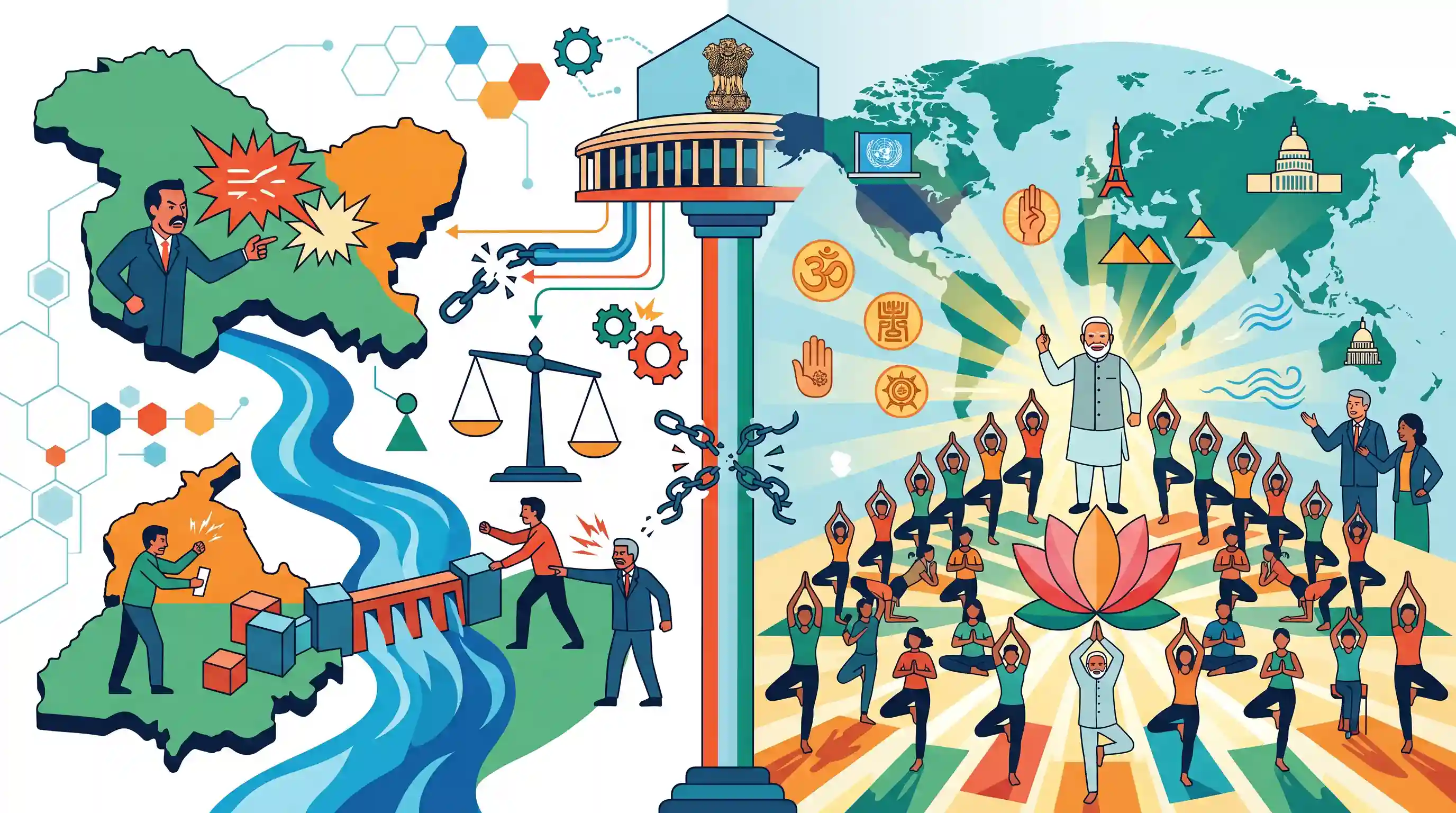
The article discusses recent political developments, highlighting J&K Chief Minister Omar Abdullah's contentious remarks on water sharing that have upset political circles in Punjab. This friction brings to the forefront the persistent federal challenges associated with inter-state water disputes and resource allocation in India. Additionally, the piece touches upon the celebration of International Yoga Day led by Prime Minister Narendra Modi, illustrating how India leverages its traditional practices as a form of cultural diplomacy and soft power on the global stage.
Key Points
- J&K Chief Minister Omar Abdullah's remarks on water sharing have escalated political tensions with Punjab, reigniting debates over inter-state water allocation.
- The controversy highlights the complex federal challenges in managing and distributing shared river resources (such as the Ravi and Beas rivers).
- The article also covers Prime Minister Narendra Modi's promotion of International Yoga Day.
- Yoga Day serves as a key tool for India's cultural diplomacy and soft power, projecting India's civilizational heritage globally.
Important Terms
Indus Water Treaty (IWT)

A 1960 World Bank-brokered agreement between India and Pakistan dividing the Indus system. India has rights over Eastern rivers (Ravi, Beas, Sutlej), while Western rivers are primarily for Pakistan.
UPSC context
GS II (International Relations). Tests transboundary water governance and India’s strategic use of river resources.
Soft Power
The capacity of a nation to influence global actors through attraction and persuasion (culture, values, and policies) rather than military or economic coercion (Hard Power).
UPSC context
GS II (International Relations). Central to analyzing India’s global standing and diplomatic strategies.
Inter-State River Water Disputes (ISRWD)
Legal and political conflicts between Indian states over the sharing, control, or distribution of rivers that flow across state boundaries, governed by the ISRWD Act, 1956.
UPSC context
GS II (Federalism). Tests understanding of Article 262 and the challenges of resource allocation.
Article 262
A constitutional provision empowering Parliament to adjudicate disputes regarding inter-state rivers and specifically allowing for the exclusion of Supreme Court jurisdiction in such matters.
UPSC context
GS II (Indian Polity). A fundamental article for questions on federal friction and adjudication mechanisms.
Cultural Diplomacy
A diplomatic strategy using cultural assets, such as Yoga, Bollywood, and heritage, to enhance a nation's prestige and build international rapport.
UPSC context
GS II (International Relations). Evaluates the use of traditional practices as tools in modern foreign policy.
Cooperative Federalism
A federal principle where the Union and States interact optimally to resolve collective challenges, essential for managing shared resources like river waters.
UPSC context
GS II (Federalism). Tests the ability to propose solutions for center-state and inter-state conflicts.
Prelims Trap
The Supreme Court has exclusive original jurisdiction over all inter-state river water disputes.
Article 262 empowers Parliament to restrict SC jurisdiction over these disputes, which it did via the Inter-State River Water Disputes Act of 1956.
Static Concepts Connected
How does the Constitution handle inter-state river water disputes?
- Article 262: Empowers Parliament to legislate on the adjudication of any dispute regarding the use, distribution, or control of inter-state river waters.
- Ousting Courts: Parliament may by law provide that neither the Supreme Court nor any other court shall exercise jurisdiction over such water disputes.
- ISRWD Act 1956: Enacted to establish ad-hoc tribunals whose final awards are binding on the disputing states, deliberately keeping them out of standard judicial routes.
What is the water allocation under the Indus Waters Treaty (1960)?
- Eastern Rivers: India was granted unrestricted use of the Ravi, Beas, and Sutlej rivers, aiming for full utilization for irrigation and hydropower.
- Western Rivers: Pakistan was allocated the Indus, Jhelum, and Chenab rivers, though India retains limited, non-consumptive usage rights (like run-of-the-river projects).
- World Bank Broker: The treaty, which remains one of the most successful water-sharing agreements globally, was negotiated and brokered by the World Bank.
Cross-Topic Patterns
Federal friction vs. Strategic utilization
Domestic water disputes between border states (like Punjab and J&K) often delay hydro projects like Shahpur Kandi, stalling India's strategic ability to fully utilize its Indus Waters Treaty share against Pakistan.
UN multilateralism for Soft Power
India frequently pairs its civilizational heritage with UN machinery (e.g., International Yoga Day, International Year of Millets) to systematically convert traditional practices into modern diplomatic soft power.

Expect a Prelims question contrasting the Supreme Court's original jurisdiction under Art 131 with water tribunals under Art 262.
Linked PYQs · 3
Linked PYQs · 3
- 2012MainsGS2
The situation today is far different to that prevalent fifty years back when the Indus Water Treaty was signed." Highlight the complexity of the current challenges on both sides of the border in this regard. Do you think that a review of the Treaty is in India's best interests?
- 2015MainsGS2
Terrorist activities and mutual distrust have clouded India-Pakistan relations. To what extent the use of soft power like sports and cultural exchanges could help generate goodwill between the two countries? Discuss with suitable examples.
- 2019MainsGS2
From the resolution of contentious issues regarding distribution of legislative powers by the courts, 'Principle of Federal Supremacy' and 'Harmonious Construction' have emerged. Explain.
