India Growth Potential in Global Ship Recycling Industry
Source:The Hindu ↗
Why It Matters
The expansion of India's ship recycling sector amid global maritime disruptions highlights the intersection of international trade logistics, environmental compliance under the Hong Kong Convention, and domestic industrial growth in secondary steel production.
Summary
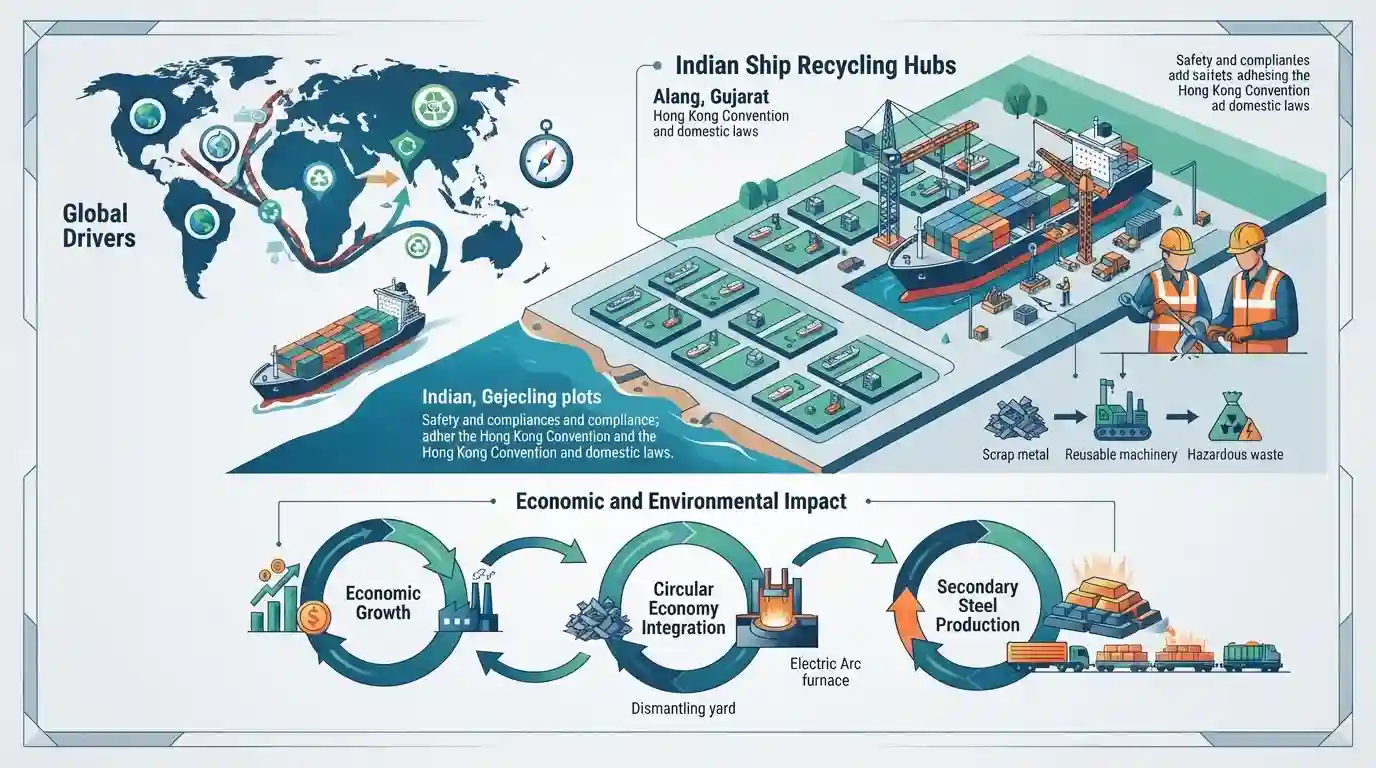
Driven by international maritime disruptions, evolving environmental rules, and geopolitical shipping route shifts, the global ship recycling industry is witnessing a major surge. India is poised to emerge as a major beneficiary of this trend, leveraging major ship recycling hubs like Alang in Gujarat. Compliance with the Hong Kong Convention and domestic legal frameworks like the Recycling of Ships Act 2019 have enabled Indian yards to adopt environmentally sound and safe ship-breaking practices, boosting economic growth, circular economy integration, and secondary steel production.
Key Points
- Global maritime disruptions, such as geopolitical tensions and environmental regulations, are driving a surge in ship recycling worldwide.
- India, particularly through ship recycling hubs like Alang in Gujarat, is well-positioned to capitalize on this global boom due to infrastructure upgrades and compliance with international standards.
- The Hong Kong Convention and the Recycling of Ships Act 2019 have helped India adopt safer and more eco-friendly ship-breaking practices, attracting international vessel owners.
- This sector boosts domestic steel production, creates employment, and integrates India deeper into the global maritime circular economy.
Important Terms
Hong Kong International Convention for the Safe and Environmentally Sound Recycling of Ships

A global treaty adopted under the IMO to ensure that ship recycling practices do not pose unnecessary risks to human health, safety, and the environment by regulating hazardous materials and facility standards.
UPSC context
Mains Paper III (Environment & Standards): Important for international environmental agreements, maritime governance, and India's compliance frameworks.
Recycling of Ships Act 2019
Legislation enacted by India in 2019 to regulate ship recycling, implementing international safety and environmental standards aligned with the Hong Kong Convention across domestic yards.
UPSC context
Prelims and Mains Paper III (Economic Development / Infrastructure): Tests domestic legislation governing industrial safety, circular economy, and secondary steel production.
Alang Ship Recycling Yard
Located on the Gulf of Khambhat in Gujarat, it is the world's largest ship-breaking and recycling yard, handling a massive share of global ship recycling.
UPSC context
Prelims and Mains Paper III (Infrastructure & Maritime Sector): Important for India's port-led development, manufacturing hub strategy, and industrial infrastructure.
Prelims Trap
The Hong Kong Convention for safe ship recycling functions under the direct administrative framework of the Basel Convention on hazardous wastes.
The Hong Kong Convention was adopted under the IMO, not the Basel Convention or UNFCCC, though it deals with hazardous materials aboard ships.
Static Concepts Connected
What are the key provisions and regulatory framework of the Recycling of Ships Act, 2019 in India?
- Legislative Intent:: Enacted to give effect to the Hong Kong International Convention for the Safe and Environmentally Sound Recycling of Ships, 2009.
- Mandatory Certification:: Mandates that all recycling yards must obtain a "Certificate of Ready for Recycling" before accepting any vessel.
- Hazardous Control:: Restricts the use of hazardous materials like asbestos and heavy metals on ships and ensures safe disposal protocols.
- Regulatory Authority:: Empowers the Director General of Shipping as the apex national authority for oversight and authorization of recycling facilities.
Cross-Topic Patterns
Ship Recycling Standards & Hazardous Waste Trade
The Hong Kong Convention bridges international environmental compliance with domestic industrial policy, mirroring how Basel Convention rules govern hazardous waste trade and electronic waste recycling hubs in India.
Circular Economy and Industrial Decarbonisation Links
Alang's secondary steel output directly reduces primary iron ore extraction pressure, feeding into broader national targets for resource efficiency and industrial decarbonisation.

Alang's compliance standards, Hong Kong Convention entry into force, and Recycling of Ships Act 2019 are prime prelims match targets.
Linked PYQs · 3
Linked PYQs · 3
- 2025MainsGS3
Why is maritime security vital to protect India's sea trade? Discuss maritime and coastal security challenges and the way forward.
- 2026PrelimsGS1
In what way(s) does the Vizhinjam International Seaport represent a structural shift in India's maritime trade and logistics policy? 1. By functioning exclusively as a domestic cargo hub to reduce reliance on coastal shipping and eliminate the need for foreign collaborations. 2. By focusing primarily on passenger cruise tourism and heritage shipping to increase Kerala's profile as a maritime heritage destination. 3. By leveraging its natural deep draft and strategic location to reduce dependence on foreign trans-shipment ports, enhance revenue retention, and reposition India in regional maritime trade. Select the answer using the code given below :
- 2026PrelimsGS1
Consider the following statements with reference to the Sagarmala Programme of the Government of India : I. The Sagarmala Programme seeks to achieve port-led economic growth through cost-effective and sustainable coastal infrastructure. II. The success of the Sagarmala Programme is reflected in significant growth in coastal and inland waterway shipping, along with improved global port rankings. III. Sagarmala 2.0 aims to position India as a global maritime innovation hub aligned with Atmanirbhar Bharat and Viksit Bharat 2047 visions. Which of the following relationships among the above statements is/are correct ? 1. Statement II validates the effectiveness of the strategies envisioned in statement I. 2. Statement III extends the objectives of statement I by embedding them into a future-oriented innovation framework. 3. Statement I contradicts statement III by focusing only on traditional infrastructure instead of modern innovation. Select the answer using the code given below :
