India Reconsiders Restrictions on Chinese Firms in Public Procurement
Source:The Hindu ↗
Why It Matters
The rollback of public procurement curbs highlights the intricate balance between national security and economic development. For UPSC aspirants, it serves as a critical case study on how infrastructure bottlenecks and global geopolitical shifts (e.g., U.S. tariffs) can force pragmatic adjustments in foreign policy and economic diplomacy, illustrating the complexities of decoupling from major supply chain hubs like China.
Summary
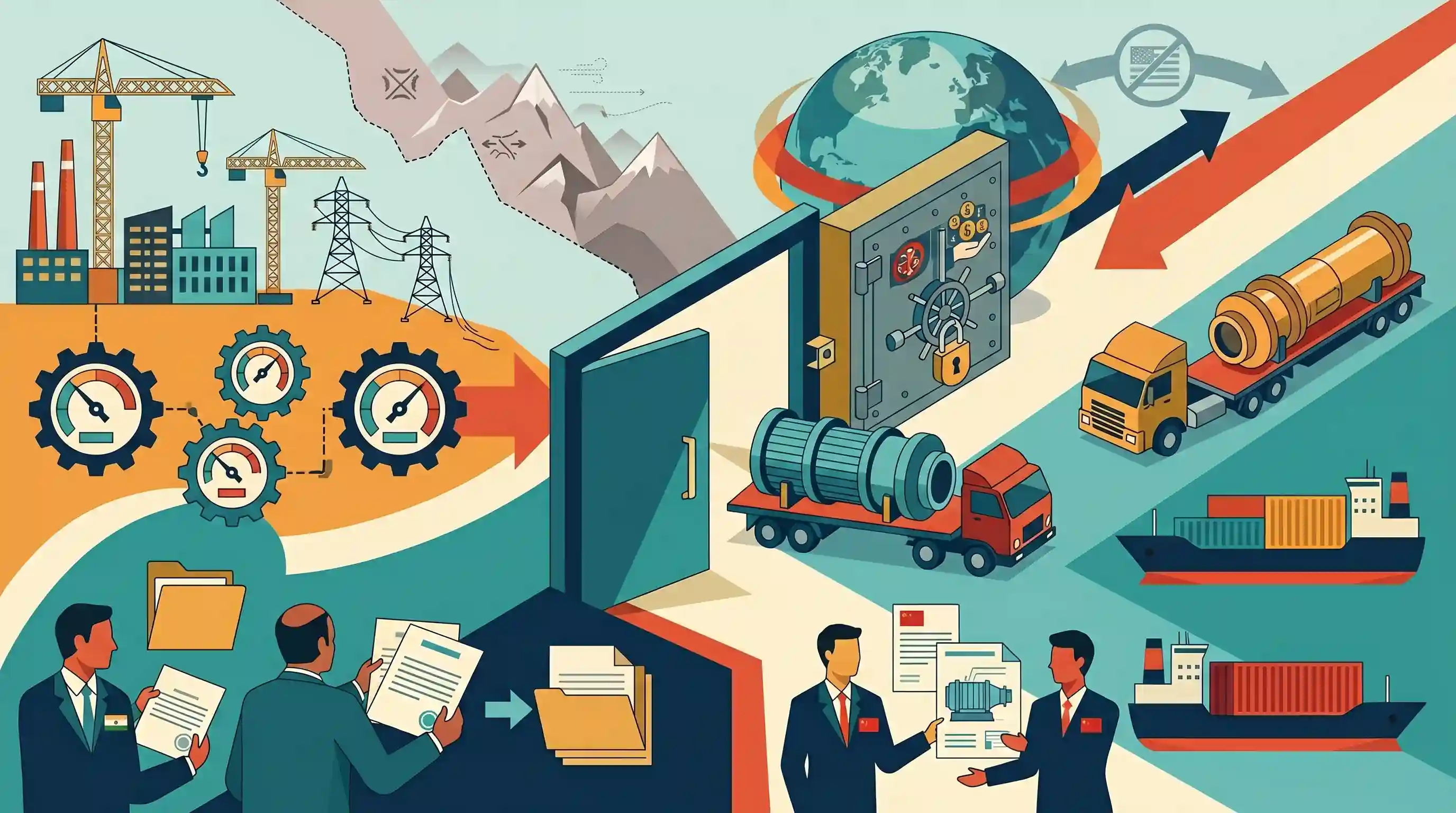
India is preparing to scrap restrictions imposed in 2020 that prevented Chinese companies from freely bidding on government contracts. Originally enacted following the deadly Galwan Valley border clash to safeguard public procurement, the rollback is primarily driven by mounting domestic infrastructure delays. The power sector has been severely impacted, as bottlenecks in importing critical Chinese thermal power equipment threaten India's capacity expansion targets. While strict Foreign Direct Investment (FDI) curbs remain intact, this pragmatic relaxation indicates a partial economic recoupling, influenced by easing border tensions and shifting global geopolitics, including U.S. trade tariffs.
Key Points
- India plans to lift 2020 restrictions that required Chinese companies to obtain political and security clearances before bidding on government contracts.
- The curbs, initially imposed following the deadly Galwan Valley border clash, have led to significant infrastructure project delays in India.
- The power sector has been particularly affected, with restricted imports of Chinese equipment hindering India's goal of raising its thermal power capacity to 307 GW over the next decade.
- While public procurement rules are being relaxed, strict Foreign Direct Investment (FDI) regulations targeting Chinese firms will remain in place.
- The policy shift occurs amid easing border tensions, prime ministerial visits, and changing geopolitical dynamics, including renewed U.S. tariffs on Indian goods.
Important Terms
General Financial Rules (GFR), 2017

A set of instructions on public finance. In 2020, Rule 144(xi) was added to restrict bidders from countries sharing land borders with India in public procurement for national security reasons.
UPSC context
GS-II/III: Governance and Economy. Tests knowledge of public procurement norms and national security-driven economic regulations.
Press Note 3 (2020)
A 2020 FDI policy amendment requiring prior government approval for investments from countries sharing a land border with India to prevent "opportunistic takeovers" of Indian firms during the COVID-19 pandemic.
UPSC context
GS-III: Indian Economy. Key for analyzing India's investment climate and regulatory responses to strategic threats.
Galwan Valley Clash
A 2020 violent military standoff in Eastern Ladakh that drastically altered India-China bilateral relations. It prompted New Delhi to implement "economic de-coupling" and restrict Chinese participation in the Indian economy.
UPSC context
GS-II: International Relations. Primary geopolitical context for India's 'border-first' approach and subsequent trade restrictions with China.
CRRC (China Railway Rolling Stock Corporation)
A Chinese state-owned enterprise and world leader in rail equipment. It was frequently disqualified from Indian metro and railway projects following the 2020 procurement restrictions on border nations.
UPSC context
GS-III: Infrastructure. Case study for the impact of geopolitical curbs on large-scale transportation and 'Make in India' targets.
Thermal Power Equipment
Machinery like turbines and boilers for coal plants. India’s reliance on Chinese imports for these components has created bottlenecks, driving a pragmatic relaxation of curbs to meet energy capacity targets.
UPSC context
GS-III: Energy/Infrastructure. Illustrates the conflict between strategic autonomy and the practical demands of national energy security.
Public Procurement
The acquisition of goods/services by government bodies. In India, it is governed by the GFR and used strategically to support 'Atmanirbhar Bharat' and manage national security risks.
UPSC context
GS-II/III: Government Policy. Tests understanding of the state's role in the market and spending as a strategic tool.
Prelims Trap
India has scrapped all prior approval requirements for entities from land-border sharing countries.
The rollback only applies to government contract bidding under the General Financial Rules. Strict FDI curbs under Press Note 3 (2020) remain fully in place.
Static Concepts Connected
What regulates FDI from countries sharing a land border with India?
- Press Note 3: Introduced in 2020, it mandates that all FDI from land-bordering countries must take the prior government approval route, bypassing the automatic route.
- Beneficial Ownership: The restriction applies even if the beneficial owner of an investment into India is situated in or is a citizen of any such country.
- Strategic Rationale: It was primarily designed to curb opportunistic takeovers or acquisitions of Indian companies due to pandemic-induced economic vulnerabilities.
How is public procurement regulated at the Union government level?
- General Financial Rules: GFRs are a comprehensive compilation of rules issued by the Ministry of Finance to govern all public spending and financial management.
- Rule 144(xi): Inserted in 2020, this rule mandated prior registration and security clearance for public procurement bidders from nations sharing a land border with India.
Cross-Topic Patterns
Supply Chain De-risking vs Infrastructure Goals
India’s 307 GW thermal capacity target exposes the limitations of strict 'de-risking', forcing a return to Chinese heavy electrical equipment to avoid infrastructure delays.
Regulatory Nuance: FDI vs Procurement Rules
UPSC frequently tests regulatory nuances; differentiating between FDI rules (Press Note 3) and public procurement policies (GFR) is critical for economy and IR sections.

Watch for a Prelims statement conflating the scrapping of GFR public procurement curbs with the intact Press Note 3 FDI restrictions.
Linked PYQs · 4
Linked PYQs · 4
- 2012MainsGS2
Do you think that China's emergence as one of the largest trading partners of India has adversely affected the settlement of the outstanding border problem?
- 2024MainsGS2
‘The West is fostering India as an alternative to reduce dependence on China's supply chain and as a strategic ally to counter China's political and economic dominance.’ Explain this statement with examples.
- 2016MainsGS3
Justify the need for FDI for the development of the Indian economy. Why there is gap between MOUs signed and actual FDIs? Suggest remedial steps to be taken for increasing actual FDIs in India.
- 2018MainsGS2
What are the key areas of reform if the WTO has to survive in the present context of "Trade War', especially keeping in mind the interest of India?
