Philippine President Visit Reinforcing Indo Pacific Naval Defense Ties
Source:Indian Express ↗
Why It Matters
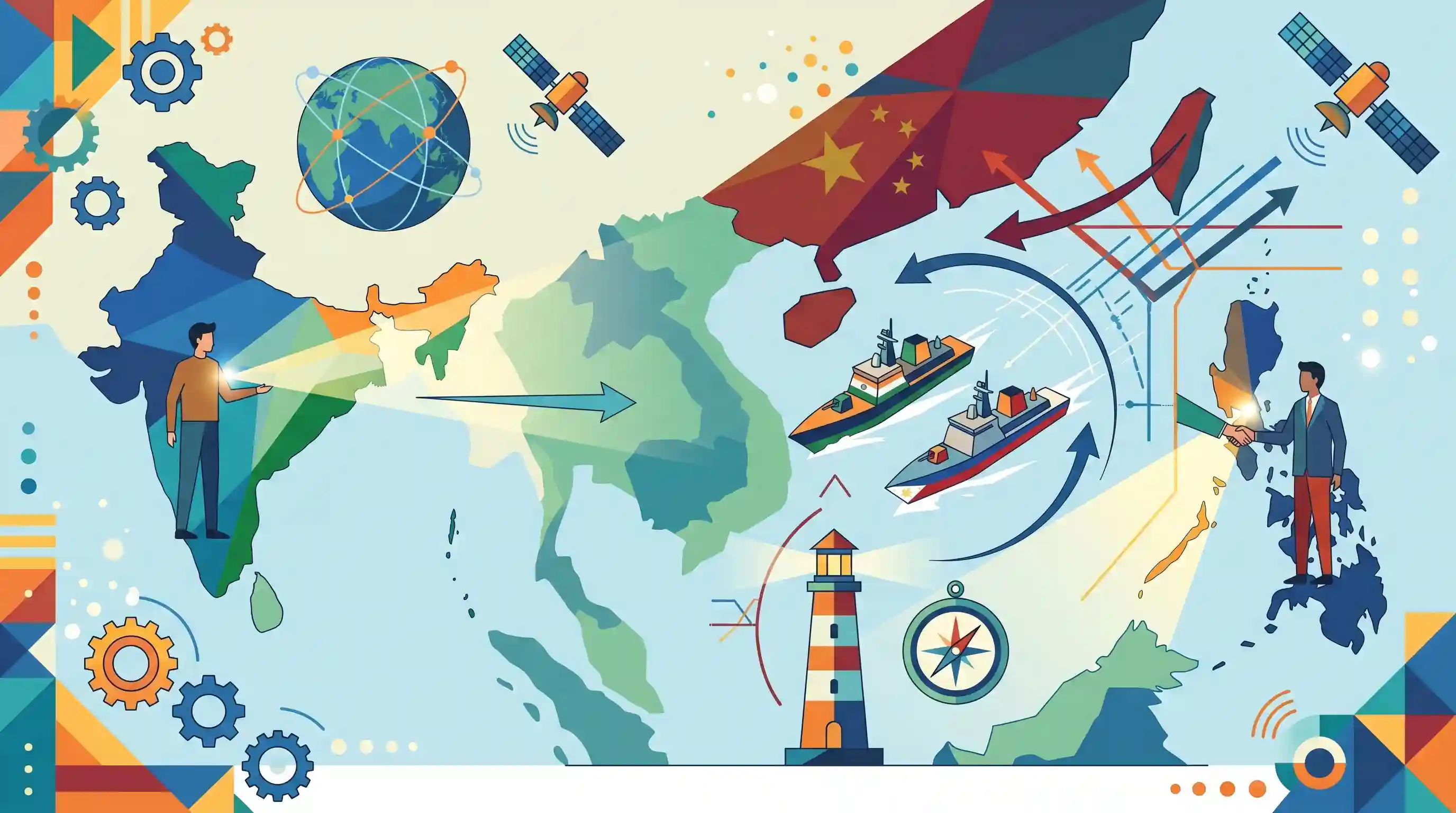
The South China Sea is a critical global geopolitical flashpoint. India's growing defense ties with Southeast Asian nations—via active naval deployments and arms exports (like BrahMos)—mark a shift from merely diplomatic to substantial strategic and military engagement under the Act East Policy, fundamentally altering the Indo-Pacific security architecture.
Summary
Philippine President Ferdinand Romualdez Marcos Jr's visit to New Delhi coincides with a joint India-Philippines naval drill in the South China Sea. This development underscores the deepening strategic, maritime, and defense cooperation between the two countries under India's 'Act East Policy'. As tensions persist over China's expansive territorial claims, India's active naval engagement in the South China Sea signifies its commitment to freedom of navigation, a rules-based order, and maintaining stability in the broader Indo-Pacific region.
Key Points
- Philippine President Ferdinand Romualdez Marcos Jr's visit to New Delhi reinforces bilateral ties and strategic alignment between India and the Philippines.
- The visit coincides with a joint India-Philippines naval drill in the contentious South China Sea, highlighting deepening maritime security cooperation.
- This deployment showcases the strategic operationalization of India's 'Act East Policy', building on milestones like the recent BrahMos missile exports to the Philippines.
- It underscores India's commitment to freedom of navigation, a rules-based maritime order, and counterbalancing aggressive territorial claims in the broader Indo-Pacific region.
Important Terms
Act East Policy

India's proactive diplomatic initiative launched in 2014 to strengthen economic, strategic, and cultural relations with Southeast Asia and the wider Indo-Pacific, focusing on connectivity and security.
UPSC context
GS II: Bilateral and regional groupings; tests India's shift from 'Look East' to proactive strategic engagement with ASEAN.
Indo-Pacific
A geopolitical construct encompassing the Indian and Pacific Oceans. India advocates for a 'free, open, and inclusive' region based on international law and ASEAN centrality.
UPSC context
GS II: Geopolitics and global groupings; tests India's vision for regional security and its role as a 'net security provider'.
Freedom of Navigation
A core principle of international law (codified in UNCLOS Article 87) ensuring ships of all states can navigate the high seas without interference from others.
UPSC context
GS II: International relations and maritime law; tests India's commitment to a rules-based order in contested waters like the South China Sea.
UNCLOS
An international treaty (1982) establishing the legal framework for all marine and maritime activities, defining zones like Territorial Seas and Exclusive Economic Zones (EEZ).
UPSC context
GS II & III: International treaties and environmental governance; tests legal foundations for resolving maritime disputes and managing ocean resources.
BrahMos Missile Deal
The first export deal for India's supersonic cruise missile, worth $375 million, marking a major milestone in India-Philippines defense ties and India's growing defense manufacturing.
UPSC context
GS III: Indigenization of technology; tests India's success in defense exports and strategic influence in Southeast Asia.
Exclusive Economic Zone (EEZ)
A 1982-defined maritime area where a coastal state has sovereign rights for resource exploration (up to 200 nautical miles) while others retain freedom of navigation.
UPSC context
GS II & III: Geography and international law; critical for understanding resource conflicts in the South China Sea.
Prelims Trap
The International Court of Justice (ICJ) ruled against China's Nine-Dash Line in 2016, binding all UNCLOS members.
The 2016 ruling was issued by an arbitral tribunal under UNCLOS administered by the Permanent Court of Arbitration (PCA), not the ICJ. Furthermore, China boycotted and entirely rejected the ruling.
Static Concepts Connected
What are the key technical features of the BrahMos cruise missile?
- Propulsion system: It is a two-stage missile featuring a solid propellant booster for initial acceleration and a liquid ramjet engine for sustained supersonic cruise.
- Speed and capability: It operates at Mach 2.8 (supersonic) and operates on a "fire and forget" principle, maintaining a low radar signature.
- Export status: The Philippines is the first international customer, having procured the shore-based anti-ship variant under a $375 million deal.
Which island groups are central to the South China Sea territorial disputes?
- Spratly Islands: Claimed entirely or partly by China, Taiwan, Vietnam, the Philippines, Malaysia, and Brunei. They sit atop potentially vast oil and gas reserves.
- Paracel Islands: A cluster of islands and reefs primarily contested between China, Taiwan, and Vietnam.
- Scarborough Shoal: A strategically important triangular chain of reefs and rocks heavily disputed between the Philippines and China, frequently seeing maritime standoffs.
Cross-Topic Patterns
Act East: Economics to Defense Diplomacy
India's 'Act East Policy' has evolved from ASEAN economic integration to strategic defense exports (BrahMos) and joint maritime security, directly counterbalancing China's influence in the Indo-Pacific.
UNCLOS and Maritime Geography
The South China Sea disputes test the application of UNCLOS, specifically how artificial islands and historical claims (Nine-Dash Line) interact with Exclusive Economic Zone (EEZ) rights.

Expect a multi-statement Prelims question linking South China Sea mapping (Spratly/Paracel) with UNCLOS EEZ and PCA arbitration in 2026.
Linked PYQs · 3
Linked PYQs · 3
- 2014MainsGS2
With respect to the South China sea, maritime territorial disputes and rising tension affirm the need for safeguarding maritime security to ensure freedom of navigation and over flight throughout the region. In this context, discuss the bilateral issues between India and China.
- 2016MainsGS2
Evaluate the economic and strategic dimensions of India's Look East Policy in the context of the post Cold War international scenario.
- 2020MainsGS2
What is the significance of Indo-US defence deals over Indo-Russian defence deals? Discuss with reference to stability in the Indo-Pacific region.
