India Paraguay Relations and MERCOSUR Trade Expansion
Source:The Hindu ↗
Why It Matters
India's strategic outreach to South America via Paraguay and the MERCOSUR bloc highlights its foreign policy pivot toward diversifying resource supplies (like critical minerals and energy) and securing new trade avenues to counter geopolitical uncertainties. Understanding trade blocs (like MERCOSUR) and Preferential Trade Agreements is essential for GS2 IR and GS3 Economy.
Summary
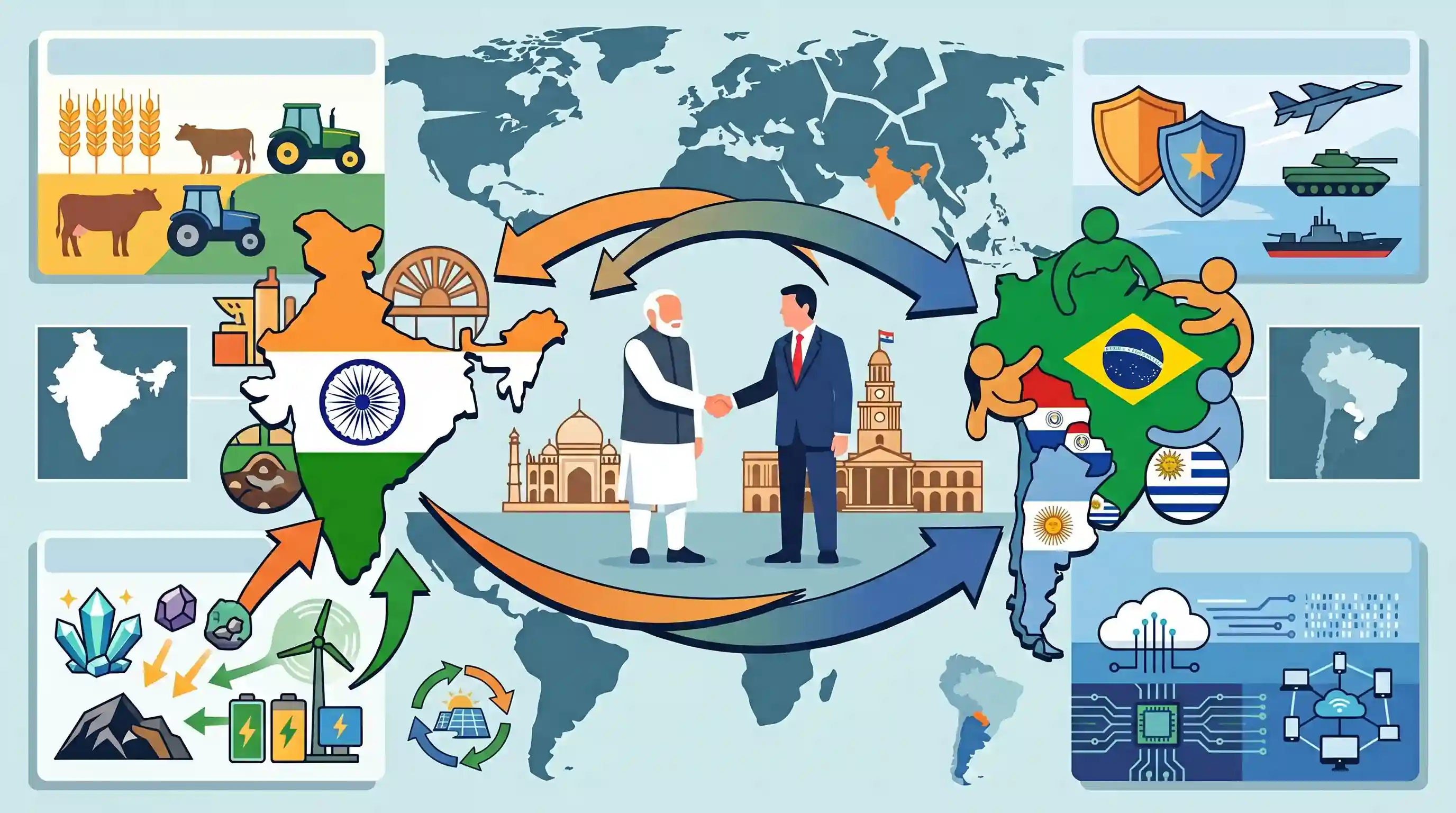
Prime Minister Narendra Modi hosted Paraguay's President Santiago Pena Palacios in New Delhi, emphasizing the mutual desire to expand trade and deepen strategic ties. The talks highlighted expanding the existing Preferential Trade Agreement (PTA) between India and the Latin American trade bloc MERCOSUR, comprising Brazil, Argentina, Paraguay, and Uruguay. Given the global disruptions in commerce, both nations pledged to enhance cooperation across critical sectors like minerals, agriculture, defense, and digital technology, signaling India's concerted push to diversify its resource supply chains and establish stronger footprints in South America.
Key Points
- Prime Minister Narendra Modi and Paraguay's President Santiago Pena Palacios met in New Delhi to discuss deepening bilateral ties.
- The leaders agreed to focus on expanding trade not just bilaterally but between India and the MERCOSUR regional trade bloc.
- Key areas identified for cooperation include critical minerals, agriculture, defense, digital technology, healthcare, and space.
- India currently has a Preferential Trade Agreement (PTA) with MERCOSUR and seeks to expand it amidst global economic uncertainty and shifting trade dynamics.
- Paraguay serves as a critical strategic partner for India due to its abundant natural resources and central position in Latin America.
Important Terms
MERCOSUR

A South American trade bloc established in 1991 (Treaty of Asunción) comprising Argentina, Brazil, Paraguay, and Uruguay; it functions as a customs union with a common external tariff.
UPSC context
GS Paper 2: Regional and Global Groupings. Tests understanding of India's trade strategy with Latin American blocs.
Preferential Trade Agreement (PTA)
A trade pact where partners reduce tariffs on a 'positive list' of specific products, representing the lowest level of commitment to trade liberalization.
UPSC context
GS Paper 3: Indian Economy (Trade). Tests knowledge of various trade agreement types (PTA vs. FTA).
Critical Minerals
Non-fuel minerals essential for economic development and national security, characterized by supply chain vulnerability; examples include Lithium, Cobalt, and Rare Earth Elements.
UPSC context
GS Paper 3: Energy, Infrastructure, and Security. Tests awareness of India's energy transition and resource security goals.
South-South Cooperation
A framework for technical and political cooperation among developing nations in the Global South to achieve shared development goals through mutual self-reliance.
UPSC context
GS Paper 2: International Relations. Tests the conceptual basis of India’s leadership and engagement with developing nations.
Rules of Origin
Criteria used to determine the national source of a product, ensuring that only goods genuinely produced in partner countries benefit from trade agreement tariff concessions.
UPSC context
GS Paper 3: Trade. Crucial technical concept for understanding how India prevents third-party trade diversion in agreements.
Free Trade Agreement (FTA)
A comprehensive trade pact that eliminates tariffs and non-tariff barriers on substantially all trade between members, usually maintaining a 'negative list' of exceptions.
UPSC context
GS Paper 3: Economy. Tests comparative understanding of trade liberalization stages beyond PTAs.
Prelims Trap
"India currently maintains a Free Trade Agreement (FTA) with the MERCOSUR grouping."
India only has a Preferential Trade Agreement (PTA) with MERCOSUR based on a limited 'positive list' of goods, not a comprehensive FTA.
Static Concepts Connected
How does a Preferential Trade Agreement (PTA) differ from an FTA?
- Positive List: PTAs operate on a positive list, offering tariff reductions only on specifically listed products between the participating nations.
- Negative List: FTAs generally use a negative list, eliminating tariffs on all goods except a few specified exceptions to protect domestic industries.
- Overall Scope: FTAs are structurally comprehensive, whereas PTAs are foundational, introductory agreements strictly limited to specific goods.
What is MERCOSUR and who are its core members?
- Core Members: Founded by Argentina, Brazil, Paraguay, and Uruguay via the 1991 Treaty of Asunción.
- Core Objective: It is a Southern Common Market aiming for the free movement of goods, services, and factors of production across member states.
- Expansion & Suspensions: Bolivia has recently joined as a full member, while Venezuela's membership has been indefinitely suspended since 2016.
Cross-Topic Patterns
Clean Energy & The Lithium Triangle
South America holds vast lithium and copper reserves. Trade expansion with MERCOSUR directly ties into India's EV transition and critical mineral supply chain security (GS3).
Countering China's Latin American footprint
China has massively expanded its economic presence in Latin America. India's multi-sectoral PTA push aims to counterbalance this influence under the broader 'Voice of the Global South' banner.

Expect a 2026 prelims question pairing South American trade blocs (MERCOSUR vs Pacific Alliance) with India's specific trade pact status.
Linked PYQs · 3
Linked PYQs · 3
- 1998PrelimsGS1
‘MERCOSUR’ consists of group of countries of
- 2016PrelimsGS1
The term 'Regional Comprehensive Economic Partnership' often appears in the news in the context of the affairs of a group of countries known as
- 2024MainsGS2
Critically analyse India's evolving diplomatic, economic and strategic relations with the Central Asian Republics (CARs) highlighting their increasing significance in regional and global geopolitics.
