Trump Claims Trade Threats Averted Nuclear War in South Asia
Source:The Hindu ↗
Why It Matters
These claims highlight the perceived influence and geopolitical leverage the United States exerts globally, including in South Asia, particularly through economic and trade pressure. The statements underscore the international community's persistent concerns regarding the risk of nuclear escalation between India and Pakistan, while also bringing attention to the broader debate on third-party mediation in bilateral disputes, a mechanism India historically opposes.
Summary
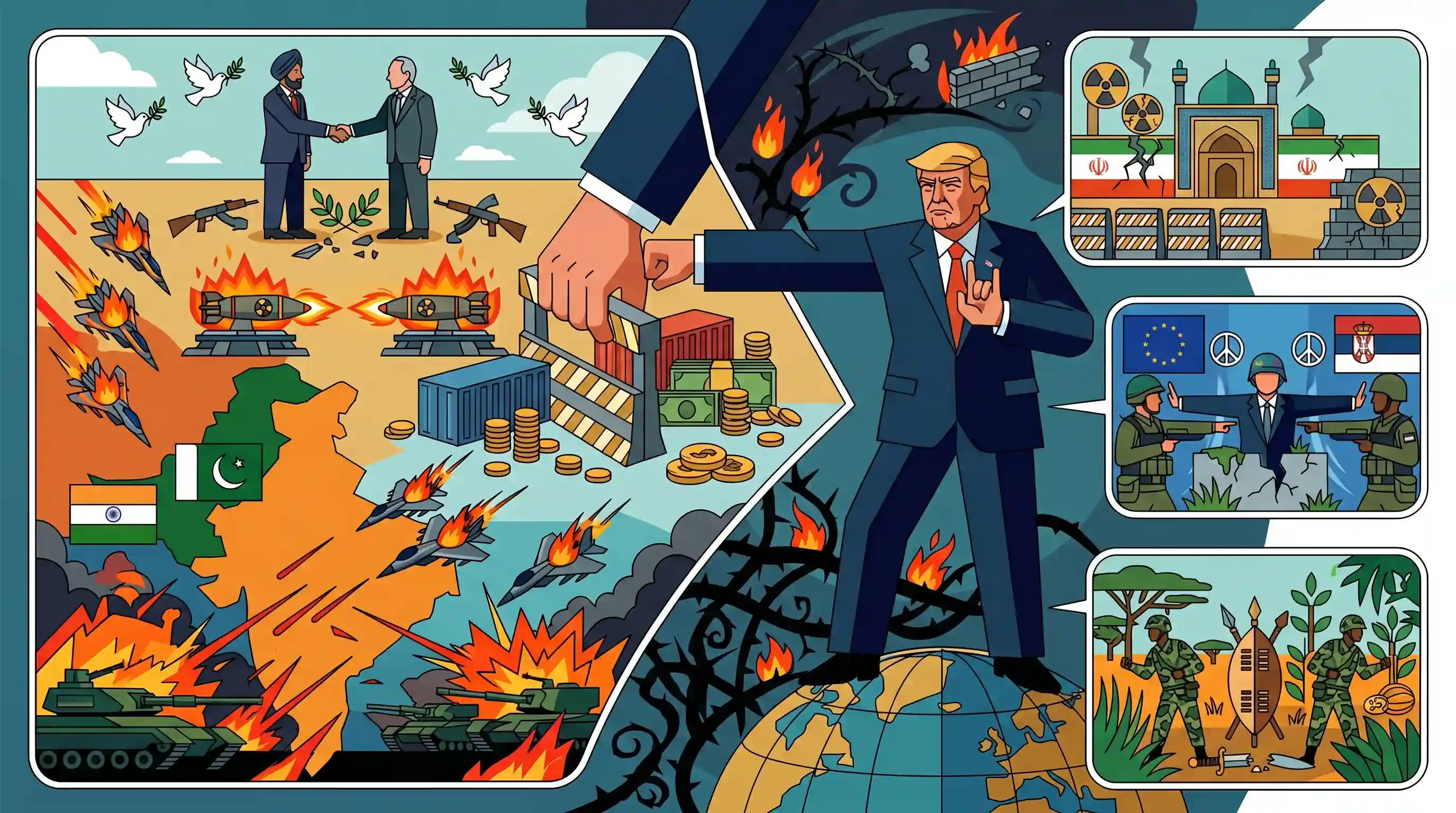
Former US President Donald Trump claimed to have halted a recent conflict between India and Pakistan by threatening to cut off trade with both nuclear-armed nations. He stated that the skirmish was escalating rapidly, with five planes reportedly shot down, and was on the brink of becoming a nuclear war. In addition to South Asia, Trump asserted his role in neutralizing Iran's nuclear capabilities and ending conflicts between the Democratic Republic of the Congo and Rwanda, as well as Kosovo and Serbia. He utilized these assertions to contrast his aggressive foreign policy and mediation record with that of current US President Joe Biden, whom he criticized for global instability.
Key Points
- Former US President Donald Trump claimed he intervened to prevent a potential nuclear war between India and Pakistan during a recent conflict, citing the shooting down of five planes.
- He alleged that he leveraged the threat of halting bilateral trade to compel both South Asian nations to de-escalate.
- Trump additionally took credit for stopping conflicts between the Democratic Republic of the Congo and Rwanda, as well as Kosovo and Serbia.
- He asserted that his administration successfully neutralized Iran's nuclear capabilities and used these claims to criticize the foreign policy competence of current President Joe Biden.
Prelims Trap
India accepted formal US mediation during the 2019 Balakot skirmishes to avert a nuclear war.
India strictly rejects formal third-party mediation in its disputes with Pakistan, adhering to bilateral resolution frameworks established under the Simla Agreement (1972).
Static Concepts Connected
What are the key pillars of India's Nuclear Doctrine?
- Minimum Credible Deterrence: Maintaining a survivable nuclear arsenal capable of inflicting unacceptable damage as a retaliatory strike.
- No First Use (NFU): A commitment to never use nuclear weapons first, retaining the right to massive retaliation only if attacked with WMDs.
- CBW Caveat: India retains the option of a nuclear response in the event of a major chemical or biological weapon attack.
Why are the DRC and Rwanda locked in persistent border conflict?
- Historical Spillover: Hutu militias fled to eastern DRC after the 1994 Rwandan genocide, permanently destabilizing the porous border region.
- Resource Curse: Eastern DRC's vast reserves of coltan, cobalt, and gold are illegally exploited by armed factions, fueling proxy conflicts.
- M23 Rebellion: Rwanda is repeatedly accused by the UN and DRC of funding and backing the M23 rebel insurgency in eastern Congo.
Cross-Topic Patterns
Coercive Diplomacy vs WTO Mechanisms
Using bilateral trade cutoff threats to force geopolitical de-escalation reflects a global shift away from multilateral WTO dispute frameworks towards the direct "weaponization of trade."
Critical Minerals and African Instability
The DRC-Rwanda conflict directly impacts global supply chains for cobalt and coltan, connecting African regional instability to the global electric vehicle and green tech transition.

Mapping matches pairing African mineral zones (DRC/Kivu) or Balkan disputes (Kosovo/Serbia) with their primary causes are highly probable.
Linked PYQs · 2
Linked PYQs · 2
- 2019MainsGS2
‘What introduces friction into the ties between India and the United States is that Washington is still unable to find for India a position in its global strategy, which would satisfy India's national self-esteem and ambitions.’ Explain with suitable examples.
- 2018MainsGS2
In what ways would the ongoing US-Iran Nuclear Pact Controversy affect the national interest of India? How should India respond to this situation?
