Operation Sindoor targets and military response to drone warfare
Source:The Hindu ↗
Why It Matters
The conflict illustrates a significant shift in modern warfare, heavily relying on drone swarms and loitering munitions, and emphasizes the persistent challenge of cross-border terrorism and dynamic border management along the LoC.
Summary
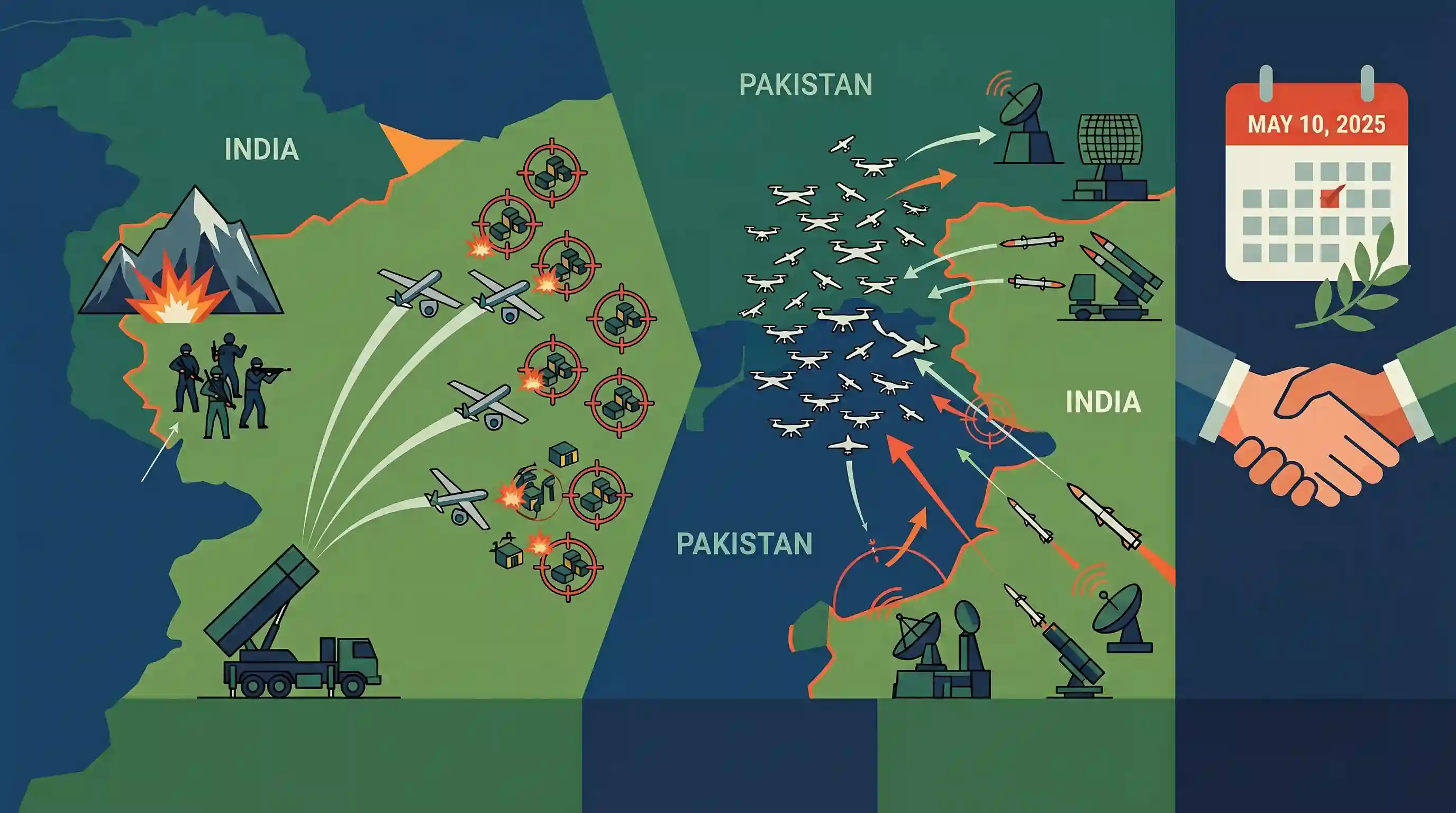
In a major escalation following the Pahalgam terror attack, India launched "Operation Sindoor," executing precision strikes on nine terror camps in Pakistan using indigenous loitering munitions. Pakistan responded with a massive swarm of Turkish-origin drones, prompting Indian counter-attacks on Pakistani air defense infrastructure. The conflict highlighted the emerging dominance of unmanned aerial vehicles (UAVs) in modern border warfare before culminating in a bilateral ceasefire on May 10, 2025.
Key Points
- India launched 'Operation Sindoor' against nine terror bases in Pakistan and PoJK in response to the Pahalgam terror attack, utilizing precision loitering munitions developed in Bengaluru.
- Pakistan retaliated by deploying 300 to 400 drones, including Turkish-made Asisguard Songar and Byker YIHA III Kamikaze drones, testing India's air defense capabilities.
- Indian forces neutralized multiple Pakistani drone attacks and targeted an air defense base in Lahore in subsequent counter-strikes.
- A ceasefire was agreed upon on May 10, 2025, after intense cross-border exchange involving missiles, drones, and heavy shelling.
Important Terms
Operation Sindoor

A May 2025 Indian military operation involving precision strikes against terror camps in Pakistan and PoK. Launched after the Pahalgam attack, it utilized indigenous loitering munitions to destroy infrastructure of groups like LeT and JeM.
UPSC context
GS Paper 3: Internal Security. Tests understanding of India's proactive defense posture and use of emerging technologies in cross-border counter-terrorism operations.
UN Charter Article 51
A legal provision affirming a state’s inherent right to individual or collective self-defense if an armed attack occurs. India used this framework and the "unwilling or unable" doctrine to justify Operation Sindoor’s strikes.
UPSC context
GS Paper 2: International Relations. Tests knowledge of international legal frameworks governing the use of force and state sovereignty in counter-terrorism.
The Resistance Front (TRF)
A shadow proxy of Lashkar-e-Taiba (LeT) that emerged in 2019 following Article 370's abrogation. It claimed the 2025 Pahalgam massacre and is designated as a terrorist organization under India's UAPA.
UPSC context
GS Paper 3: Internal Security. Tests awareness of "hybrid" warfare, proxy groups, and current terrorist threats in the Jammu and Kashmir region.
Lashkar-e-Taiba (LeT)
A Pakistan-based, UN-designated terrorist group founded by Hafiz Saeed. Known for the 2008 Mumbai attacks, it seeks Kashmir's merger with Pakistan and operates through fronts like TRF to evade international scrutiny.
UPSC context
GS Paper 3: Internal Security. Crucial for understanding cross-border terrorism, terror financing (FATF), and the role of external state/non-state actors.
Jaish-e-Mohammed (JeM)
An Islamist terrorist group founded in Pakistan by Masood Azhar. Responsible for the 2001 Parliament and 2019 Pulwama attacks, its infrastructure was a primary target during the precision strikes of Operation Sindoor.
UPSC context
GS Paper 3: Internal Security. Relevant for studying major security threats, the evolution of militancy in Kashmir, and India’s retaliatory strategies.
Hizb-ul-Mujahideen
One of the oldest and largest militant groups in Jammu and Kashmir, founded in 1989. It advocates for the region’s merger with Pakistan and was targeted during India’s 2025 military response.
UPSC context
GS Paper 3: Internal Security. Important for historical context of Kashmir insurgency and the dynamics of indigenous vs. foreign militant groups.
Loitering Munitions
Precision-guided unmanned aerial vehicles that can search for targets while hovering over an area before engaging them with an explosive warhead. They were a key technological feature of Operation Sindoor.
UPSC context
GS Paper 3: Science & Technology/Security. Tests knowledge of modern warfare technologies (drones) and the indigenization of defense equipment under Atmanirbhar Bharat.
Prelims Trap
Article 51 of the UN Charter requires prior Security Council approval for a nation to conduct self-defense strikes.
Article 51 affirms the "inherent right" of self-defence until the UNSC acts. Prior approval is not needed; actions must just be reported. India cites this to justify preemptive cross-border strikes.
Static Concepts Connected
How do loitering munitions differ from cruise missiles and traditional UCAVs?
- Hover capability: Unlike cruise missiles, they can loiter (hover) in the air passively for extended periods while searching for targets before striking.
- Kamikaze nature: Unlike UCAVs (Unmanned Combat Aerial Vehicles) which drop payloads and return to base, loitering munitions are expendable and crash into the target.
- Cost-effectiveness: They are significantly cheaper than traditional guided missiles, allowing for mass deployment in "swarm" formations to overwhelm air defenses.
What is the scope of Article 51 of the UN Charter?
- Inherent right: It recognizes the inherent right of individual or collective self-defence if an armed attack occurs against a Member of the United Nations.
- Preemptive strikes: Nations increasingly use this article to justify preemptive counter-terror strikes against non-state actors operating from foreign soil.
- Reporting requirement: Measures taken in the exercise of this right of self-defence must be immediately reported to the UN Security Council.
Cross-Topic Patterns
Drone Swarms & Border Management
The shift from isolated drug-smuggling hexacopters to massive military drone swarms tests the limits of India's Comprehensive Integrated Border Management System (CIBMS) and anti-drone electronic warfare systems.
Turkiye-Pakistan Defense Nexus
Growing defense technology transfers (like Turkish Kamikaze drones to Pakistan) complicate India's security matrix, adding hard-power backing to the historical diplomatic alignment between Ankara and Islamabad on Kashmir.

Expect a multi-statement Prelims question comparing loitering munitions, UCAVs, and drone swarm technologies under the S&T section in 2026.
Linked PYQs · 3
Linked PYQs · 3
- 2024MainsGS3
India has a long and troubled border with China and Pakistan fraught with contentious issues. Examine the conflicting issues and security challenges along the border. Also give out the development being undertaken in these areas under the Border Area Development Programme (BADP) and Border Infrastructure and Management (BIM) Scheme.
- 2023MainsGS3
The use of unmanned aerial vehicles (UAVs) by our adversaries across the borders to ferry arms/ammunitions, drugs, etc., is a serious threat to the internal security. Comment on the measures being taken to tackle this threat.
- 2020MainsGS3
Analyze internal security threats and transborder crimes along Myanmar, Bangladesh and Pakistan borders including Line of Control (LoC). Also discuss the role played by various security forces in this regard.
