Regional security implications of bilateral tensions in South Asia
Source:Indian Express ↗
Why It Matters
Understanding the ripple effects of India-Pakistan ties is critical for answering questions on India's 'Neighbourhood First' policy, the failure of SAARC, and the broader geopolitical challenges in securing South Asia's economic and strategic interests.
Summary
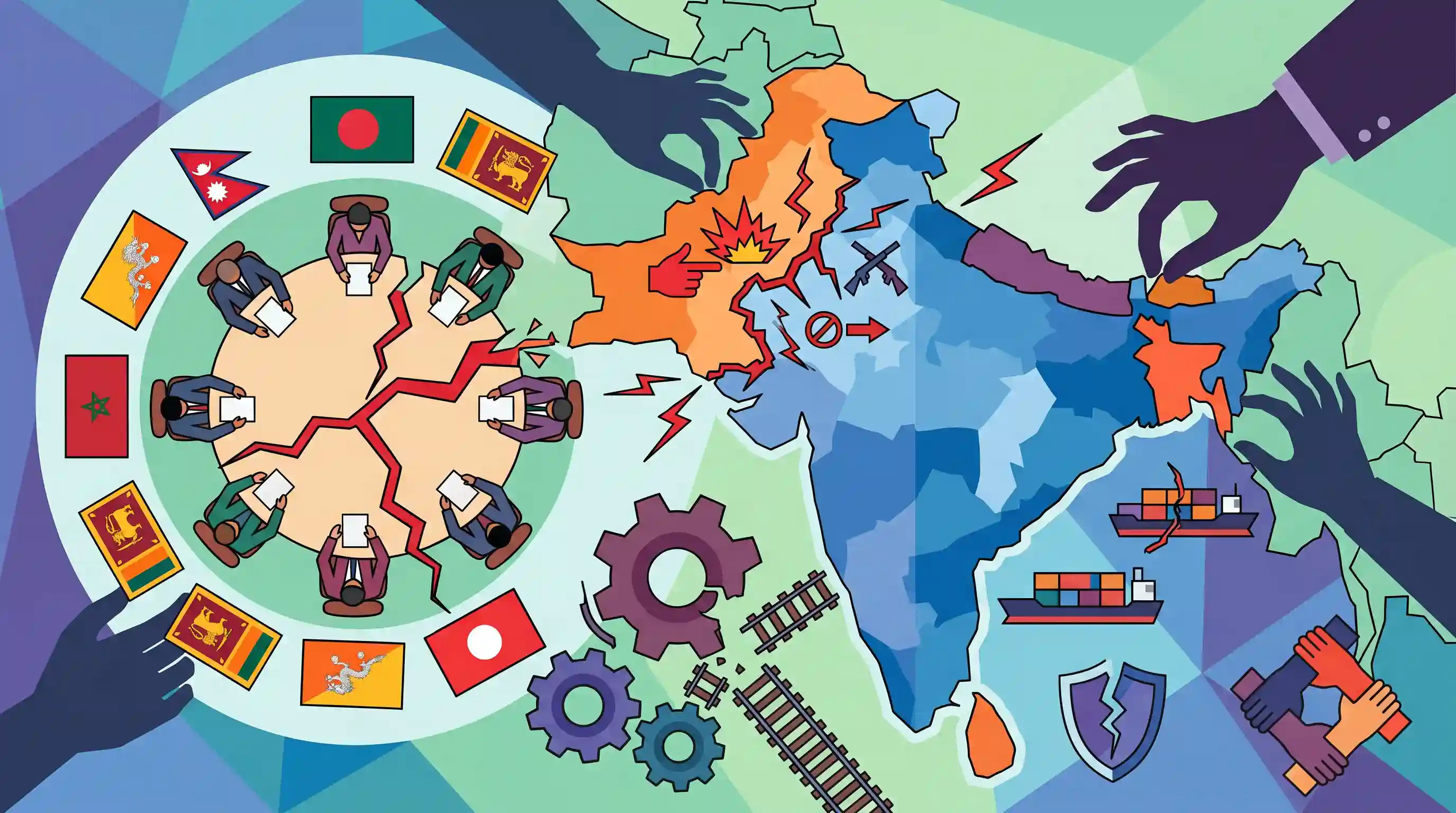
The article examines the prolonged geopolitical tensions between India and Pakistan and their broader ramifications for the South Asian subcontinent. Driven by issues such as cross-border terrorism and unresolved historical disputes, this bilateral hostility not only stalls dialogue but also paralyses broader regional integration, notably undermining forums like SAARC. The resulting fragmentation deprives the region of economic synergies and collective security mechanisms, underscoring the necessity of at least managing the bilateral conflict to unlock South Asia's developmental potential and curb external geopolitical interferences.
Key Points
- Chronic bilateral friction between India and Pakistan continues to stall meaningful dialogue and escalate regional instability.
- Cross-border terrorism remains the central impediment to restoring diplomatic normalcy and peace processes between the two nations.
- The ongoing hostility severely cripples regional integration efforts, most notably rendering the SAARC platform largely dysfunctional.
- The lack of cohesive subcontinental cooperation limits economic development and creates strategic vacuums that external powers often exploit.
- Managing the India-Pakistan dynamic is essential for actualizing a secure, integrated, and prosperous South Asian neighborhood.
Important Terms
SAARC (South Asian Association for Regional Cooperation)

An intergovernmental organization of eight South Asian nations established in 1985. It aims to promote regional economic and social development but remains largely stalled due to India-Pakistan bilateral tensions.
UPSC context
GS Paper 2: International Relations. Tests knowledge of regional groupings, 'Neighborhood First' policy, and challenges to multilateralism in South Asia.
Indus Waters Treaty (IWT)
A 1960 World Bank-brokered water-sharing pact between India and Pakistan. It allocates the three eastern rivers to India and three western rivers to Pakistan; recently under strain due to security concerns.
UPSC context
GS Paper 2 & 3: Tests transboundary water governance, resource diplomacy, and the use of treaties as strategic leverage.
Cross-border Terrorism
The state-sponsored or facilitated movement of militants across international boundaries to conduct violence. It is cited by India as the primary obstacle to dialogue and regional integration with Pakistan.
UPSC context
GS Paper 3: Internal Security. Evaluates understanding of external security threats and their impact on India’s diplomatic relations and regional stability.
Line of Control (LoC)
A 740-km de facto military boundary dividing Jammu and Kashmir between India and Pakistan. Established via the 1972 Simla Agreement, it is not an internationally recognized legal border.
UPSC context
GS Paper 3: Security. Relates to border management, historical territorial disputes, and the geography of the India-Pakistan conflict.
Regional Integration
The process of neighboring countries collaborating to enhance trade, connectivity, and collective security. In South Asia, this is hindered by political fragmentation and exceptionally low intra-regional trade.
UPSC context
GS Paper 2: Tests economic diplomacy and the strategic importance of a cohesive neighborhood for India’s global ambitions.
BIMSTEC
A regional grouping connecting countries around the Bay of Bengal. India increasingly views it as a viable alternative to SAARC for advancing sub-regional cooperation without Pakistan's participation.
UPSC context
GS Paper 2: International Relations. Tests 'Act East' and 'Neighborhood First' policies and the shift toward sub-regionalism in foreign policy.
Prelims Trap
Pakistan's membership in BIMSTEC was suspended following cross-border terror attacks.
Pakistan was never a part of BIMSTEC. BIMSTEC was formed in 1997 for Bay of Bengal littoral states, which naturally excludes Pakistan geographically.
Static Concepts Connected
What are the fundamental differences in the mandates of SAARC and BIMSTEC?
- Geographic Scope: SAARC covers all of South Asia; BIMSTEC links South Asia with Southeast Asia via Bay of Bengal littorals (excluding Pakistan and Afghanistan).
- Origins: SAARC (1985, Dhaka Declaration); BIMSTEC (1997, Bangkok Declaration).
- Operational Focus: SAARC's charter excludes bilateral/contentious issues, yet bilateral politics paralyze it. BIMSTEC focuses strictly on sector-driven technical and economic cooperation.
How does the Indus Waters Treaty (1960) allocate transboundary river waters?
- Eastern Rivers: Ravi, Beas, and Sutlej are allocated to India for unrestricted use.
- Western Rivers: Indus, Jhelum, and Chenab are allocated to Pakistan, but India is permitted limited agricultural use and run-of-the-river hydroelectric projects.
- Dispute Mechanism: Permanent Indus Commission resolves initial questions; differences go to a Neutral Expert; disputes go to a Court of Arbitration.
Cross-Topic Patterns
BIMSTEC as the 'Act East' bridge
India's pivot from SAARC to BIMSTEC directly integrates its 'Neighbourhood First' policy with the 'Act East' policy, seamlessly linking South Asian economies to ASEAN markets via Myanmar and Thailand.
Strategic vacuum and China's Belt & Road
The lack of a functional South Asian economic architecture (like SAFTA) allows China to exploit the strategic vacuum, leveraging bilateral debt via BRI in Sri Lanka, Maldives, and Nepal.

Expect a 2026 Mains question analyzing the failure of SAARC/SAFTA and how India's BIMSTEC pivot acts as a counter to China's BRI.
Linked PYQs · 3
Linked PYQs · 3
- 2016MainsGS2
Increasing cross-border terrorist attacks in India and growing interference in the internal affairs of several member-states by Pakistan are not conducive for the future of SAARC (South Asian Association for Regional Cooperation)." Explain with suitable examples.
- 2020MainsGS3
Analyze internal security threats and transborder crimes along Myanmar, Bangladesh and Pakistan borders including Line of Control (LoC). Also discuss the role played by various security forces in this regard.
- 2024MainsGS2
‘Terrorism has become a significant threat to global peace and security.’ Evaluate the effectiveness of the United Nations Security Council's Counter Terrorism Committee (CTC) and its associated bodies in addressing and mitigating this threat at the international level.
