UN General Assembly India Pakistan Clash over Terrorism and Pahalgam
Source:The Hindu ↗
Why It Matters
The bilateral sparring at the UN highlights the persistent deadlock in India-Pakistan relations, fueled by cross-border terrorism. It also showcases India's assertive diplomatic posture at multilateral forums (like the UN) and references recent significant military/security events like the Pahalgam attack and Operation Sindoor.
Summary
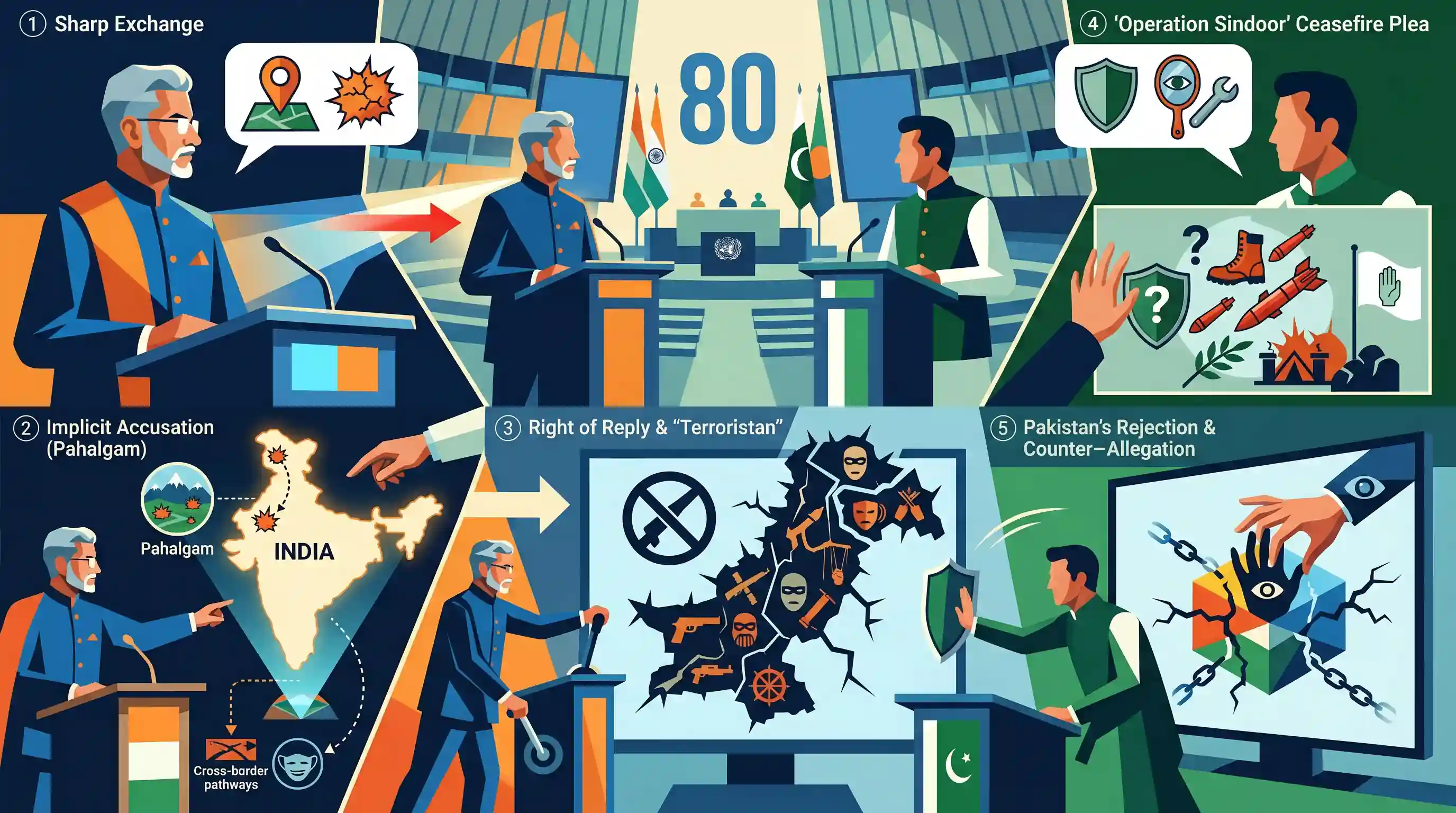
At the 80th United Nations General Assembly, India and Pakistan engaged in a sharp exchange over terrorism. External Affairs Minister S. Jaishankar implicitly accused Pakistan of orchestrating the April 2025 Pahalgam terror attack. Exercising its Right of Reply, India dubbed its neighbor "Terroristan," criticizing its history of cross-border terrorism and recalling Pakistan's plea for a ceasefire during the recent "Operation Sindoor." Pakistan rejected the allegations, accusing Indian intelligence of attempting to destabilize the region.
Key Points
- External Affairs Minister S. Jaishankar implicitly accused Pakistan of being a hub of terrorism and orchestrating the April 2025 Pahalgam terror attack during his UN General Assembly address.
- Exercising its Right of Reply, Indian diplomat Rentala Srinivas referred to Pakistan as "Terroristan" and highlighted its longstanding practice of cross-border terrorism.
- India noted that the Pakistani military had pleaded for a cessation of fighting during the recent "Operation Sindoor."
- Pakistan denied the allegations, citing a lack of evidence, and counter-accused Indian intelligence agencies of attempting to destabilize neighboring nations.
Important Terms
Operation Sindoor

India's May 2025 military operation involving missile and air strikes against Pakistan-based terror infrastructure, launched in response to the Pahalgam terrorist massacre.
UPSC context
GS Paper III: Internal Security. Tests awareness of recent military doctrines, surgical strikes, and India's evolving response to cross-border terror.
Pahalgam Attack (2025)
A major terrorist attack on April 22, 2025, where 26 civilians were killed in Jammu and Kashmir's Baisaran Valley, triggering a brief India-Pakistan conflict.
UPSC context
GS Paper III: Security challenges in J&K. Tests understanding of regional flashpoints and their impact on internal security and tourism.
United Nations General Assembly (UNGA)
The principal deliberative and policymaking organ of the United Nations, where all 193 member states hold equal voting power and representation.
UPSC context
GS Paper II: International Relations. Essential for understanding global governance, multilateral diplomacy, and the structure of the UN.
Right of Reply
A UN procedural rule (Decision 34/401) allowing a member state to respond to remarks or accusations made by another state during General Assembly debates.
UPSC context
GS Paper II: International Relations. Tests knowledge of diplomatic protocols and India's assertive stance in multilateral forums.
Terroristan
A rhetorical label used by Indian diplomats at the UN (2017, 2025) to describe Pakistan as a "geography synonymous with terror."
UPSC context
GS Paper II: India-Pakistan relations. Tests knowledge of India's strategic communication and counter-terror diplomacy on the global stage.
Cross-border terrorism
The act of sponsoring or facilitating terrorist activities across international boundaries to achieve political or ideological goals in another country.
UPSC context
GS Paper III: Role of external state/non-state actors in creating challenges to internal security. Core concept for regional stability.
Prelims Trap
"The 'Right of Reply' at the UNGA is an exclusive prerogative of the UN Security Council members."
The Right of Reply is a standard procedural right available to all UN member states under UNGA Rules of Procedure, not just UNSC members.
Static Concepts Connected
What is the 'Right of Reply' mechanism at the UN General Assembly?
- Procedural Rule: It allows any member state to respond on the floor to statements made by other nations that attack its reputation or national interests.
- Governance: It is governed by the Rules of Procedure of the UNGA (Rule 73), ensuring equal footing for all member states.
- Constraints: Interventions are strictly time-bound and limited in frequency to prevent endless back-and-forth debating during plenary sessions.
How does the 1972 Shimla Agreement dictate India's diplomatic stance?
- Strict Bilateralism: It mandates that India and Pakistan resolve differences peacefully through bilateral negotiations, expressly rejecting third-party or international intervention.
- UN Circumvention: India uses this specific bilateral commitment to structurally reject Pakistan's attempts to internationalize the Kashmir dispute at UN forums.
- LoC Sanctity: It established the Line of Control (LoC), committing both sides to respect it without unilateral alteration.
Cross-Topic Patterns
Diplomatic posture & FATF leverage
India's rhetorical condemnation of state-sponsored terror at the UN parallels its strategy of utilizing FATF frameworks to economically penalize terror financing networks.
Shimla Agreement vs. UN Mediation
Pakistan's UNGA posturing constantly tests the 1972 Shimla Agreement, linking GS-2 historical treaties with contemporary multilateral diplomacy and internationalization attempts.

GS-2 Mains 2026 may test the Shimla Agreement's "strict bilateralism" against the backdrop of repeated UNGA internationalization attempts.
Linked PYQs · 3
Linked PYQs · 3
- 2025MainsGS3
Terrorism is a global scourge. How has it manifested in India? Elaborate with contemporary examples. What are the counter measures adopted by the State? Explain.
- 2015MainsGS2
Terrorist activities and mutual distrust have clouded India-Pakistan relations. To what extent the use of soft power like sports and cultural exchanges could help generate goodwill between the two countries? Discuss with suitable examples.
- 2024MainsGS2
‘Terrorism has become a significant threat to global peace and security.’ Evaluate the effectiveness of the United Nations Security Council's Counter Terrorism Committee (CTC) and its associated bodies in addressing and mitigating this threat at the international level.
