Indus Waters Treaty and India Pakistan Strategic Calculus
Source:Indian Express ↗
Why It Matters
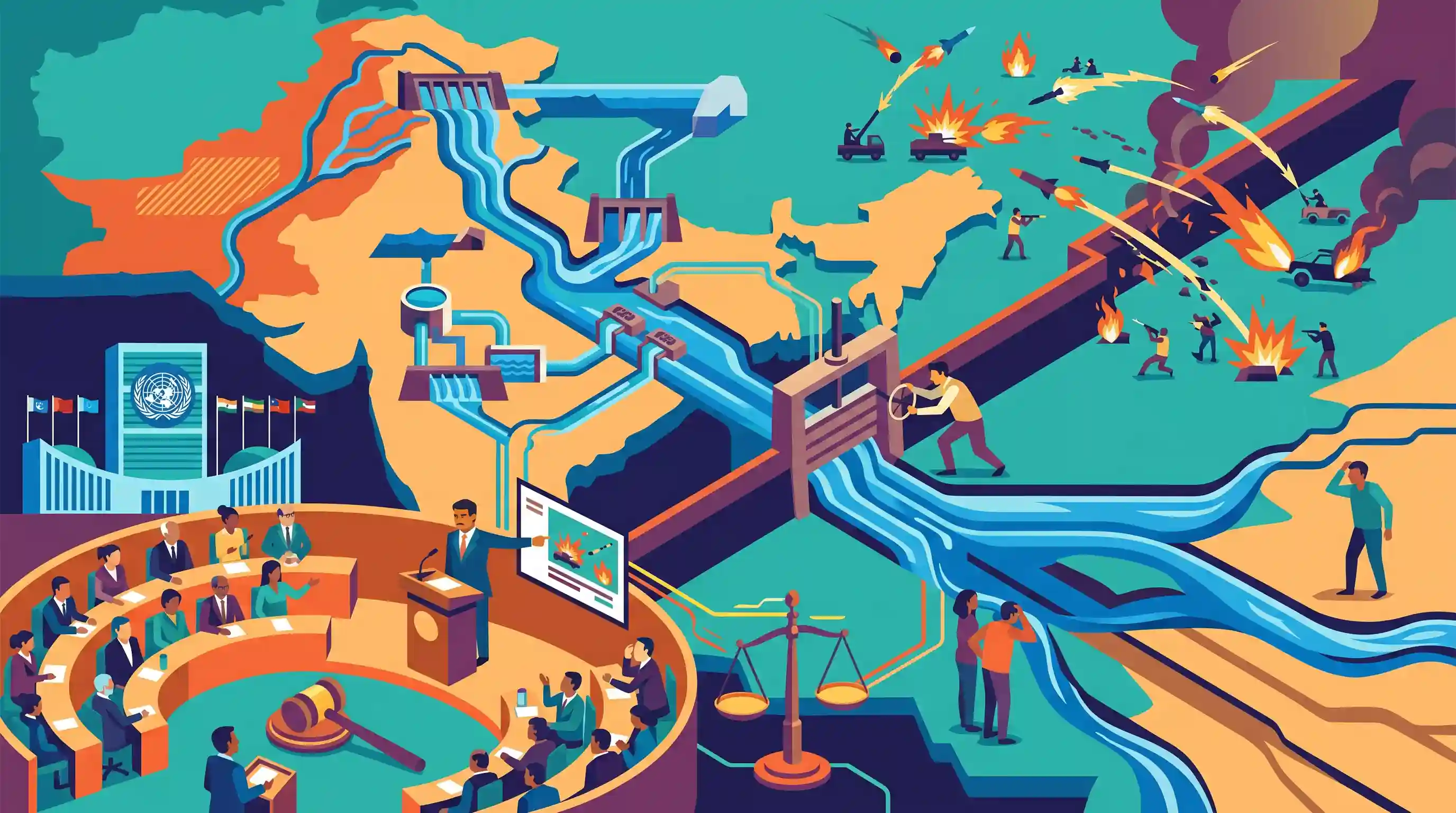
The Indus Waters Treaty is a cornerstone of India-Pakistan relations and one of the world's most successful water-sharing pacts. However, the debate over weaponizing water as a response to terrorism connects geography (water resources) with GS2 (bilateral relations/IR) and GS3 (internal security), making it a high-yield topic for UPSC.
Summary
The article discusses India's evolving stance on the Indus Waters Treaty in the context of persistent cross-border terrorism from Pakistan. It argues that in the aftermath of events like the Pulwama attack, India must adopt a firm, unsentimental approach at international forums such as the UN and UNSC. Rather than treating the 1960 water-sharing agreement as sacrosanct, India should leverage its position as an upper riparian state to deter Pakistan's proxy war, emphasizing that bilateral cooperation on resource-sharing cannot co-exist with state-sponsored terrorism.
Key Points
- Despite historical wars and state-sponsored terrorism from Pakistan, India has largely honored the Indus Waters Treaty (1960), but the strategic calculus is shifting.
- Following provocations like the Pulwama attack, there is a growing consensus that India must leverage its upper-riparian advantage to deter cross-border terrorism.
- The phrase 'blood and water cannot flow together' encapsulates India's increasingly firm stance on linking treaty compliance with the cessation of hostilities.
- At international forums like the UN and UNSC, India is urged to adopt an unsentimental and pragmatic approach, prioritizing national security over mere treaty preservation.
Important Terms
Indus Waters Treaty (1960)

A 1960 water-sharing agreement between India and Pakistan, brokered by the World Bank. It divides the Indus system's six rivers, giving India control over the Eastern rivers and Pakistan the Western rivers.
UPSC context
GS Paper II (International Relations); essential for understanding transboundary water governance and India’s neighborhood policy.
Upper Riparian State
A nation situated upstream on a river system. India’s position as an upper riparian for the Indus rivers grants it physical control over water flow before it reaches downstream Pakistan.
UPSC context
GS Paper II; relates to hydro-politics and India’s strategic leverage in the South Asian region.
Hydro-diplomacy
The use of water resources as a diplomatic tool to manage transboundary disputes, build regional cooperation, or exert political pressure on neighboring states regarding non-water issues.
UPSC context
GS Paper II; tests the ability to analyze non-traditional diplomatic tools in conflict resolution.
Cross-border Terrorism
Acts of terrorism where perpetrators, funding, or support originate in one country to strike another. India identifies this as a "proxy war" and a primary hurdle to bilateral cooperation.
UPSC context
GS Paper III (Internal Security); a core challenge for India’s security and a frequent topic in foreign policy debates.
United Nations Security Council (UNSC)
The principal UN organ responsible for maintaining global peace and security. It is the primary forum where India seeks international sanctions against state-sponsored terrorist groups and individuals.
UPSC context
GS Paper II (International Institutions); relevant for India's push for global counter-terrorism reforms and permanent membership.
Pulwama Attack (2019)
A February 2019 suicide bombing in Jammu and Kashmir that killed 40 CRPF personnel. The event significantly hardened India's diplomatic and water-sharing stance toward Pakistan.
UPSC context
GS Paper III; a landmark event that reshaped India’s "Doctrine of Strategic Restraint" into one of "Proactive Deterrence."
Prelims Trap
"India is explicitly prohibited from building hydroelectric projects on the Western Rivers under the IWT."
Aspirants assume India has zero rights over the Indus, Jhelum, and Chenab. Actually, India can build 'run-of-the-river' hydroelectric projects and use waters for domestic/agricultural needs.
Static Concepts Connected
How are river waters divided under the Indus Waters Treaty?
- Eastern Rivers: Eastern rivers (Ravi, Beas, Sutlej) are allocated for unrestricted use by India.
- Western Rivers: Western rivers (Indus, Jhelum, Chenab) are allocated to Pakistan, but India retains specific limited rights for non-consumptive, domestic, and agricultural use.
- World Bank role: The treaty was brokered by the World Bank (IBRD) in 1960, not the United Nations, and features a graded dispute resolution mechanism (Neutral Expert to Court of Arbitration).
What characterizes Run-of-the-River (RoR) hydroelectric projects?
- Design principle: They generate electricity using the natural flow of water, requiring little to no water storage (large reservoirs) compared to traditional dams.
- IWT Compliance: India is explicitly allowed to construct RoR projects (like Kishanganga and Ratle) on Western rivers, as they do not significantly alter downstream flow to Pakistan.
Cross-Topic Patterns
Hydro-diplomacy: Pakistan vs China
India's posture as an upper-riparian state asserting rights on the Indus basin contrasts sharply with its lower-riparian vulnerability regarding China's aggressive dam-building on the Brahmaputra (Yarlung Tsangpo).
UNSC 1267 and Proxy Warfare
India's push for 'pragmatic realism' at the UN extends beyond water treaties, closely linking to its campaigns to list Pakistan-based terrorists under the UNSC 1267 sanctions regime.

Expect a Prelims question pairing hydro-projects (Kishanganga/Jhelum, Ratle/Chenab) with India's permitted Western river rights under IWT.
Linked PYQs · 4
Linked PYQs · 4
- 2012MainsGS2
The situation today is far different to that prevalent fifty years back when the Indus Water Treaty was signed." Highlight the complexity of the current challenges on both sides of the border in this regard. Do you think that a review of the Treaty is in India's best interests?
- 2015MainsGS2
Terrorist activities and mutual distrust have clouded India-Pakistan relations. To what extent the use of soft power like sports and cultural exchanges could help generate goodwill between the two countries? Discuss with suitable examples.
- 2016MainsGS2
Increasing cross-border terrorist attacks in India and growing interference in the internal affairs of several member-states by Pakistan are not conducive for the future of SAARC (South Asian Association for Regional Cooperation)." Explain with suitable examples.
- 2020MainsGS3
Analyze internal security threats and transborder crimes along Myanmar, Bangladesh and Pakistan borders including Line of Control (LoC). Also discuss the role played by various security forces in this regard.
