India Pakistan Ceasefire Remains Fragile Without Political Dialogue
Source:Indian Express ↗
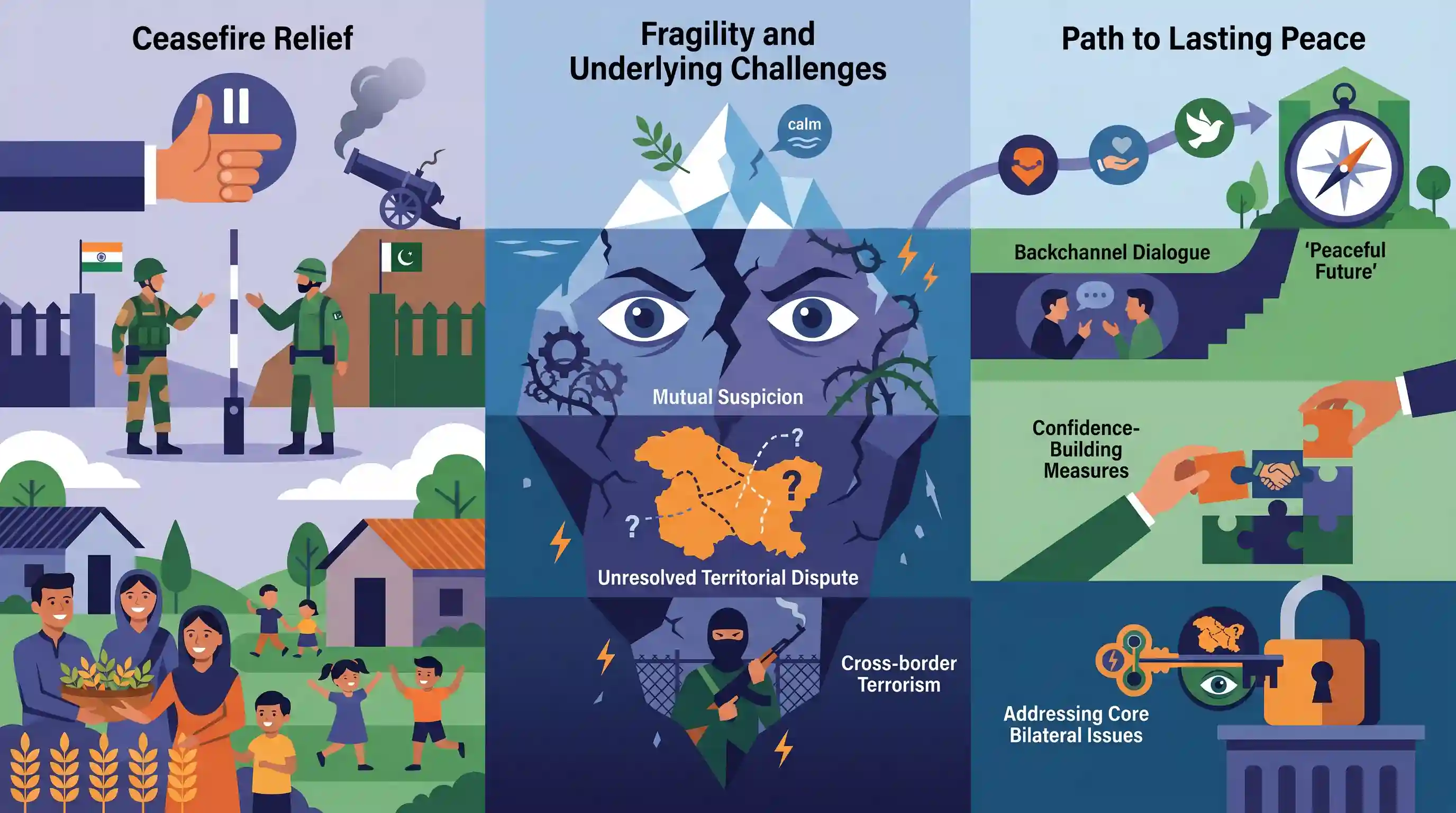
Why It Matters
Understanding the dynamics of India-Pakistan relations and border management is crucial for the UPSC exam, particularly for GS Paper 2 (International Relations) and GS Paper 3 (Internal Security). The fragility of ceasefires highlights the complex interplay between military tactics and diplomatic strategy in managing hostile borders.
Summary
The article analyzes the current state of the India-Pakistan ceasefire along the Line of Control (LoC). While welcoming the halt in cross-border firing for the relief it provides to local border residents and the de-escalation of military tensions, the author cautions that the ceasefire remains highly fragile. The underlying structural challenges—including cross-border terrorism, unresolved territorial disputes, and deep-seated mutual suspicion—continue to loom large. The piece stresses that without backchannel dialogue, robust confidence-building measures, and a genuine attempt to address core bilateral issues, a military-level ceasefire is unlikely to translate into lasting peace.
Key Points
- The ceasefire along the Line of Control (LoC) provides essential relief to border communities and prevents immediate military escalation.
- However, the peace remains inherently fragile due to the absence of substantive political dialogue and persistent mutual distrust between the two nations.
- Cross-border terrorism remains a primary spoiler, capable of derailing the temporary calm at any moment.
- A durable peace process requires moving beyond temporary military stand-downs to establishing long-term confidence-building measures and diplomatic engagement.
Important Terms
2021 DGMO Ceasefire Understanding

A joint commitment by Indian and Pakistani military heads in February 2021 to strictly observe all ceasefire agreements along the Line of Control to reduce record-high border hostilities.
UPSC context
GS II (International Relations) & GS III (Security). Tests knowledge of bilateral de-escalation mechanisms and contemporary border management.
2003 Ceasefire Agreement
A foundational bilateral pact reached in November 2003 between India and Pakistan to halt cross-border firing along the International Border, Line of Control, and Actual Ground Position Line.
UPSC context
GS II (Neighborhood Relations). Crucial for understanding the historical basis of peace efforts along the western border.
Line of Control (LoC)
The 740-km de facto military boundary dividing Jammu and Kashmir between India and Pakistan, redesignated from the Ceasefire Line following the 1972 Simla Agreement.
UPSC context
GS III (Border Management). Essential geographic and legal context for territorial disputes and internal security challenges.
Director General of Military Operations (DGMO)
A high-ranking military official responsible for operational planning; the India-Pakistan DGMO hotline is a primary communication channel used to prevent unintended military escalation.
UPSC context
GS III (Internal Security). Tests understanding of institutional mechanisms for conflict management and crisis communication.
Confidence Building Measures (CBMs)
Diplomatic or military steps—such as hotlines, flag meetings, or trade corridors—designed to reduce suspicion and build trust between adversarial nations to prevent conflict.
UPSC context
GS II (International Relations). Evaluates strategies for peace-building and regional stability in South Asian geopolitics.
Cross-border Terrorism
The infiltration of armed groups from one country's soil to conduct attacks in another; it remains the central structural challenge in India-Pakistan bilateral relations.
UPSC context
GS III (Security). Key topic regarding external state/non-state actors and their role in internal security challenges.
Prelims Trap
"The 2021 India-Pakistan ceasefire is a formal bilateral treaty signed by the political executives."
The 2021 development was a joint reiteration of the 2003 understanding by the Directors General of Military Operations (DGMOs), not a new political treaty.
Static Concepts Connected
What are the key formal military CBMs between India and Pakistan?
- Nuclear Facilities: Annual exchange of lists on Jan 1st under the 1988 agreement to prohibit attacks on nuclear installations.
- DGMO Hotline: Routine communication mechanism between Directors General of Military Operations to de-escalate tactical border tensions.
- Missile Notification: The 2005 agreement requiring advance notice before flight testing of ballistic missiles to prevent misinterpretation.
How does WTO allow the revocation of Most Favoured Nation (MFN) status?
- GATT Article XXI: Contains the 'security exception' allowing members to breach WTO obligations, including MFN, to protect essential security interests.
- India's 2019 Revocation: India legally utilized this clause to withdraw Pakistan's MFN status following the 2019 Pulwama terror attack.
Cross-Topic Patterns
Security exceptions in multilateral trade
India's 2019 revocation of Pakistan's MFN status connects bilateral terror challenges to WTO rules, demonstrating how GATT Article XXI is invoked for national security.
Internal security & border infrastructure
Tactical ceasefires directly influence the pace of Border Roads Organisation (BRO) projects. Sustained peace is a prerequisite for executing strategic infrastructure without civilian and military casualties.

Expect a GS2 Mains question linking bilateral border fragility (LoC ceasefire) to the stagnation of SAARC and India's shift toward BIMSTEC.
Linked PYQs · 4
Linked PYQs · 4
- 2015MainsGS2
Terrorist activities and mutual distrust have clouded India-Pakistan relations. To what extent the use of soft power like sports and cultural exchanges could help generate goodwill between the two countries? Discuss with suitable examples.
- 2020MainsGS3
Analyze internal security threats and transborder crimes along Myanmar, Bangladesh and Pakistan borders including Line of Control (LoC). Also discuss the role played by various security forces in this regard.
- 2024MainsGS3
India has a long and troubled border with China and Pakistan fraught with contentious issues. Examine the conflicting issues and security challenges along the border. Also give out the development being undertaken in these areas under the Border Area Development Programme (BADP) and Border Infrastructure and Management (BIM) Scheme.
- 2016MainsGS3
Border management is a complex task due to difficult terrain and hostile relations with some countries. Elucidate the challenges and strategies for effective border management.
