Economic cost of India Pakistan conflict on South Asian integration
Source:Indian Express ↗
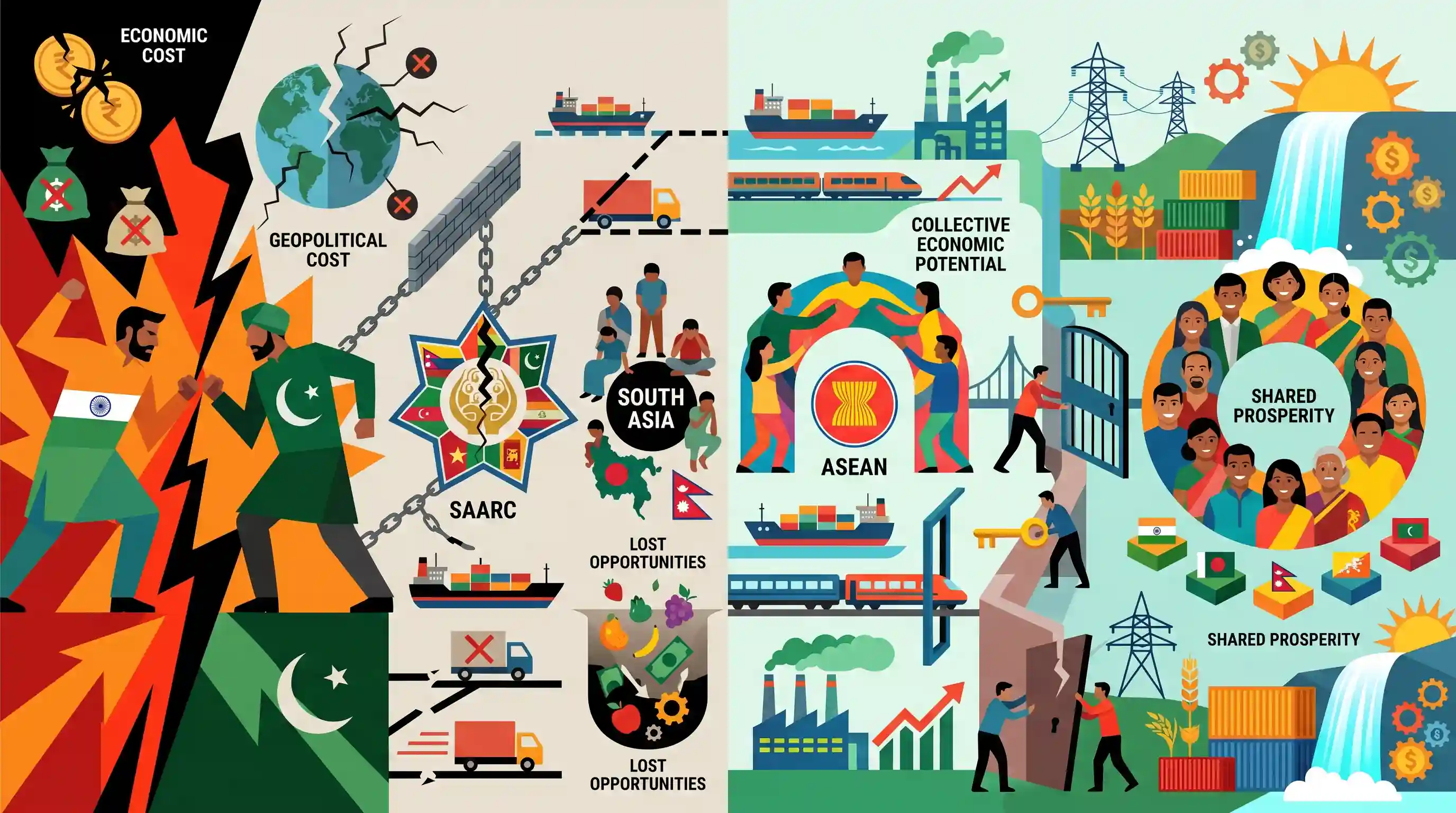
Why It Matters
Understanding the interplay between bilateral conflicts (India-Pakistan) and multilateral failures (SAARC) is critical for GS2 International Relations. It highlights the economic cost of poor neighborhood relations and the necessity of regional integration for economic growth, a recurring theme in UPSC Mains.
Summary
The article analyzes the severe economic and geopolitical costs of the ongoing India-Pakistan conflict on the broader South Asian region. It highlights how bilateral tensions have effectively paralyzed the South Asian Association for Regional Cooperation (SAARC), thereby stunting intra-regional trade and connectivity. By comparing South Asia's low integration to the economically successful ASEAN bloc, the piece underscores the massive lost opportunities for neighboring countries like Bangladesh and Nepal. It emphasizes that resolving or compartmentalizing bilateral disputes is critical to unlocking the region's collective economic potential and ensuring shared prosperity.
Key Points
- The persistent bilateral conflict between India and Pakistan significantly hampers regional integration and cooperation in South Asia.
- SAARC remains largely ineffective and paralyzed due to these hostilities, contrasting sharply with successful regional blocs like ASEAN.
- Intra-regional trade in South Asia is among the lowest globally, resulting in immense economic opportunity costs.
- Neighboring countries such as Bangladesh and Nepal suffer from the lack of seamless connectivity and integrated markets.
- Overcoming bilateral disputes is essential to unlock South Asia's collective economic potential and foster regional stability.
Important Terms
SAARC

A regional intergovernmental organization established in 1985 to promote economic and social development among South Asian nations. It is currently stalled due to India-Pakistan tensions.
UPSC context
GS Paper 2: International Relations. Tests knowledge of regional groupings and the impact of bilateral conflicts on multilateral cooperation.
ASEAN
A 10-member regional organization in Southeast Asia focused on economic growth, security, and cultural exchange, often cited as a benchmark for successful regional integration.
UPSC context
GS Paper 2: International Relations. Important for "Act East Policy" and comparing regional integration models.
Intra-regional Trade
Trade occurring between countries within the same geographic region. In South Asia, it remains abysmally low (5-7%) compared to regions like ASEAN (over 20%).
UPSC context
GS Paper 3: Indian Economy. Relevant for regional integration, trade barriers, and economic diplomacy in South Asia.
Connectivity Projects
Physical and digital infrastructure initiatives (roads, rail, energy grids) designed to facilitate the movement of goods and people across national borders to boost economic growth.
UPSC context
GS Paper 2: International Relations. Tests understanding of "Neighbourhood First" and strategic bypass of hostile neighbors.
SAFTA
An agreement signed in 2004 to reduce customs duties and promote free trade among SAARC members, though its implementation is hampered by political mistrust.
UPSC context
GS Paper 2/3: International Relations/Economy. Critical for evaluating the effectiveness of South Asian economic agreements.
Neighbourhood First Policy
A core component of India's foreign policy prioritizing active engagement, economic support, and improved connectivity with its immediate neighbors to ensure regional stability.
UPSC context
GS Paper 2: International Relations. Essential for questions on India’s strategic interests and regional leadership.
Prelims Trap
"SAARC decisions are taken by majority and its charter provides mechanisms to resolve bilateral disputes."
Article X of the SAARC Charter mandates absolute unanimity for decisions and explicitly prohibits the discussion of "bilateral and contentious issues."
Static Concepts Connected
What is the BBIN Motor Vehicle Agreement and why was it formed?
- Origin: Conceived as a sub-regional alternative after Pakistan vetoed the SAARC Motor Vehicle Agreement at the 2014 Kathmandu summit.
- Scope: Aims to facilitate seamless cross-border movement of passenger and cargo vehicles among Bangladesh, Bhutan, India, and Nepal.
- Current Status: Bhutan temporarily opted out pending environmental clearances, but Bangladesh, India, and Nepal are actively operationalizing the corridors.
How does the 'ASEAN Way' structurally differ from SAARC?
- Non-interference: ASEAN actively compartmentalizes bilateral disputes through strict non-interference, prioritizing economic integration over political rivalries.
- The Unanimity Trap: SAARC's charter requirement for unanimity means a single bilateral conflict (India-Pakistan) functions as a veto, paralyzing all regional connectivity efforts.
Cross-Topic Patterns
Shift from SAARC to BIMSTEC
India’s frustration with SAARC’s structural paralysis led to heavily prioritizing BIMSTEC, seamlessly bridging its 'Neighborhood First' doctrine with the 'Act East' policy.
South Asian Non-Tariff Barriers
High intra-regional trade costs and rigid sensitive lists under SAFTA mirror broader WTO macro-economics on how non-tariff barriers and paratariffs severely undermine developing market integration.

Expect a 2026 comparative question on the institutional mechanics (veto rules, dispute handling) of SAARC versus ASEAN and BIMSTEC.
Linked PYQs · 3
Linked PYQs · 3
- 2016MainsGS2
Increasing cross-border terrorist attacks in India and growing interference in the internal affairs of several member-states by Pakistan are not conducive for the future of SAARC (South Asian Association for Regional Cooperation)." Explain with suitable examples.
- 2022MainsGS2
Do you think that BIMSTEC is a parallel organisation like the SAARC ? What are the similarities and dissimilarities between the two ? How are Indian foreign policy objectives realized by forming this new organisation?
- 2016PrelimsGS1
The term 'Regional Comprehensive Economic Partnership' often appears in the news in the context of the affairs of a group of countries known as
