Bilateralism versus third party mediation in ceasefires
Source:Indian Express ↗
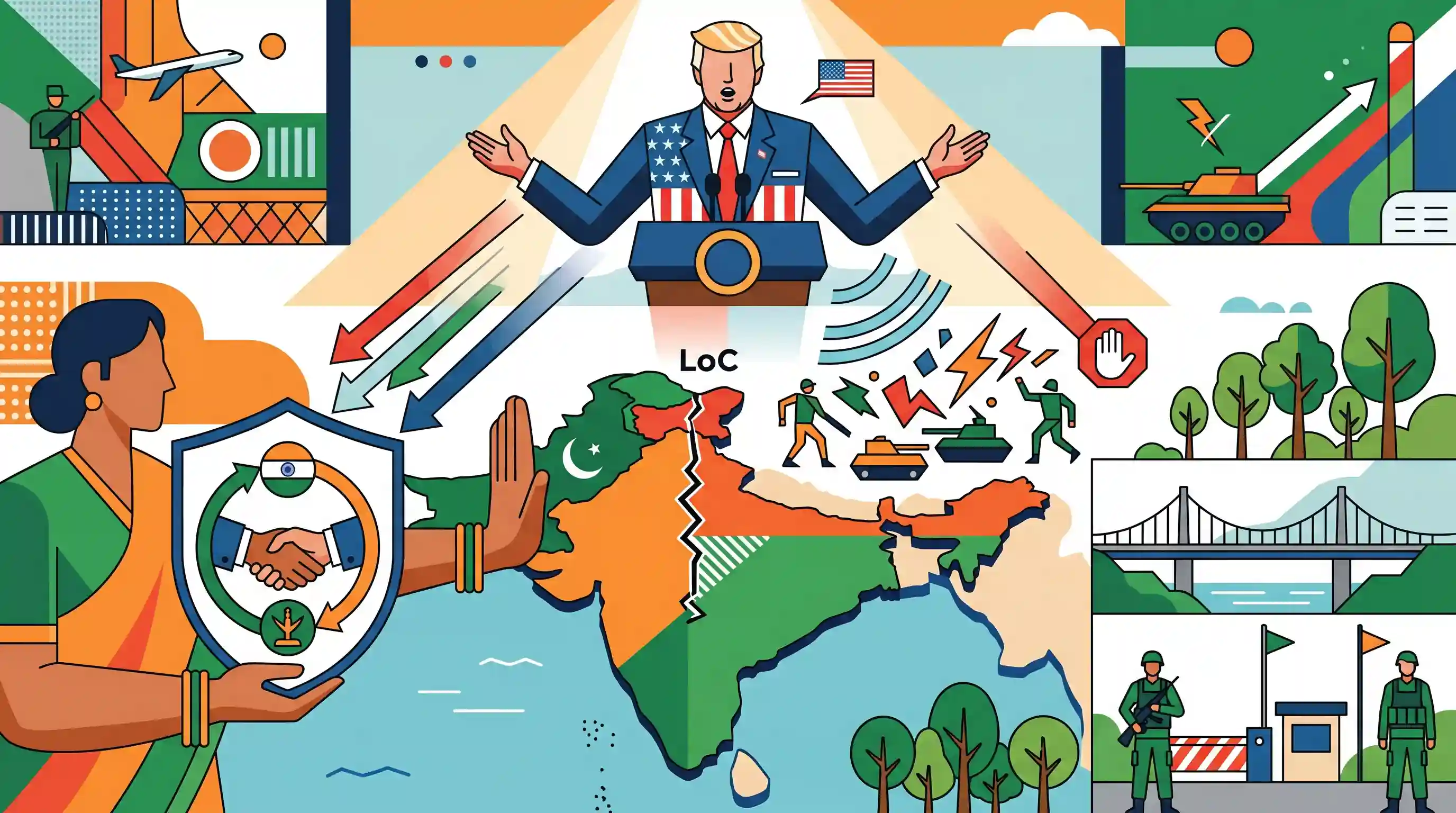
Why It Matters
The announcement touches upon core tenets of India's foreign policy—specifically its stance on bilateralism versus third-party mediation—and has direct implications for internal security and border management along the volatile Line of Control.
Summary
US President Donald Trump announced a full and immediate ceasefire between India and Pakistan. This major diplomatic development has profound implications for regional stability, border management along the Line of Control (LoC), and the broader trajectory of India-Pakistan bilateral relations. Crucially, the public involvement of the US President brings the debate of third-party mediation in South Asian disputes back into focus, a concept India has historically rejected in favor of the bilateral framework established by the Shimla Agreement.
Key Points
- US President Donald Trump announced that India and Pakistan have agreed to a 'full and immediate ceasefire', potentially easing historical tensions along the Line of Control.
- The involvement of the US President brings international mediation into focus, contrasting with India's traditional stance of handling Pakistan relations bilaterally under the Shimla Agreement.
- A sustained ceasefire could significantly aid in better border management and counter-infiltration efforts by Indian security forces.
- The development highlights the evolving role of the United States in South Asian geopolitics and crisis de-escalation between the two nuclear-armed neighbors.
Important Terms
Shimla Agreement

A 1972 peace treaty between India and Pakistan following the 1971 war. It established a framework for resolving disputes through direct bilateral negotiations, explicitly rejecting third-party mediation in the Jammu and Kashmir issue.
UPSC context
GS Paper II (International Relations). Core pillar of India's 'bilateralism' policy and historical rejection of external intervention in Kashmir.
2003 Ceasefire Agreement
An informal 'understanding' reached between Indian and Pakistani militaries to halt cross-border firing along the Line of Control. While not a formal treaty, it is periodically reaffirmed by both countries' DGMOs to lower tensions.
UPSC context
GS Paper III (Internal Security). Crucial for border management and protecting civilian lives in frontier regions during periods of high escalation.
Line of Control (LoC)
The ~740 km de facto military boundary dividing the Indian and Pakistani-administered parts of Jammu and Kashmir. Originally the 1949 Ceasefire Line, it was renamed and formalized under the 1972 Shimla Agreement.
UPSC context
GS Paper III (Security). Tests knowledge of border disputes, infiltration challenges, and the legal status of boundaries in J&K.
Third-party Mediation
Intervention by an external actor (e.g., the US or UN) to resolve disputes between two nations. India traditionally rejects this in its neighborhood, favoring bilateral frameworks to preserve strategic autonomy and sovereignty.
UPSC context
GS Paper II (IR). Tests understanding of India's diplomatic principles, strategic autonomy, and response to international pressure on regional issues.
Bilateralism
A diplomatic approach emphasizing the resolution of issues between two countries through direct dialogue without external influence. It is the cornerstone of India’s engagement strategy with Pakistan and other neighbors.
UPSC context
GS Paper II (International Relations). Fundamental to India's 'Neighbourhood First' policy and its rejection of internationalizing local disputes.
Prelims Trap
"India has officially accepted US mediation to resolve the Kashmir dispute and enforce the LoC ceasefire."
India strictly maintains a bilateral framework under the 1972 Shimla Agreement. US facilitation or public announcements do not equal India accepting formal third-party mediation.
Static Concepts Connected
What are the foundational agreements governing India-Pakistan bilateral relations?
- Shimla Agreement (1972): Committed both nations to settle disputes through peaceful bilateral negotiations, formally rejecting third-party mediation in cross-border issues.
- Lahore Declaration (1999): Reaffirmed the bilateral framework and introduced essential nuclear confidence-building measures (CBMs) to prevent accidental conflicts.
- 2003 Ceasefire: A military-to-military unwritten understanding to halt cross-border firing, strategically reaffirmed by the DGMOs in February 2021.
How does the Line of Control legally and administratively differ from the International Boundary?
- Legal Status: The LoC is a military control line formalized after the 1971 war, replacing the 1949 Ceasefire Line. It is not a legally recognized international boundary.
- Border Management: The LoC is heavily guarded by the Indian Army (MoD), whereas the formal International Boundary (IB) is managed by the Border Security Force (MHA).
Cross-Topic Patterns
Strategic autonomy vs. US mediation
The US President's public announcement directly tests India's traditional doctrine of strategic autonomy and its longstanding policy against internationalizing the Kashmir dispute.
Ceasefires & counter-terror infrastructure
Periods of LoC tranquility directly impact GS3 internal security, allowing the Indian Army to repair the Anti-Infiltration Obstacle System (AIOS) without facing hostile covering fire.

Expect a Prelims question contrasting the legal nature of the 1972 Shimla Agreement with the military-to-military 2003 DGMO ceasefire.
Linked PYQs · 3
Linked PYQs · 3
- 2015MainsGS2
Terrorist activities and mutual distrust have clouded India-Pakistan relations. To what extent the use of soft power like sports and cultural exchanges could help generate goodwill between the two countries? Discuss with suitable examples.
- 2020MainsGS3
Analyze internal security threats and transborder crimes along Myanmar, Bangladesh and Pakistan borders including Line of Control (LoC). Also discuss the role played by various security forces in this regard.
- 2020MainsGS3
For effective border area management, discuss the steps required to be taken to deny local support to militants and also suggest ways to manage favourable perception among locals.
