India Pakistan Agree to Maintain Border Ceasefire
Source:The Hindu ↗
Why It Matters
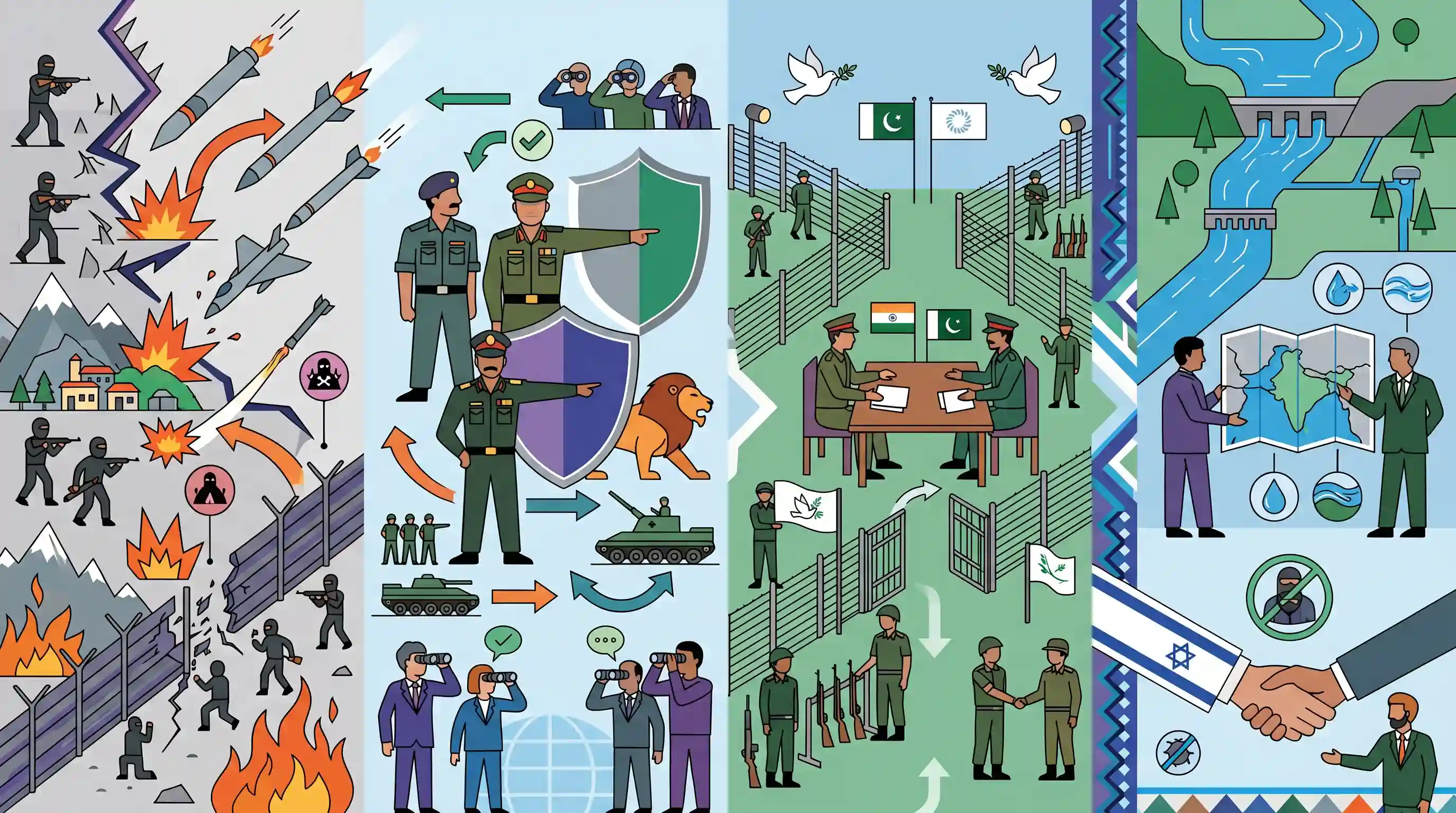
Operation Sindoor highlights a pivotal shift in India's strategic military doctrine towards cross-border terrorism, emphasizing calibrated deterrence. The concurrent use of military action and subsequent DGMO-level dialogue for de-escalation demonstrates complex statecraft relevant to GS-2 and GS-3 syllabi.
Summary
Following the military escalation triggered by the Pahalgam terror attack and India's subsequent retaliatory precision strikes under 'Operation Sindoor', India and Pakistan have agreed to extend confidence-building measures and observe a ceasefire to reduce border alertness levels. Indian military leadership commended the armed forces for achieving strategic deterrence without sparking a general war, a sentiment echoed by international defense analysts. Amid the de-escalation, Pakistan has signaled a willingness to restart talks on the Indus Waters Treaty, while Israel extended diplomatic support for India's counter-terrorism efforts.
Key Points
- India and Pakistan have committed to extending confidence-building measures and enforcing a ceasefire until May 18 to de-escalate military alertness.
- The standoff was triggered by India's Operation Sindoor, a series of precision strikes on terror infrastructure in Pakistan and PoK in response to the Pahalgam terror attack.
- Indian Army Chief General Upendra Dwivedi praised the troops for their calibrated military actions and humanitarian assistance provided to border civilians.
- Urban warfare expert John Spencer characterized the operation as a textbook example of deterrence that successfully redefined India's strategic red lines without leading to a full-scale war.
- Diplomatically, Pakistan has proposed resuming dialogue over the Indus Waters Treaty, while Israel officially expressed support for India's anti-terrorism operations.
Important Terms
Operation Sindoor

A 2025 Indian precision military operation targeting terror camps in Pakistan and PoJK following the Pahalgam attack. It aimed to establish deterrence through limited, swift air and missile strikes.
UPSC context
GS Paper III (Internal Security). Tests understanding of India’s calibrated military responses to cross-border terrorism and 'limited war' doctrines.
Indus Waters Treaty (IWT)
A 1960 World Bank-brokered water-sharing agreement between India and Pakistan. It governs the use of six rivers, allocating the 'Western Rivers' to Pakistan and 'Eastern Rivers' to India.
UPSC context
GS Paper II (International Relations). Crucial for questions on transboundary water diplomacy and using treaties as leverage in bilateral security conflicts.
Confidence-Building Measures (CBMs)
Tactical or diplomatic steps (e.g., hotlines, ceasefire agreements, trade) taken by adversarial states to reduce suspicion, prevent accidental escalation, and foster transparency in border areas.
UPSC context
GS Paper II (India and its Neighborhood). Essential for analyzing de-escalation strategies and the fragility of peace processes in South Asia.
Strategic Deterrence
A military doctrine focused on preventing an adversary's aggression by maintaining a credible threat of retaliatory force that makes the cost of attack unacceptably high.
UPSC context
GS Paper III (Security). Tests knowledge of modern warfare theories, nuclear stability, and the 'stability-instability paradox' in the subcontinent.
Cross-border Terrorism
The act of carrying out terrorist activities across international borders, typically where perpetrators are supported by one state to destabilize or attack a neighbor.
UPSC context
GS Paper III (Security). A recurring theme in internal security and external threats to Indian sovereignty and regional stability.
Prelims Trap
Operation Sindoor is a joint urban warfare training exercise conducted by the Indian and Israeli armed forces.
Operation Sindoor was India's unilateral retaliatory precision strike against terror infrastructure in Pakistan and PoK following the Pahalgam attack, not a joint military exercise.
Static Concepts Connected
How are rivers allocated under the 1960 Indus Waters Treaty?
- Eastern Rivers: Ravi, Beas, and Sutlej are allocated entirely to India for unrestricted usage.
- Western Rivers: Indus, Jhelum, and Chenab are allocated largely to Pakistan, though India is allowed limited agricultural and run-of-the-river hydroelectric use.
- World Bank role: Brokered the 1960 treaty and maintains a procedural role in dispute resolution, including appointing neutral experts or a Court of Arbitration.
What distinguishes Deterrence by Denial from Deterrence by Punishment?
- Deterrence by Denial: Preventing an adversary's success through strong defenses, making an attack seem futile (e.g., border fencing, heavy troop deployment).
- Deterrence by Punishment: Threatening severe retaliatory costs if attacked, demonstrated by India's shift to precision strikes across the border.
Cross-Topic Patterns
Water diplomacy amid military escalation
Pakistan using the Indus Waters Treaty as a diplomatic icebreaker highlights how institutionalized transboundary water-sharing frameworks often survive severe military escalations, preserving vital bilateral communication channels.
Sub-conventional warfare & deterrence shift
The shift from defensive border posturing to offensive precision strikes reflects India's evolving military doctrine to counter state-sponsored terrorism without crossing the threshold of full-scale conventional war.

Expect a 2026 Prelims question pairing recent military operations (Operation Sindoor) with the World Bank's exact arbitration role in the IWT.
Linked PYQs · 3
Linked PYQs · 3
- 2015MainsGS2
Terrorist activities and mutual distrust have clouded India-Pakistan relations. To what extent the use of soft power like sports and cultural exchanges could help generate goodwill between the two countries? Discuss with suitable examples.
- 2016MainsGS3
The terms 'Hot Pursuit' and 'Surgical Strikes' are often used in connection with armed action against terrorist attacks. Discuss the strategic impact of such actions.
- 2012MainsGS2
The situation today is far different to that prevalent fifty years back when the Indus Water Treaty was signed." Highlight the complexity of the current challenges on both sides of the border in this regard. Do you think that a review of the Treaty is in India's best interests?
