India and Pakistan Agree to Ceasefire Amid Ongoing Border Tensions
Source:The Hindu ↗
Why It Matters
The development showcases the fragile nature of India-Pakistan peace agreements, the challenge of cross-border terrorism, and India's evolving strategic posture involving punitive diplomatic actions and border military operations.
Summary
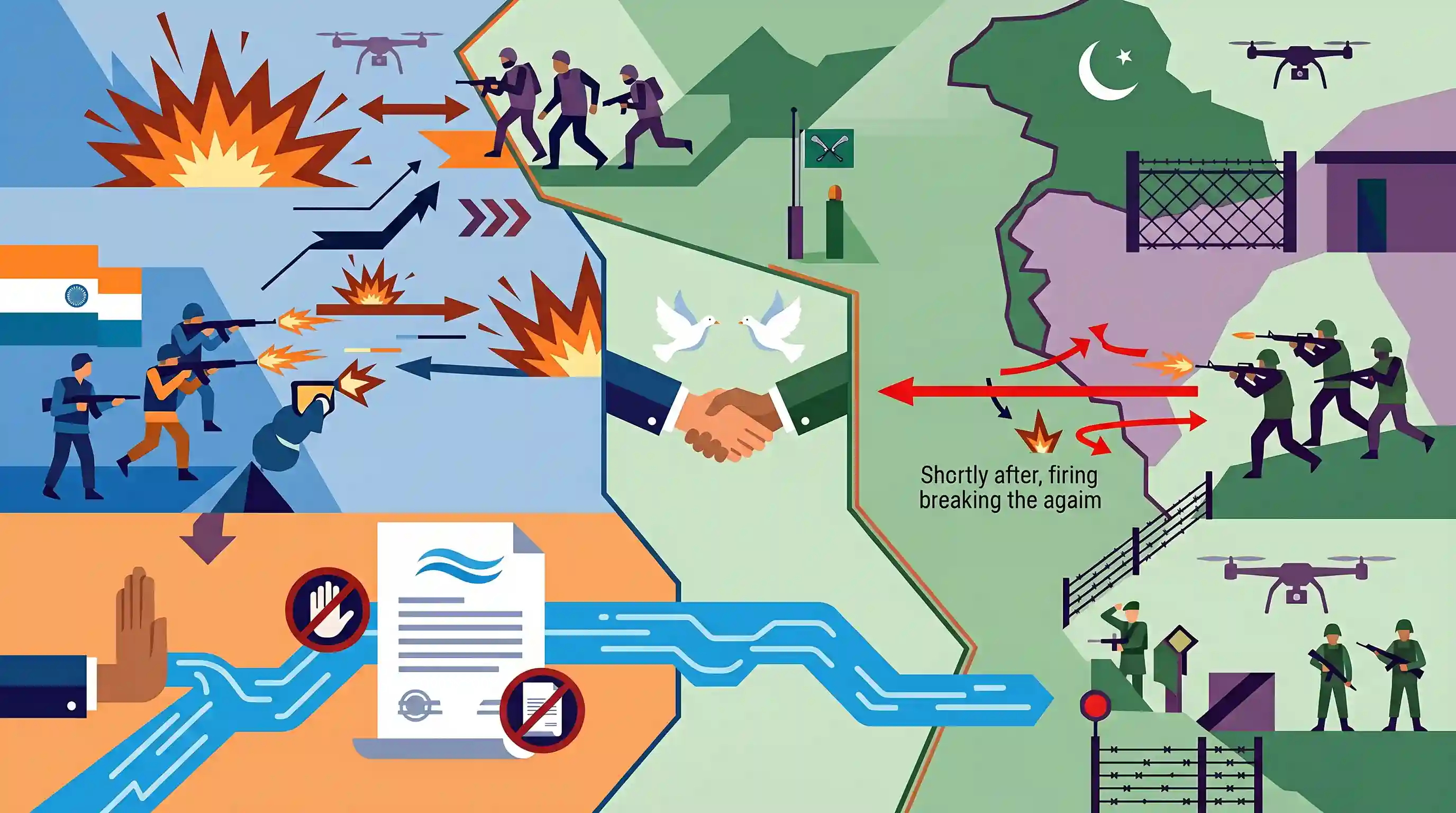
India and Pakistan agreed to an 'understanding' to halt military action and cross-border firing following intense hostilities triggered by the Pahalgam terror attack and India's retaliatory 'Operation Sindoor'. However, Pakistan violated the ceasefire shortly after the announcement. India maintained that previous punitive measures, including holding the Indus Waters Treaty in abeyance, remain in place.
Key Points
- A sudden ceasefire understanding was reached between the DGMOs of India and Pakistan to halt military action and cross-border firing following escalating military hostilities.
- Pakistan violated the understanding shortly after with cross-border firing in Jammu and explosions in Srinagar, prompting India to order a strong military response.
- India clarified the ceasefire has no preconditions and its uncompromising stance on cross-border terrorism remains intact.
- Punitive measures taken against Pakistan post the Pahalgam attack, including placing the Indus Waters Treaty in abeyance and suspending the Kartarpur Corridor, continue to be enforced.
Important Terms
Operation Sindoor

India's May 2025 military operation involving precision missile and air strikes on terror infrastructure in Pakistan and PoJK, following the Pahalgam terror attack.
UPSC context
GS Paper III: Security; tests India's 'proactive' defense doctrine and use of precision strikes for strategic deterrence below the nuclear threshold.
Indus Waters Treaty (IWT)
A 1960 World Bank-brokered water-sharing pact between India and Pakistan; India placed it in 'abeyance' in 2025, linking water cooperation directly to the cessation of terrorism.
UPSC context
GS Paper II: International Relations; critical for questions on hydro-diplomacy, transboundary water rights, and bilateral treaty obligations under stress.
Director General of Military Operations (DGMO)
A three-star general responsible for directing army operations; the primary military channel for negotiating ceasefires and managing the 'hotline' between India and Pakistan.
UPSC context
GS Paper III: Security; essential for understanding border management, crisis de-escalation mechanisms, and civil-military coordination.
Ministry of External Affairs (MEA)
The Union ministry responsible for India's foreign policy and international diplomacy, led by the Foreign Secretary and the External Affairs Minister.
UPSC context
GS Paper II: Governance/IR; the central node for India’s global engagement and diplomatic responses to national security crises.
Foreign Secretary
The administrative head of the MEA and senior-most diplomat who articulates India’s official stance on international conflicts and bilateral negotiations.
UPSC context
GS Paper II: International Relations; tests knowledge of India's diplomatic hierarchy and the execution of foreign policy.
Pahalgam Terror Attack (2025)
The April 2025 terrorist strike on civilians in Jammu & Kashmir that served as the trigger for Operation Sindoor and the suspension of water-sharing agreements.
UPSC context
GS Paper III: Internal Security; a case study for the link between proxy warfare and state-level military/diplomatic retaliation.
Prelims Trap
India has formally abrogated the Indus Waters Treaty to stop the flow of Western rivers to Pakistan.
India placed the IWT 'in abeyance'—suspending diplomatic meetings and data-sharing. It has not formally abrogated the treaty, nor can it immediately stop physical water flow without massive, long-term infrastructure.
Static Concepts Connected
What are the core provisions of the Indus Waters Treaty (1960)?
- Eastern Rivers: India has unrestricted use of the three Eastern rivers: Ravi, Beas, and Sutlej.
- Western Rivers: Pakistan receives the Indus, Jhelum, and Chenab. India is allowed limited agricultural and run-of-the-river hydroelectric usage.
- Broker & Mechanism: Brokered by the World Bank, the treaty requires a Permanent Indus Commission (PIC) to meet regularly for data sharing.
What is the DGMO Hotline mechanism between India and Pakistan?
- Establishment: Set up post-1971 war to ensure direct military-to-military communication and prevent accidental escalations along the Line of Control.
- Weekly Contact: The Director Generals of Military Operations (DGMOs) conventionally speak every Tuesday to discuss border deployments and violations.
- 2003 Ceasefire: It serves as the institutional bedrock for managing and reiterating the landmark 2003 Ceasefire Agreement.
Cross-Topic Patterns
Hydro-diplomacy as a coercive tool
Keeping the IWT in abeyance mirrors the broader weaponization of shared river basins, comparable to China withholding hydrological data for the Brahmaputra during the 2017 Doklam standoff.
Evolution of cross-border military doctrines
'Operation Sindoor' marks a doctrinal shift from the 2016 single-service surgical strikes to proactive, tri-services precision strikes, reflecting a highly evolved, non-escalatory retaliatory posture against state-sponsored terrorism.

The legal distinction between 'abeyance' and 'abrogation' of the Indus Waters Treaty, alongside Western river geography, is a 2026 target.
Linked PYQs · 5
Linked PYQs · 5
- 2015MainsGS2
Terrorist activities and mutual distrust have clouded India-Pakistan relations. To what extent the use of soft power like sports and cultural exchanges could help generate goodwill between the two countries? Discuss with suitable examples.
- 2016MainsGS2
Increasing cross-border terrorist attacks in India and growing interference in the internal affairs of several member-states by Pakistan are not conducive for the future of SAARC (South Asian Association for Regional Cooperation)." Explain with suitable examples.
- 2012MainsGS2
The situation today is far different to that prevalent fifty years back when the Indus Water Treaty was signed." Highlight the complexity of the current challenges on both sides of the border in this regard. Do you think that a review of the Treaty is in India's best interests?
- 2020MainsGS3
For effective border area management, discuss the steps required to be taken to deny local support to militants and also suggest ways to manage favourable perception among locals.
- 2020MainsGS3
Analyze internal security threats and transborder crimes along Myanmar, Bangladesh and Pakistan borders including Line of Control (LoC). Also discuss the role played by various security forces in this regard.
