India Pakistan Ceasefire Agreement and Ongoing Punitive Measures
Source:The Hindu ↗
Why It Matters
The suspension of the Indus Waters Treaty and the volatile nature of bilateral ceasefire agreements are vital for GS-2 (India and its Neighborhood) and GS-3 (Security). Aspirants must understand the transition in India's strategic posture (treating terror acts as acts of war) and the geopolitical fallout of suspending key diplomatic and economic ties.
Summary
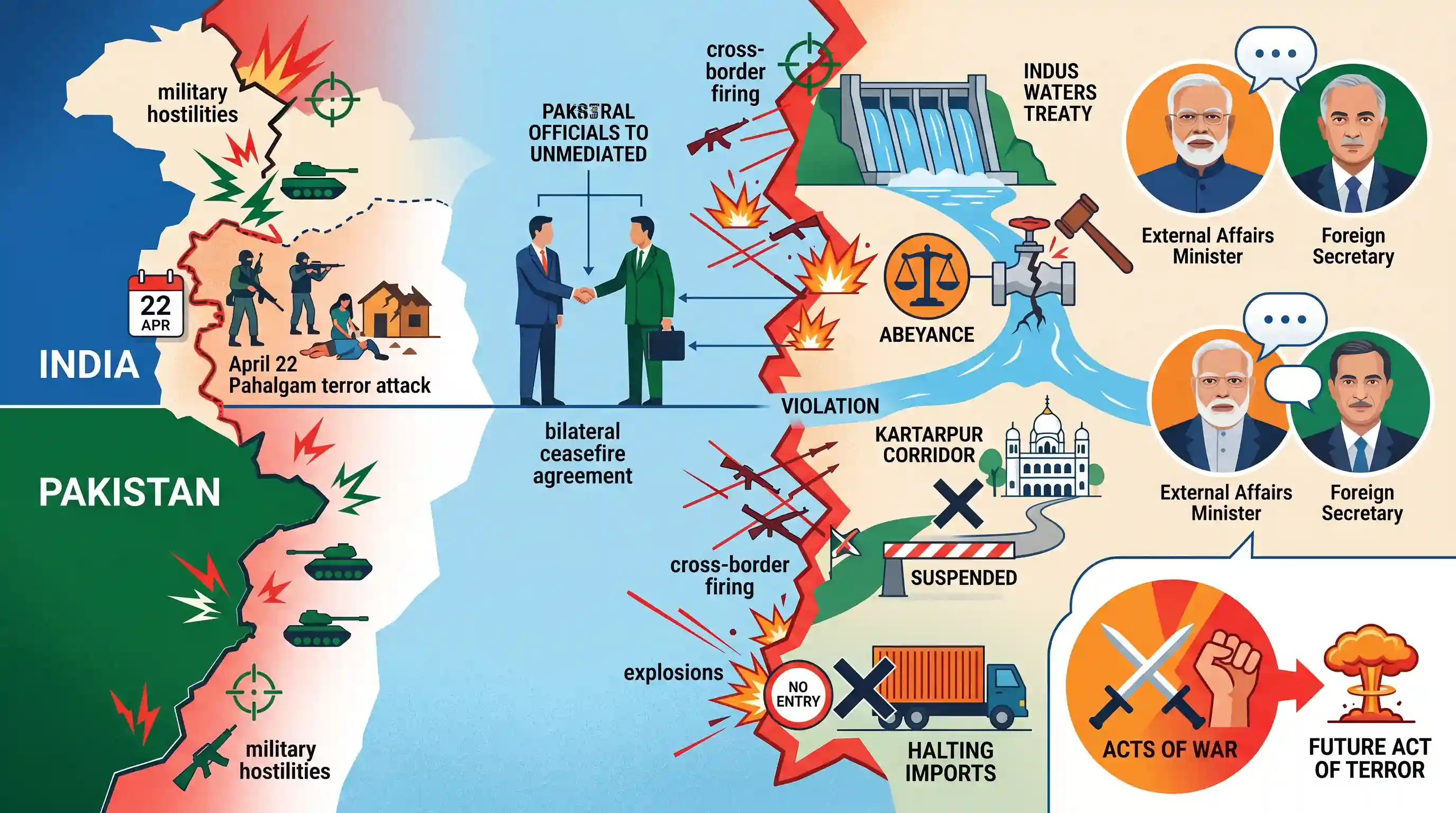
Following days of military hostilities and the April 22 Pahalgam terror attack, India and Pakistan agreed to a bilateral ceasefire. However, the understanding was quickly violated by Pakistan through cross-border firing and explosions. External Affairs Minister S. Jaishankar and Foreign Secretary Vikram Misri highlighted that while the peace deal was struck without mediation, India's strict punitive measures against Pakistan—such as placing the Indus Waters Treaty in abeyance, suspending the Kartarpur Corridor, and halting imports—will remain in full effect. Furthermore, India warned that future acts of terror would be treated as acts of war.
Key Points
- India and Pakistan reached a bilateral understanding to cease military action and firing, with no preconditions or external mediation involved.
- The ceasefire agreement was quickly violated by Pakistan through cross-border firing in Jammu and explosions in Srinagar, prompting India to instruct its armed forces to deal strongly with the breach.
- The pause in hostilities will not affect India's punitive measures implemented after the April 22 Pahalgam terror attack and subsequent Operation Sindoor.
- Punitive measures remaining in place include keeping the Indus Waters Treaty in abeyance, freezing imports, suspending the Kartarpur Corridor, and revoking most visas for Pakistani citizens.
- India established a new deterrence baseline, signaling that any future act of terror from Pakistan will be considered an act of war.
Important Terms
Indus Waters Treaty

A 1960 World Bank-brokered water-sharing agreement between India and Pakistan. It allocates the three eastern rivers to India and three western rivers to Pakistan; currently held in abeyance by India.
UPSC context
GS Paper II: India’s Neighborhood Relations. Tests understanding of transboundary water diplomacy and strategic leverage in bilateral conflicts.
Kartarpur Corridor
A visa-free passage connecting India's Dera Baba Nanak with Pakistan’s Gurdwara Darbar Sahib. It facilitates religious pilgrimage and acts as a tool for cultural diplomacy between the two nations.
UPSC context
GS Paper II: International Relations. Focuses on cultural diplomacy and people-to-people ties as a tool for peace-building.
Operation Sindoor
A 2025 Indian military campaign involving high-precision missile and drone strikes on terror infrastructure in Pakistan-occupied Kashmir and Pakistan, launched in response to the Pahalgam terror attack.
UPSC context
GS Paper III: Internal Security. Evaluates India's evolving counter-terrorism doctrine and the use of military strikes as a deterrent strategy.
Cross-Border Terrorism
The state-sponsored or state-supported use of non-state actors and proxies by a country to conduct terrorist activities in a neighboring nation's territory.
UPSC context
GS Paper III: Internal Security. Examines asymmetric warfare and security challenges along the Line of Control.
Border Management
The strategic oversight of international boundaries through physical barriers, surveillance technology, and patrolling to prevent infiltration, smuggling, and unauthorized crossings.
UPSC context
GS Paper III: Internal Security. Relevant for strategies regarding the Line of Control and technological interventions like CIBMS.
Prelims Trap
India has formally abrogated the Indus Waters Treaty and permanently exited its obligations.
India placed the IWT 'in abeyance' (a temporary suspension of operations), not abrogated it. Abrogation implies permanent legal termination of the treaty.
Static Concepts Connected
What is the river division and dispute mechanism under the Indus Waters Treaty (1960)?
- Eastern Rivers: India has unrestricted use of the Ravi, Beas, and Sutlej rivers.
- Western Rivers: Pakistan is allocated the Indus, Jhelum, and Chenab, but India retains limited rights for run-of-the-river hydroelectric projects.
- Dispute Resolution: A three-tiered mechanism: Permanent Indus Commission, Neutral Expert (appointed by World Bank), and Court of Arbitration.
Under what WTO provision did India halt bilateral trade and revoke Pakistan's MFN status?
- MFN Principle: GATT Article I mandates non-discriminatory trade treatment (Most Favoured Nation) to all World Trade Organization members.
- Security Exception: India invoked GATT Article XXI (National Security Exception) in 2019 to legally revoke Pakistan's MFN status without violating WTO rules.
Cross-Topic Patterns
Riparian rights as coercive diplomacy
Placing the IWT in abeyance links GS-1/Geography (transboundary rivers) directly with GS-2/IR (utilizing upper-riparian hydro-hegemony to penalize cross-border terrorism).
Deterrence baseline and nuclear overhang
Declaring state-sponsored terrorism an 'act of war' shifts India's sub-conventional warfare doctrine, altering the GS-3 security paradigm beneath a nuclear umbrella.

IWT's dispute resolution mechanism and the legal mechanics of India's 'abeyance' move are prime for a 2026 Prelims multi-statement Q.
Linked PYQs · 4
Linked PYQs · 4
- 2012MainsGS2
The situation today is far different to that prevalent fifty years back when the Indus Water Treaty was signed." Highlight the complexity of the current challenges on both sides of the border in this regard. Do you think that a review of the Treaty is in India's best interests?
- 2016MainsGS3
Border management is a complex task due to difficult terrain and hostile relations with some countries. Elucidate the challenges and strategies for effective border management.
- 2015MainsGS2
Terrorist activities and mutual distrust have clouded India-Pakistan relations. To what extent the use of soft power like sports and cultural exchanges could help generate goodwill between the two countries? Discuss with suitable examples.
- 2016MainsGS2
Increasing cross-border terrorist attacks in India and growing interference in the internal affairs of several member-states by Pakistan are not conducive for the future of SAARC (South Asian Association for Regional Cooperation)." Explain with suitable examples.
