India Pakistan Military De Escalation and Border Management
Source:The Hindu ↗
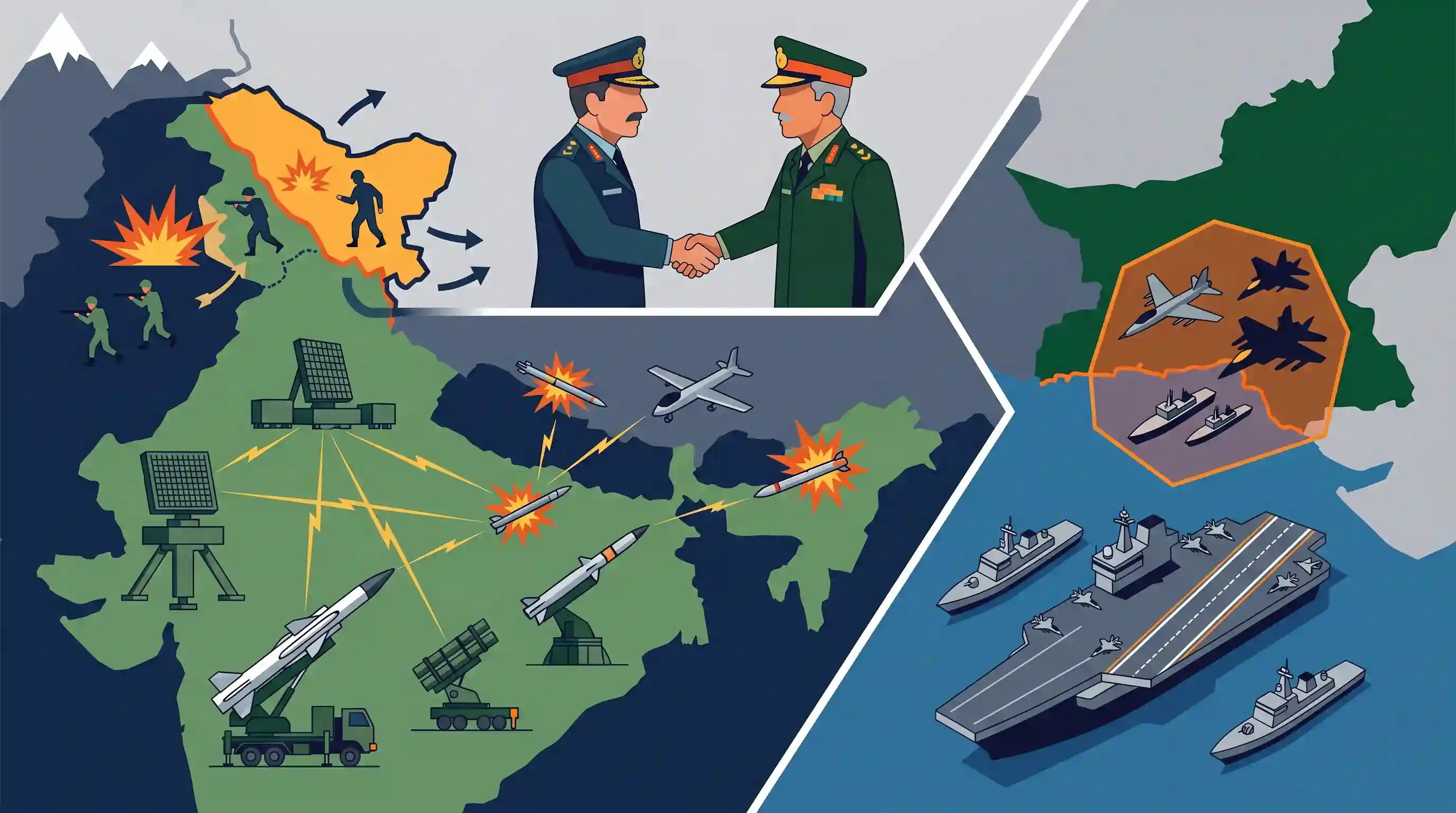
Why It Matters
This incident is crucial for UPSC aspirants as it touches upon multiple dimensions of Internal Security and International Relations: managing contentious borders, assessing the role of the DGMO in military diplomacy, mitigating aerial threats via UAVs/drones, and understanding the significance of naval dominance (Carrier Battle Groups) in securing maritime frontiers.
Summary
Following military clashes during Operation Sindoor—sparked by a terror attack in Pahalgam—India and Pakistan's Directors-General of Military Operations (DGMOs) have reached a ceasefire agreement to cease hostilities and reduce border troop deployments. The conflict showcased extensive synergy among the Indian Armed Forces. India's integrated Air Defence (AD) network effectively thwarted multiple drone and missile attacks using a combination of older imported systems and the indigenous Akash missile. Concurrently, the Indian Navy's deployment of a Carrier Battle Group (CBG) near Pakistan's Makaran coast bottled up adversarial air and naval assets, demonstrating India's cross-platform defensive and offensive capabilities in a complex threat environment.
Key Points
- The Directors-General of Military Operations (DGMOs) of India and Pakistan agreed via hotline to halt firing and consider immediate troop reduction along the borders.
- This diplomatic de-escalation follows Operation Sindoor, launched by India in response to a Pakistan-sponsored terrorist attack at Pahalgam.
- During the conflict, India's Air Defence (AD) grid successfully neutralized waves of Pakistani drones and missiles using legacy systems (Pechora, OSA-AK, L-70) as well as the indigenous Akash surface-to-air missile.
- The Indian Navy deployed a powerful Carrier Battle Group (CBG) equipped with MiG-29K fighters near the Makaran coast, maintaining an uncontested presence and restricting Pakistani maritime and air movements.
Important Terms
Operation Sindoor

Codename for India's 2025 multi-domain military operation against terror infrastructure in Pakistan, following a Pahalgam attack; it involved precision airstrikes, naval blockades, and integrated air defense networks.
UPSC context
GS Paper III: Security challenges in border areas; tests knowledge of cross-border deterrence and tri-service military synergy.
India-Pakistan ceasefire understanding
Reciprocal military-to-military agreements to halt cross-border firing along the Line of Control (LoC), aimed at reducing tensions and preventing full-scale conflict escalation.
UPSC context
GS Paper II: International Relations; tests understanding of bilateral Confidence Building Measures (CBMs) and conflict resolution mechanisms.
Director-General of Military Operations (DGMO)
A high-ranking Lieutenant General responsible for the Indian Army's operational direction; serves as the primary contact via the bilateral hotline for crisis management and de-escalation.
UPSC context
GS Paper III: Role of security agencies and their mandate; tests knowledge of military-diplomatic communication channels.
Carrier Battle Group (CBG)
A strategic naval formation consisting of an aircraft carrier and escort vessels (destroyers, frigates, submarines), used for maritime power projection, sea control, and air cover at sea.
UPSC context
GS Paper III: Maritime Security; tests understanding of naval assets in securing India's interests in the Indian Ocean Region.
Akash Missile System
An indigenously developed, short-to-medium range surface-to-air missile system capable of neutralizing multiple aerial threats simultaneously, such as aircraft, drones, and cruise missiles.
UPSC context
GS Paper III: Science and Technology; tests knowledge of defense indigenization and the Integrated Guided Missile Development Program (IGMDP).
Makran Coast
A semi-desert coastal strip in Balochistan, Pakistan, strategically located along the Arabian Sea; it is home to Gwadar Port and critical for naval monitoring of trade routes.
UPSC context
GS Paper I/II: Geography and Strategic Relations; tests understanding of the geostrategic landscape of the North Arabian Sea.
Prelims Trap
The DGMO hotline agreement between India and Pakistan is a legally binding international treaty.
DGMO hotline agreements are military-to-military operational understandings and Confidence Building Measures (CBMs), not formal, legally binding international treaties signed by governments.
Static Concepts Connected
What is the Integrated Guided Missile Development Programme (IGMDP)?
- Origin & Aim: Conceived by Dr. A.P.J. Abdul Kalam in the 1980s to achieve self-reliance in missile technology for the Indian Armed Forces.
- The Five Missiles: It successfully developed five core missile systems: Prithvi, Agni, Trishul, Nag, and Akash (commonly remembered by the acronym PATNA).
- Akash System: An indigenous, medium-range mobile surface-to-air missile (SAM) system capable of tracking and neutralizing multiple aerial threats simultaneously.
Why is the Makran Coast strategically vital?
- Geographic Location: A semi-desert coastal strip spanning southeastern Iran and southwestern Pakistan along the Arabian Sea and the Gulf of Oman.
- Geopolitical Ports: It hosts highly strategic regional nodes: the China-backed Gwadar port in Pakistan and the India-backed Chabahar port in Iran.
- Energy Security: Its close proximity to the Strait of Hormuz makes it a critical maritime zone for overseeing global energy and trade transit.
Cross-Topic Patterns
Theaterisation & Tri-Service Synergy
Synchronized deployment of IAF defense grids and Navy CBGs acts as a practical blueprint for India's ongoing shift toward Integrated Theatre Commands.
Atmanirbhar Bharat in Defence
Using indigenous Akash SAMs alongside legacy imported systems highlights India's transitional phase toward total import substitution and self-reliance in military hardware.
Countering the String of Pearls
Deploying a Carrier Battle Group near the Makran coast directly signals India's capacity to bottleneck adversarial naval assets near Gwadar port.

Akash SAM under IGMDP + Makran Coast mapping + Navy CBG capabilities likely to form a composite multi-statement defence tech question.
Linked PYQs · 5
Linked PYQs · 5
- 2024MainsGS3
India has a long and troubled border with China and Pakistan fraught with contentious issues. Examine the conflicting issues and security challenges along the border. Also give out the development being undertaken in these areas under the Border Area Development Programme (BADP) and Border Infrastructure and Management (BIM) Scheme.
- 2020MainsGS3
Analyze internal security threats and transborder crimes along Myanmar, Bangladesh and Pakistan borders including Line of Control (LoC). Also discuss the role played by various security forces in this regard.
- 2023MainsGS3
The use of unmanned aerial vehicles (UAVs) by our adversaries across the borders to ferry arms/ammunitions, drugs, etc., is a serious threat to the internal security. Comment on the measures being taken to tackle this threat.
- 2022MainsGS3
What are the maritime security challenges in India ? Discuss the organisational, technical and procedural initiatives taken to improve the maritime security.
- 2025MainsGS3
Why is maritime security vital to protect India's sea trade? Discuss maritime and coastal security challenges and the way forward.
