Indus Waters Treaty Evolution and Hydro Diplomacy Challenges
Source:Indian Express ↗
Why It Matters
The Indus Water Treaty is widely regarded as one of the most successful transboundary water-sharing agreements, having survived numerous conflicts. Its current strains are vital for UPSC aspirants to understand, as they touch upon international law, bilateral relations with Pakistan, hydro-diplomacy, and the growing impact of climate change on regional security.
Summary
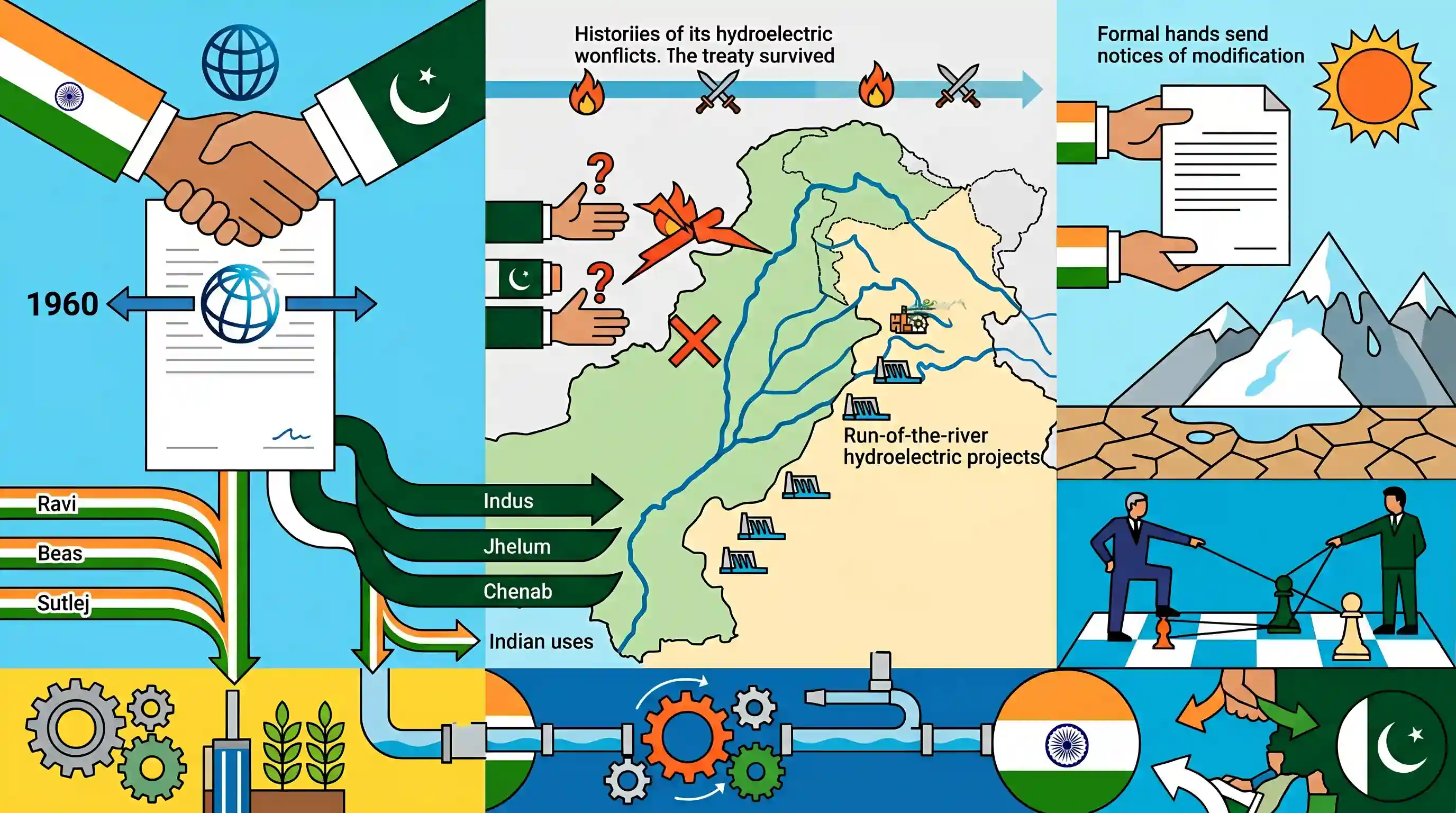
The article analyzes the complex relationship between India and Pakistan through the lens of the Indus Water Treaty (IWT). Signed in 1960 and brokered by the World Bank, the treaty allocates the Eastern rivers (Ravi, Beas, Sutlej) to India and the Western rivers (Indus, Jhelum, Chenab) to Pakistan, while allowing India limited non-consumptive uses on the Western rivers. Although the agreement has survived multiple wars, it has increasingly become a source of contention due to Pakistan's repeated objections to India's run-of-the-river hydroelectric projects (such as Kishanganga and Ratle) in Jammu and Kashmir. The piece explores how changing geopolitical dynamics, India's recent notices to modify the treaty, and growing water scarcity linked to climate change are introducing new pressures to the historic water-sharing pact. Ultimately, water security and the management of the Indus basin remain deeply intertwined with the broader bilateral ties and strategic posturing between the two nations.
Key Points
- The Indus Water Treaty (1960) allocated the eastern rivers (Beas, Ravi, Sutlej) to India and the western rivers (Indus, Chenab, Jhelum) to Pakistan.
- India enjoys unrestricted use of the eastern rivers but has limited, non-consumptive rights—such as run-of-the-river hydroelectric projects—on the western rivers.
- Pakistan has frequently objected to Indian hydroelectric projects (like Kishanganga and Ratle) on the western rivers, triggering dispute resolution mechanisms under the treaty.
- Recent moves by India to issue a formal notice seeking modification of the IWT indicate a more assertive approach to cross-border water diplomacy.
- The treaty serves as a barometer for India-Pakistan relations, where mutual distrust over water sharing reflects broader geopolitical tensions and security concerns.
- Climate change and growing water scarcity add further complexity to the management of the Indus basin, increasing the strategic value of water resources.
Important Terms
Permanent Indus Commission (PIC)

A 10-member bilateral commission of officials from India and Pakistan established to implement the 1960 treaty and resolve technical issues through annual meetings.
UPSC context
GS Paper II (IR); institutional mechanisms for managing transboundary water disputes and maintaining bilateral communication channels during conflict.
Indus Water Treaty (1960)
A 1960 water-sharing agreement brokered by the World Bank, allocating the Eastern rivers to India and the Western rivers to Pakistan with limited Indian usage.
UPSC context
GS Paper II (IR); foundational agreement for South Asian hydro-politics, testing knowledge of neighborhood relations and international mediation.
Run-of-the-river (ROR) Hydroelectric Projects
Hydroelectric plants that utilize the natural flow and elevation of a river to generate power with minimal water storage or reservoir capacity.
UPSC context
GS Paper III (Infrastructure/Energy) and GS Paper II; central to technical disputes between India and Pakistan over water flow.
Neutral Expert (NE)
A technical authority appointed by the World Bank under the IWT's dispute resolution mechanism to resolve technical 'differences' between the two nations.
UPSC context
GS Paper II (IR); critical for understanding the tiered dispute resolution framework and India's recent legal victories regarding project designs.
Western Rivers
The three rivers (Indus, Jhelum, Chenab) allocated to Pakistan for unrestricted use, though India retains limited rights for power generation and irrigation.
UPSC context
GS Paper I (Geography) and GS Paper II; tests understanding of river basins and the specific geographic scope of treaty obligations.
Kishanganga and Ratle Projects
Specific Indian power projects in Jammu and Kashmir that have become primary flashpoints for legal disputes regarding treaty compliance and water flow.
UPSC context
GS Paper II (Current Affairs); identifies the specific infrastructure projects central to modern India-Pakistan water tensions and litigation.
Prelims Trap
"Under the IWT, India has absolutely no usage rights over the Western rivers (Indus, Jhelum, Chenab)."
False. India retains restricted, non-consumptive usage rights on the Western rivers. This includes domestic use, limited agriculture, and run-of-the-river hydroelectric projects like Kishanganga and Ratle.
Static Concepts Connected
What is the 3-tier graded dispute resolution mechanism of the IWT?
- Permanent Indus Commission: The Permanent Indus Commission (PIC), comprising commissioners from both countries, is the first forum to resolve questions bilaterally.
- Neutral Expert: If unresolved, technical 'differences' (like dam design specifications) are referred to a Neutral Expert appointed by the World Bank.
- Court of Arbitration: If the issue escalates to a formal legal 'dispute', it is referred to a formal Court of Arbitration for final adjudication.
Which major run-of-the-river hydroelectric projects are located on the Western Rivers?
- Kishanganga Project: A run-of-the-river project located on the Kishanganga river, which is a tributary of the Jhelum river in Jammu and Kashmir.
- Ratle Project: An 850 MW run-of-the-river hydroelectric power station currently under construction on the Chenab river in the Kishtwar district.
- Baglihar and Salal: Older run-of-the-river projects on the Chenab river that previously faced Pakistani objections but were cleared by neutral experts.
Cross-Topic Patterns
IWT modification & International Treaty Law
India's notice to modify the IWT invokes principles of international law. This links bilateral water sharing to the Vienna Convention on the Law of Treaties (fundamental change of circumstances).
Climate Change as a Treaty Stressor
Changing Himalayan glacier melt rates alter river yields, shifting the IWT from a static volume-allocation issue in GS2 to a dynamic climate-security and disaster management challenge in GS1/GS3.

The 3-tier graded dispute mechanism of the IWT and the World Bank's exact procedural role are highly probable for a 2026 Prelims question.
Linked PYQs · 3
Linked PYQs · 3
- 2012MainsGS2
The situation today is far different to that prevalent fifty years back when the Indus Water Treaty was signed." Highlight the complexity of the current challenges on both sides of the border in this regard. Do you think that a review of the Treaty is in India's best interests?
- 2021PrelimsGS1
With reference to the Indus river system, of the following four rivers, three of them pour into one of them which joins the Indus direct. Among the following, which one is such river that joins the Indus direct?
- 2015MainsGS2
Terrorist activities and mutual distrust have clouded India-Pakistan relations. To what extent the use of soft power like sports and cultural exchanges could help generate goodwill between the two countries? Discuss with suitable examples.
