India Launches Operation Sindhu to Evacuate Citizens From Iran
Source:Indian Express ↗
Why It Matters
West Asia is critical for India's energy security and hosts a massive Indian diaspora. Evacuation operations (like Operation Ganga, Kaveri, and now Sindhu) frequently appear in UPSC contexts to highlight India's soft power, crisis response capabilities, and the complexities of maintaining strategic autonomy while navigating conflicts between partner nations (Iran and Israel).
Summary
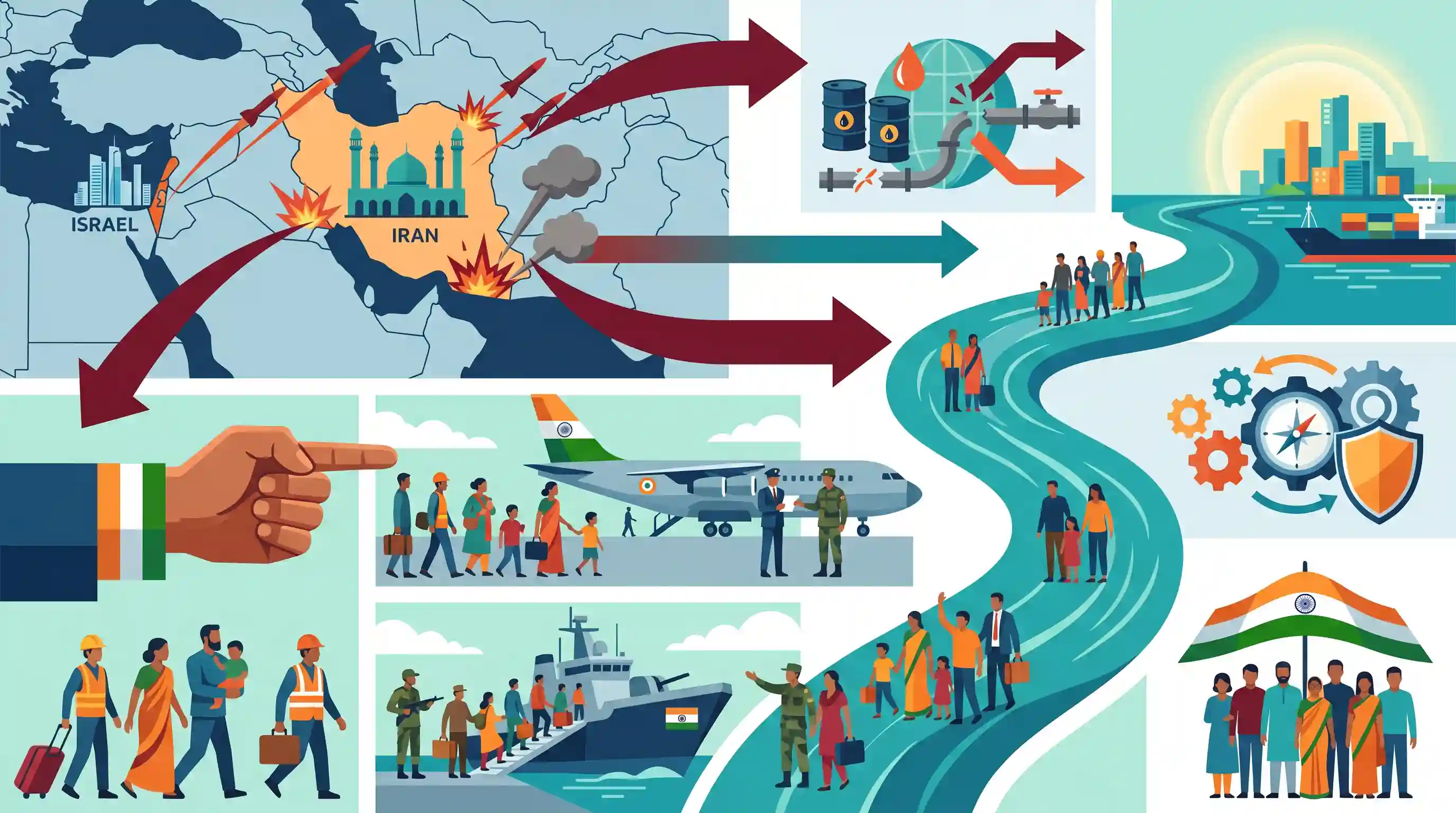
The Government of India has initiated 'Operation Sindhu' to evacuate Indian nationals from Iran due to the escalating military conflict between Iran and Israel. The operation highlights India's proactive approach to crisis management and its commitment to protecting the Indian diaspora in conflict zones. It also underscores the broader geopolitical implications of the Middle East crisis on India's strategic and economic interests in West Asia.
Key Points
- The Indian government has launched 'Operation Sindhu' to safely evacuate Indian nationals stranded in Iran amid the escalating military conflict between Iran and Israel.
- This evacuation effort reflects India's ongoing commitment to safeguarding its large diaspora and citizens working or residing in the volatile West Asian region.
- The escalating Iran-Israel conflict poses significant challenges to regional stability, threatening India's strategic, energy, and economic interests in the Middle East.
Important Terms
Operation Sindhu

An evacuation mission launched by India in June 2025 to rescue Indian nationals, primarily students and workers, from Iran and Israel during the escalating military conflict between the two nations.
UPSC context
GS Paper II: International Relations; tests knowledge of India's crisis management, diaspora protection, and diplomatic response to regional conflicts.
Indian Diaspora
The Indian community living abroad, including Non-Resident Indians (NRIs) and Overseas Citizens of India (OCIs), whose safety and interests are a key pillar of India's foreign policy.
UPSC context
GS Paper II: Indian Diaspora; tests understanding of the strategic and economic importance of the diaspora and government protection mechanisms.
Neighbourhood First Policy
A foreign policy priority emphasizing stable and cooperative relations with immediate neighbors; demonstrated in Operation Sindhu by the evacuation of Nepalese and Sri Lankan nationals alongside Indians.
UPSC context
GS Paper II: International Relations; tests India's role as a regional leader and 'net security provider' in South Asia.
Ministry of External Affairs (MEA)
The nodal ministry responsible for conducting India’s foreign relations and coordinating large-scale evacuation operations through its diplomatic missions and specialized 24/7 control rooms.
UPSC context
GS Paper II: Statutory/Regulatory Bodies; tests knowledge of institutional frameworks for foreign policy and emergency response.
C-17 Globemaster III
A heavy-lift transport aircraft used by the Indian Air Force for strategic airlift missions, including the evacuation of citizens from high-risk conflict zones during Operation Sindhu.
UPSC context
GS Paper III: Security; tests awareness of defense assets and their dual-use role in humanitarian and disaster relief (HADR).
West Asia
A strategically vital region for India's energy security and diaspora; its internal conflicts, such as the Iran-Israel rivalry, directly impact India’s economic and security interests.
UPSC context
GS Paper II: International Relations; tests understanding of regional geopolitics and India's 'Link West' policy.
Prelims Trap
Operation Sindhu was a naval evacuation conducted by the Indian Navy via the Chabahar Port.
Aspirants might assume a maritime rescue via Chabahar. However, Operation Sindhu primarily utilized an overland geostrategic route through the 44-km Armenia border.
Static Concepts Connected
What is the International North-South Transport Corridor (INSTC)?
- Founding Members: A multi-modal transport network initiated in 2000 by Russia, India, and Iran, later joined by 10 other nations.
- Strategic Objective: Designed to reduce transit time and freight costs between Mumbai and St. Petersburg, bypassing the Suez Canal.
- Key Nodes: Chabahar and Bandar Abbas ports in Iran serve as critical maritime-to-land gateways for Indian goods heading north.
Which geographic entities share a border with Iran?
- Land Borders: Armenia, Azerbaijan, Turkmenistan, Afghanistan, Pakistan, Iraq, and Turkey.
- Maritime Boundaries: Bounded by the Caspian Sea to the north, and the Persian Gulf and Gulf of Oman to the south.
- Strategic Chokepoint: Controls the Strait of Hormuz, a critical chokepoint connecting the Persian Gulf to the open ocean.
Cross-Topic Patterns
Armenia as a rising strategic partner
India's reliance on Armenia for evacuation aligns with its recent defense exports (Pinaka systems) to Yerevan, countering the Pakistan-Turkey-Azerbaijan axis in the Caucasus region.
Evolution of Evacuation Diplomacy
Pairs Operation Sindhu with recent missions like Operation Ajay (Israel), Ganga (Ukraine), and Kaveri (Sudan) to highlight India's evolving rapid-response crisis doctrine.

Expect a match-the-following Prelims question on recent evacuation ops (Sindhu, Ajay, Kaveri) or map-based on Iran's Caucasus borders.
Linked PYQs · 3
Linked PYQs · 3
- 2018MainsGS2
“India’s relations with Israel have, of late, acquired a depth and diversity, which cannot be rolled back.” Discuss.
- 2023PrelimsGS1
Consider the following statements: Statement-I: Israel has established diplomatic relations with some Arab States. Statement-II: The 'Arab Peace Initiative' mediated by Saudi Arabia was signed by Israel and Arab League. Which one of the following is correct in respect of the above statements?
- 2018PrelimsGS1
The term "two-state solution" is sometimes mentioned in the news in the context of the affairs of
