Bilateral Trade Agreement Progress and Challenges
Source:The Hindu ↗
Why It Matters
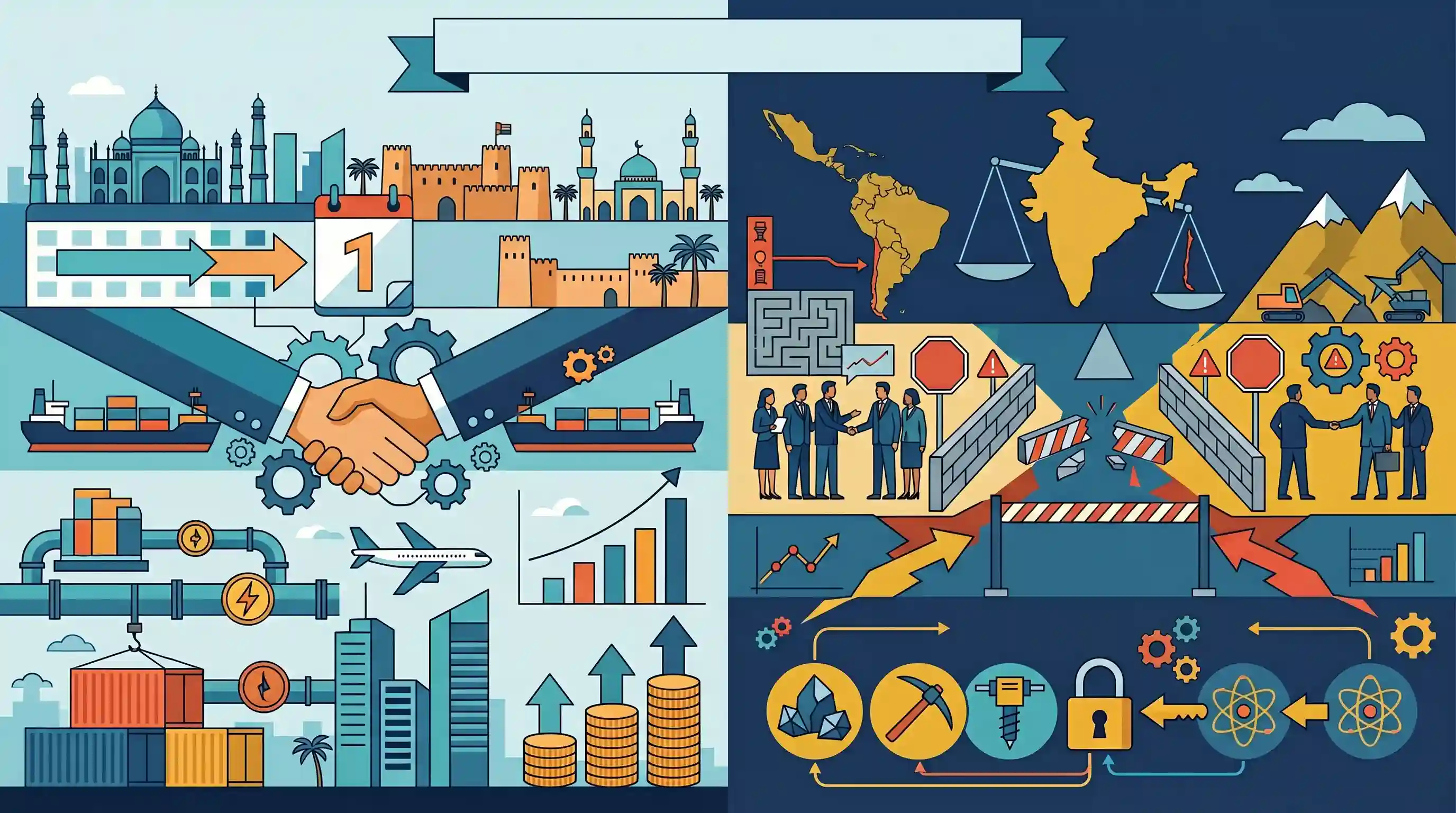
FTAs and CEPAs are central to India's strategy to boost exports, secure vital resources (like critical minerals from Chile), and deepen geopolitical ties (like the strategic partnership with Oman). This highlights the dual challenge of fast-tracking agreements with aligned partners while negotiating complex deals with asymmetrical economies.
Summary
The India-Oman Comprehensive Economic Partnership Agreement (CEPA) is on track to be implemented on June 1, 2026, boosting bilateral trade and economic connectivity. However, negotiations for a Free Trade Agreement (FTA) with Chile are facing hurdles due to the mismatch in economic sizes. India is looking for strategic concessions, particularly a favorable deal on critical minerals, as an innovative solution to finalize the pact with Chile.
Key Points
- The India-Oman Comprehensive Economic Partnership Agreement (CEPA) is anticipated to take effect on June 1, 2026.
- Bilateral discussions with Oman emphasized enhancing connectivity, logistics, and trade flows under the new CEPA framework.
- India's FTA negotiations with Chile are facing obstacles due to disparities in the scale and size of their respective economies.
- India is seeking strategic concessions on critical minerals from Chile to help bridge the gaps and finalize the trade pact.
Important Terms
India-Oman Comprehensive Economic Partnership Agreement (CEPA)

A deep-tier trade pact effective June 2026, granting duty-free access to 98% of Indian exports (textiles, gems) while facilitating energy and petrochemical imports from Oman.
UPSC context
GS Paper II (International Relations) and GS Paper III (Economy); tests knowledge of bilateral groupings and Middle East trade strategy.
India-Chile Free Trade Agreement (FTA)
A proposed expansion of existing trade ties aimed at securing strategic access to Chile's lithium and copper reserves, currently hindered by economic size disparities.
UPSC context
GS Paper II (Bilateral Agreements) and GS Paper III (Energy Security); examines resource diplomacy and Latin American relations.
Comprehensive Economic Partnership Agreement (CEPA)
An integrated trade agreement broader than a standard FTA, covering goods, services, investment, intellectual property, and regulatory cooperation to ensure deep economic integration.
UPSC context
GS Paper III (Economy); essential for distinguishing between different levels of economic integration in Prelims/Mains.
Critical Minerals
Non-fuel minerals (e.g., lithium, cobalt, copper) essential for high-tech manufacturing, defense, and green energy, characterized by high supply risk and geographic concentration.
UPSC context
GS Paper III (Environment/S&T) and GS Paper I (Resources); vital for topics on energy transition and Atmanirbhar Bharat.
Preferential Trade Agreement (PTA)
A limited trade pact where partners reduce tariffs on an agreed number of tariff lines (products), often serving as a precursor to more comprehensive FTAs.
UPSC context
GS Paper III (Economy); fundamental concept for understanding the hierarchy of international trade instruments.
Prelims Trap
Oman is the first Gulf Cooperation Council (GCC) nation to sign a CEPA with India.
India signed its first CEPA with a GCC country with the UAE in 2022. Oman is the second, not the first.
Static Concepts Connected
What is the difference between a PTA, FTA, and CEPA?
- PTA (Preferential): Reduces tariffs on a limited 'positive list' of specific goods (e.g., the existing India-Chile pact).
- FTA (Free Trade): Eliminates tariffs on a comprehensive 'negative list' of goods.
- CEPA (Comprehensive): Deep integration extending beyond goods to include services, investments, IPR, mobility, and regulatory cooperation.
Which countries form the South American 'Lithium Triangle'?
- The Triangle: Comprises Argentina, Bolivia, and Chile, clustered around the Andean borders.
- Significance: Holds over half of the world's identified lithium reserves, primarily in high-altitude salt flats (salars).
- Strategic Link: Directly ties to EV battery manufacturing and India's strategic overseas acquisitions via KABIL.
Cross-Topic Patterns
Mineral security driving FTA concessions
India is shifting from traditional goods/services FTAs to leveraging trade pacts for critical mineral access, explicitly linking trade diplomacy with clean energy transition goals.
Oman's Hormuz proximity + India's energy
Oman's location near the Strait of Hormuz makes the CEPA not just an economic pact, but a maritime and energy security buffer for India in the volatile Middle East.

Lithium Triangle geography paired with India's KABIL acquisitions and FTA mineral concessions is highly probable for a 2026 crossover MCQ.
Linked PYQs · 3
Linked PYQs · 3
- 2025PrelimsGS1
Consider the following pairs : Country Resource-rich in I. Botswana : Diamond II. Chile : Lithium III. Indonesia : Nickel In how many of the above rows is the given information correctly matched?
- 2025MainsGS3
What are the challenges before the Indian economy when the world is moving away from free trade and multilateralism to protectionism and bilateralism? How can these challenges be met?
- 2025MainsGS2
"Energy security constitutes the dominant kingpin of India's foreign policy, and is linked with India's overarching influence in Middle Eastern countries.” How would you integrate energy security with India's foreign policy trajectories in the coming years?
