India Oman Comprehensive Economic Partnership Agreement Progress
Source:The Hindu ↗
Why It Matters
This development is significant for UPSC aspirants as it highlights India's strategic economic outreach to West Asia. It touches upon energy security (petroleum imports), agricultural security (urea imports), and the expanding footprint of Indian Free Trade Agreements (FTAs) to stabilize supply chains and boost exports.
Summary
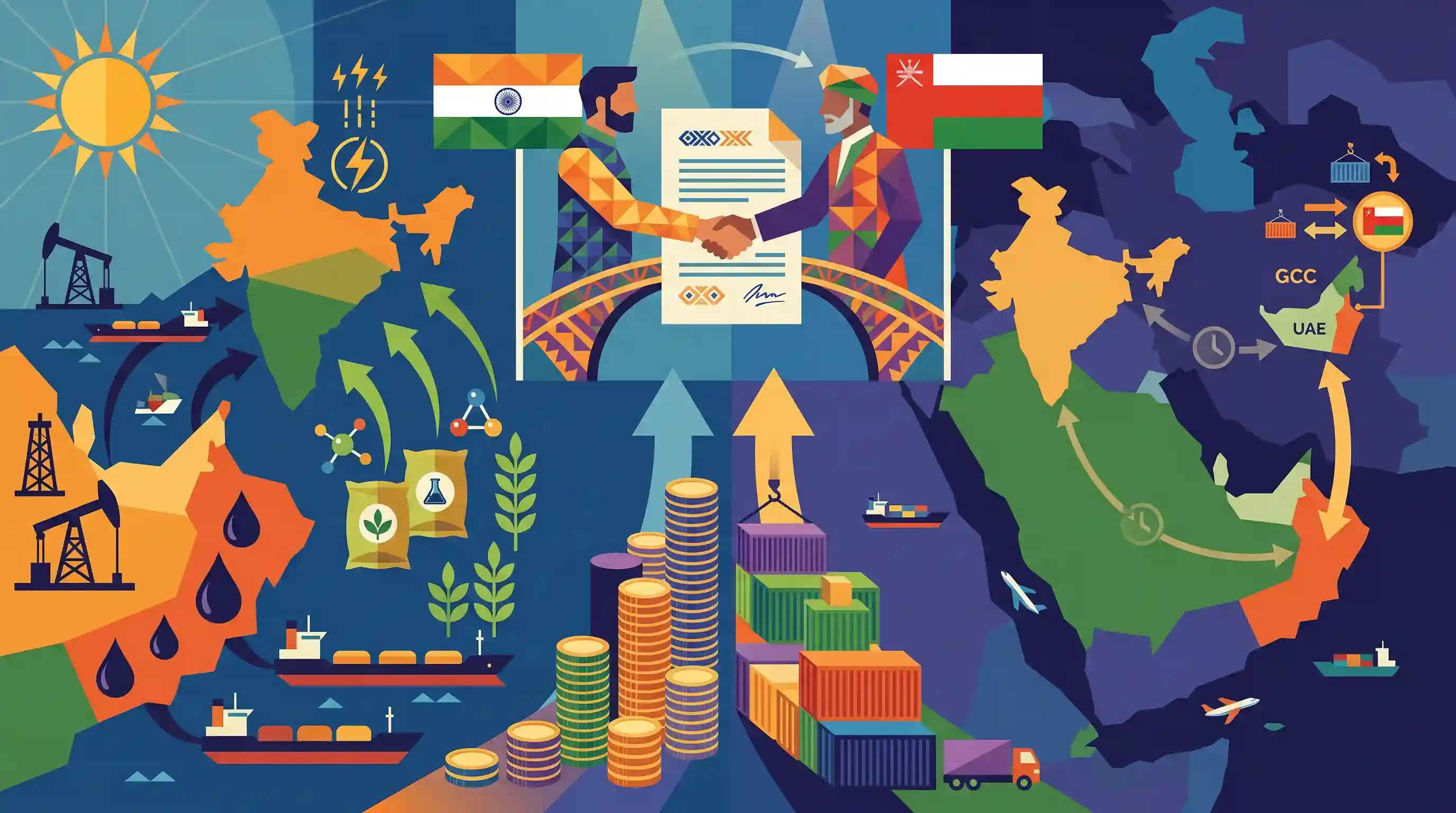
India and Oman are close to formally announcing a Comprehensive Economic Partnership Agreement (CEPA), aimed at deepening economic and trade ties. Bilateral trade between the two countries currently exceeds $10 billion. The agreement is strategically important for India, as Oman is a crucial supplier of petroleum products and urea, and ranks as India's third-largest export destination within the Gulf Cooperation Council (GCC). This pact underscores India's broader strategy to secure energy resources and expand its economic footprint in West Asia, following its 2022 CEPA with the UAE.
Key Points
- India and Oman are finalizing a Comprehensive Economic Partnership Agreement (CEPA) following negotiations that began in November 2023.
- The two nations have agreed to amend their existing tax treaty to facilitate greater economic cooperation.
- Oman is currently India's third-largest export destination among Gulf Cooperation Council (GCC) countries.
- Over 70% of India's imports from Oman consist of critical resources like petroleum products and urea.
- This CEPA represents India's continuing push to strengthen economic ties with the Gulf, building on the earlier CEPA signed with the UAE in May 2022.
Important Terms
Comprehensive Economic Partnership Agreement (CEPA)

A deep, bilateral trade pact covering not just goods (tariffs) but also services, investment, intellectual property, and movement of professionals. It offers more comprehensive integration than a standard FTA.
UPSC context
GS Paper 2 (International Relations) and GS Paper 3 (Economy). Tests understanding of India's trade diplomacy and bilateral economic frameworks.
Gulf Cooperation Council (GCC)
A regional political and economic union of six Arab states: Saudi Arabia, UAE, Qatar, Kuwait, Oman, and Bahrain. It is India's largest trading partner bloc.
UPSC context
GS Paper 2 (International Relations). Crucial for questions on India's 'Look West' policy and regional groupings in West Asia.
Energy Security
A nation's ability to maintain a secure, reliable, and affordable supply of energy resources (oil, gas) to fuel its economy, often involving strategic reserves and diversified suppliers.
UPSC context
GS Paper 3 (Energy/Security). Vital for analyzing India's import dependence (85% for oil) and strategic autonomy in foreign policy.
West Asia
A geopolitically vital region for India (the 'extended neighborhood'), serving as a primary source of hydrocarbons, a destination for the 9-million-strong Indian diaspora, and a major trade partner.
UPSC context
GS Paper 2 (International Relations). Central to India's maritime security, counter-terrorism, and diaspora welfare policies.
Rules of Origin (RoO)
Specific criteria used to determine the national source of a product. In agreements like CEPA, these prevent third-party countries from 'routing' goods through a partner to avoid tariffs.
UPSC context
GS Paper 3 (Economy/Trade Policy). Critical for understanding the technical safeguards in Free Trade Agreements and preventing 'trade diversion'.
Remittances
Funds transferred by the Indian diaspora abroad to their home country. The GCC region accounts for a massive share, supporting India's foreign exchange reserves and current account balance.
UPSC context
GS Paper 3 (Economy) and GS Paper 2 (Diaspora). Tests the socio-economic link between migration and India's macro-economic stability.
Prelims Trap
Oman is the first GCC country with which India has signed a CEPA.
The UAE was the first GCC nation to sign a CEPA with India in 2022. Oman is the second, reflecting a continued push into West Asia.
Static Concepts Connected
What distinguishes a CEPA from a traditional Free Trade Agreement (FTA)?
- Broader Scope: CEPAs cover a comprehensive range of areas including trade in services, cross-border investments, and IPR, whereas standard FTAs mostly focus on goods.
- Regulatory Aspects: CEPAs usually incorporate mutual recognition agreements, customs cooperation, and deeper regulatory harmonisation.
- Tariff Elimination: CEPAs aim for the comprehensive elimination or significant reduction of customs duties across almost all product tariff lines.
What is the Gulf Cooperation Council (GCC) and who are its members?
- Nature: It is a political and economic alliance of six Arab states bordering the Gulf.
- Members: Bahrain, Kuwait, Oman, Qatar, Saudi Arabia, and the United Arab Emirates. Crucially, Iran and Iraq are not members.
- Significance for India: The GCC is one of India's largest trading bloc partners and a primary source of hydrocarbons and inward remittances.
Cross-Topic Patterns
Energy security & fertilizer imports
Oman supplies a large share of India's urea imports. This links bilateral trade pacts directly to India's domestic agricultural subsidies, agricultural input costs, and the broader fertilizer sector.
Strategic geography: Port of Duqm
Economic integration pairs with maritime strategy. India's access to Oman's Port of Duqm allows the Indian Navy to monitor the Strait of Hormuz, countering China's regional footprint.

Expect a multi-statement question contrasting CEPA, CECA, and FTAs, paired with a geographical mapping of GCC nations and West Asian ports.
Linked PYQs · 3
Linked PYQs · 3
- 2017MainsGS2
The question of India's Energy Security constitutes the most important part of India's economic progress. Analyze India's energy policy cooperation with West Asian countries.
- 2016PrelimsGS1
The term 'Regional Comprehensive Economic Partnership' often appears in the news in the context of the affairs of a group of countries known as
- 2018PrelimsGS1
Consider the following countries: 1. Australia 2. Canada 3. China 4. India 5. Japan 6. USA Which of the above are among the 'free-trade partners' of ASEAN?
