India Oil Demand Growth and Crude Import Diversification
Source:Indian Express ↗
Why It Matters
As the locus of global oil demand growth shifts to India, the country's energy import strategy becomes central to its macroeconomic stability and geopolitical maneuvering. This makes crude diversification, energy diplomacy, and strategic reserves highly critical themes for both Prelims and Mains (GS-2 International Relations & GS-3 Economy).
Summary
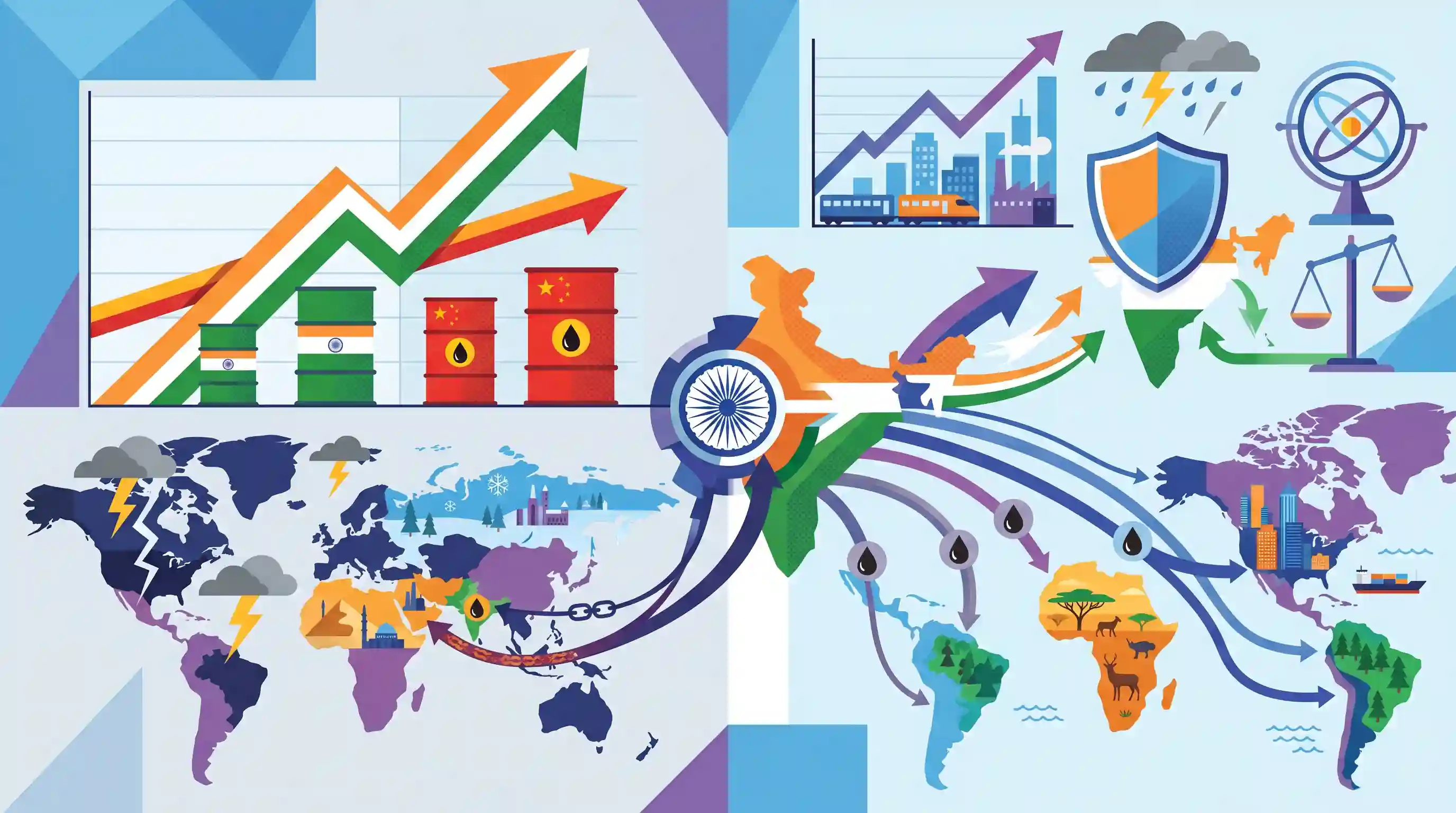
India's oil demand growth is projected to surpass China's, positioning the country as the primary driver of global oil consumption. In response to this surging domestic demand and volatile global geopolitics, India is actively accelerating its efforts to diversify its crude oil import sources. By reducing over-reliance on traditional suppliers like the Middle East and Russia, and expanding its energy ties with diverse geographies, India aims to fortify its energy security and buffer its economy against supply chain shocks.
Key Points
- India is overtaking China as the world's leading driver of crude oil demand growth due to rapid economic expansion, urbanization, and increasing mobility.
- With an import dependence of over 85% for its crude oil needs, India remains highly vulnerable to global price volatility and geopolitical supply disruptions.
- To mitigate these risks, India is accelerating its crude diversification efforts, seeking to expand its import basket beyond traditional Middle Eastern suppliers and recent heavy reliance on discounted Russian oil.
- The strategy involves tapping into newer markets in Africa, North America, and South America to ensure stable, cost-effective, and secure energy supply chains.
- This shift highlights the critical integration of energy security with India's broader foreign policy, necessitating robust energy diplomacy and strategic long-term partnerships.
Important Terms
Strategic Petroleum Reserves (SPR)

Massive stockpiles of crude oil stored in underground caverns to safeguard against supply disruptions caused by geopolitical tensions or natural disasters.
UPSC context
GS Paper 3 (Energy Security); tests understanding of India’s buffer capacity and energy sovereignty strategies.
International Energy Agency (IEA)
An autonomous intergovernmental organization established in 1974 to ensure reliable, affordable, and clean energy for its members; India is an 'Association' country.
UPSC context
GS Paper 2 (International Institutions); focuses on global energy governance and India's growing engagement with Western-led energy bodies.
Organization of the Petroleum Exporting Countries (OPEC)
A permanent intergovernmental organization of 12 oil-exporting nations that coordinates petroleum policies to stabilize global oil markets and ensure fair producer returns.
UPSC context
GS Paper 2 (International Relations); critical for analyzing the impact of global cartels on India’s import bill.
Crude Diversification
The strategy of expanding crude oil import sources across different geographies to reduce over-reliance on traditional suppliers and mitigate geopolitical risks.
UPSC context
GS Paper 3 (Economic Development/Infrastructure); tests knowledge of India’s shifting trade patterns and energy risk management.
Energy Diplomacy
The use of energy resources and needs to influence international relations, foster strategic partnerships, and secure long-term national energy interests through diplomatic channels.
UPSC context
GS Paper 2 (Effect of policies of developed/developing countries); explores the intersection of foreign policy and energy security.
Prelims Trap
India is now the world's largest consumer of crude oil, having surpassed China.
India's *growth* in oil demand is surpassing China's, making it the primary driver of new demand. In absolute total consumption, the US and China still lead India.
Static Concepts Connected
Where are India's Strategic Petroleum Reserves (SPR) located?
- Phase I Sites: Visakhapatnam (Andhra Pradesh), Mangaluru (Karnataka), and Padur (Karnataka) with a total capacity of 5.33 MMT.
- Phase II Expansion: Approved for Chandikhol (Odisha) and further expansion at Padur under Public-Private Partnership models.
- Management: Maintained by Indian Strategic Petroleum Reserves Limited (ISPRL), under the Ministry of Petroleum and Natural Gas.
How do crude oil price shocks impact India's macroeconomy?
- Twin Deficits: Increases the import bill (widening Current Account Deficit) and potentially lowers excise revenues if fuel taxes are cut (widening Fiscal Deficit).
- Inflation: Directly increases fuel components in WPI/CPI and indirectly causes cost-push inflation through higher transportation and logistics costs.
- Currency Depreciation: Higher dollar demand to pay for expanded oil import bills exerts downward pressure, depreciating the Indian Rupee.
Cross-Topic Patterns
Energy security + Maritime chokepoints
Diversifying crude sources shifts India's reliance away from the Strait of Hormuz towards Atlantic routes, altering the Indian Navy's strategic maritime deployment priorities in the wider Indian Ocean.
Strategic Autonomy + Western Sanctions
Navigating imports from sanctioned nations (Russia, Venezuela) regularly tests India's diplomatic leverage to secure domestic energy needs without triggering Western secondary sanctions like CAATSA.

Expect a 2026 prelims question mixing India's SPR locations, IEA associate membership criteria, and crude import source rankings.
Linked PYQs · 3
Linked PYQs · 3
- 2025MainsGS2
"Energy security constitutes the dominant kingpin of India's foreign policy, and is linked with India's overarching influence in Middle Eastern countries.” How would you integrate energy security with India's foreign policy trajectories in the coming years?
- 2017MainsGS2
The question of India's Energy Security constitutes the most important part of India's economic progress. Analyze India's energy policy cooperation with West Asian countries.
- 2025PrelimsGS1
Consider the following activities : I. Production of crude oil II. Refining, storage and distribution of petroleum III. Marketing and sale of petroleum products IV. Production of natural gas How many of the above activities are regulated by the Petroleum and Natural Gas Regulatory Board in our country?
