Sovereign Energy Sourcing and Strategic Autonomy in Crude Imports
Source:Indian Express ↗
Why It Matters
The issue serves as a contemporary case study of India's strategic autonomy and the integration of energy security into its foreign policy, crucial for GS2 International Relations and GS3 Economy.
Summary
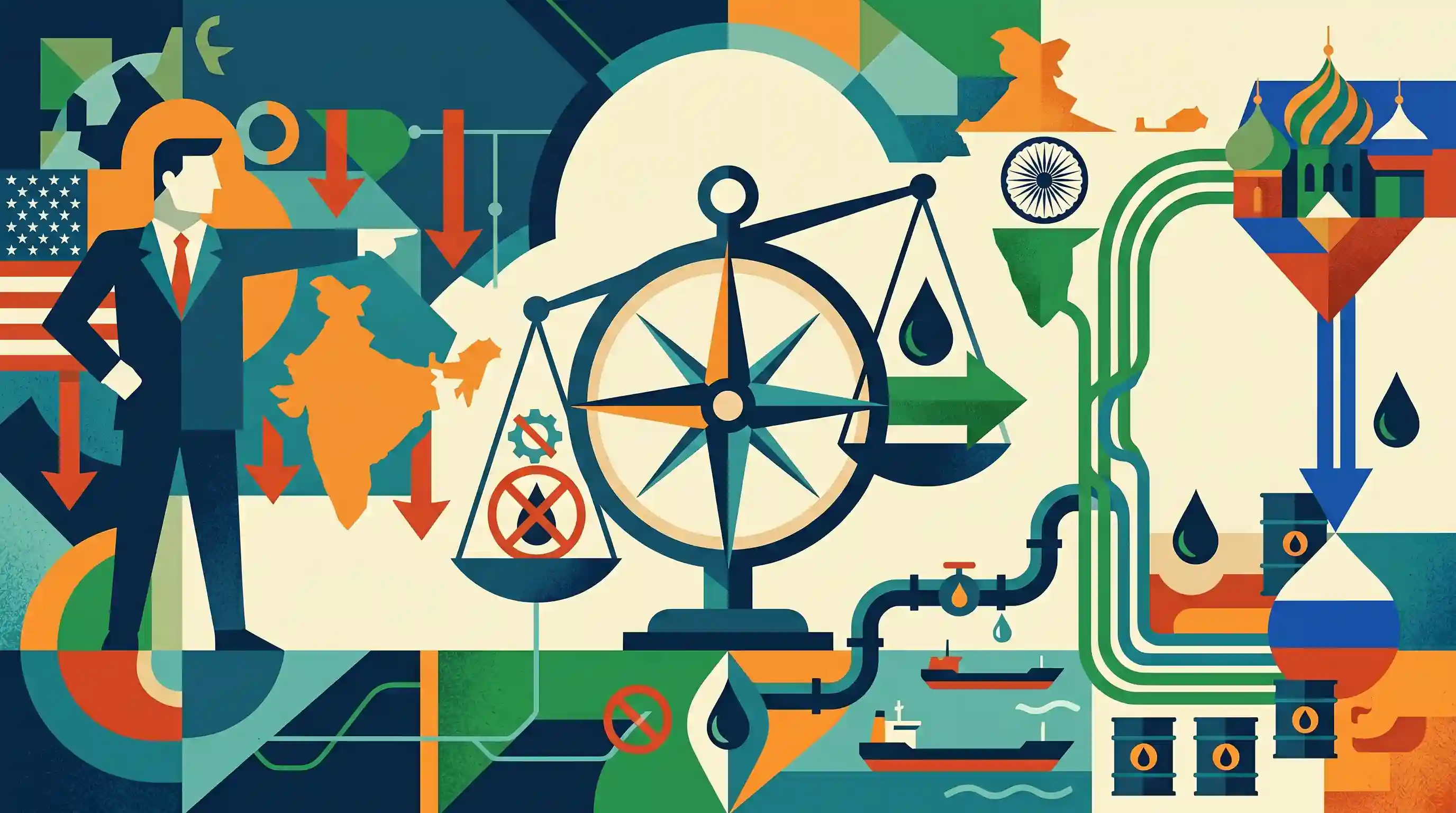
Following a claim by US President Donald Trump that India would stop purchasing Russian oil, the Kremlin stated that India, as a sovereign nation, is free to buy oil from any country. This highlights India's ongoing strategic autonomy and the crucial role of energy security in its foreign policy amid global geopolitical pressures.
Key Points
- US President Donald Trump claimed that Prime Minister Narendra Modi agreed to stop buying Russian oil following a phone conversation between them.
- Russia's Kremlin rebuffed the claim, emphasizing India's sovereignty and its right to source crude oil based on its national interests.
- India's crude oil imports from Russia increased significantly post the Ukraine war due to discounted prices, ensuring energy security despite Western sanctions.
- The diplomatic exchange highlights India's strategic autonomy, balancing its strategic partnership with the US and its historical, economic ties with Russia.
Important Terms
Strategic Autonomy

A foreign policy doctrine where a nation makes independent decisions based on its own interests and merits, remaining free from external coercion or the constraints of formal military alliances with superpowers.
UPSC context
GS Paper-II (Foreign Policy). Tests India's ability to navigate multipolar rivalries while prioritizing national development and security needs.
Energy Security
The reliable and affordable availability of energy resources necessary for economic stability. It involves diversifying supply sources and mitigating risks from global price volatility or supply chain disruptions.
UPSC context
GS Paper-II & III (Resources/Economy). Tests strategies for managing import dependency and geopolitical risks to sustain economic growth.
Multi-alignment
A pragmatic diplomatic strategy where a country engages with multiple, often competing, global powers and blocs simultaneously to maximize its strategic space, economic benefits, and national security options.
UPSC context
GS Paper-II (International Relations). Tests the evolution of Indian diplomacy from non-alignment to issue-based partnerships in a multipolar world.
Kremlin
The historic fortified complex in Moscow that serves as the official residence of the Russian President and shorthand for the Russian government's executive authority and political leadership.
UPSC context
GS Paper-II (International Relations). Tests understanding of major power centers and their influence on India’s bilateral and strategic relations.
Sovereignty
The supreme and independent authority of a state to govern its territory and conduct foreign policy without external interference. It is the legal basis for statehood in international law.
UPSC context
GS Paper-II (Polity/Constitution). Tests the core principle of India as a sovereign republic capable of independent diplomatic and trade decision-making.
Prelims Trap
India enjoys a formal, permanent waiver under CAATSA for purchasing Russian crude oil and defense systems.
The US has not granted India a permanent, blanket CAATSA waiver. It merely exercises executive discretion to not apply secondary sanctions currently, maintaining geopolitical leverage over New Delhi.
Static Concepts Connected
What is the mechanism behind US secondary sanctions like CAATSA?
- Primary Sanctions: These restrict the sanctioning country's own citizens, banks, and companies from doing business with the targeted nation.
- Secondary Sanctions: These target third-party nations, threatening to cut off their access to the US financial system if they engage in significant transactions with the sanctioned adversary.
- Indian Stance: India legally recognizes only UN-mandated multilateral sanctions, officially rejecting the extraterritorial application of unilateral secondary sanctions by any individual nation.
Why does the Rupee-Rouble alternative payment mechanism face implementation hurdles?
- Trade Asymmetry: India's massive trade deficit with Russia means Moscow accumulates billions in Rupees from oil sales without sufficient Indian goods to buy in return.
- Currency Convertibility: Because the Indian Rupee (INR) is not fully convertible on the capital account, Russia struggles to repatriate or utilize these surplus funds globally.
- Vostro Accounts: To facilitate this, funds are parked in Special Rupee Vostro Accounts (SRVAs) in Indian banks, which strictly require RBI approval and monitoring.
Cross-Topic Patterns
Energy Security + Current Account Deficit
Discounted Russian oil heavily buffered India's import bill and Current Account Deficit (CAD) during global inflationary spikes, directly linking foreign policy choices to macroeconomic stability.
QUAD Dynamics + Minilateralism
Despite deep US-India alignment in the QUAD, India's Russia oil trade proves that modern minilateral groupings do not enforce the total policy conformity seen in formal Cold War alliances.

Mains 2026 will likely test the limits of 'Strategic Autonomy' by mapping India's energy security needs against US secondary sanctions.
Linked PYQs · 2
Linked PYQs · 2
- 2025MainsGS2
"Energy security constitutes the dominant kingpin of India's foreign policy, and is linked with India's overarching influence in Middle Eastern countries.” How would you integrate energy security with India's foreign policy trajectories in the coming years?
- 2012MainsGS2
How have the US sanctions against Iran affected India's bilateral relations with Iran?
