India withdraws candidacy to host COP 33 climate summit in 2028
Source:The Hindu ↗
Why It Matters
India's shifting stance on hosting the international climate summit demonstrates a balancing of diplomatic optics with domestic governance realities, while its updated NDCs present critical data points for analyzing India's energy transition trajectory in GS-3 answers.
Summary
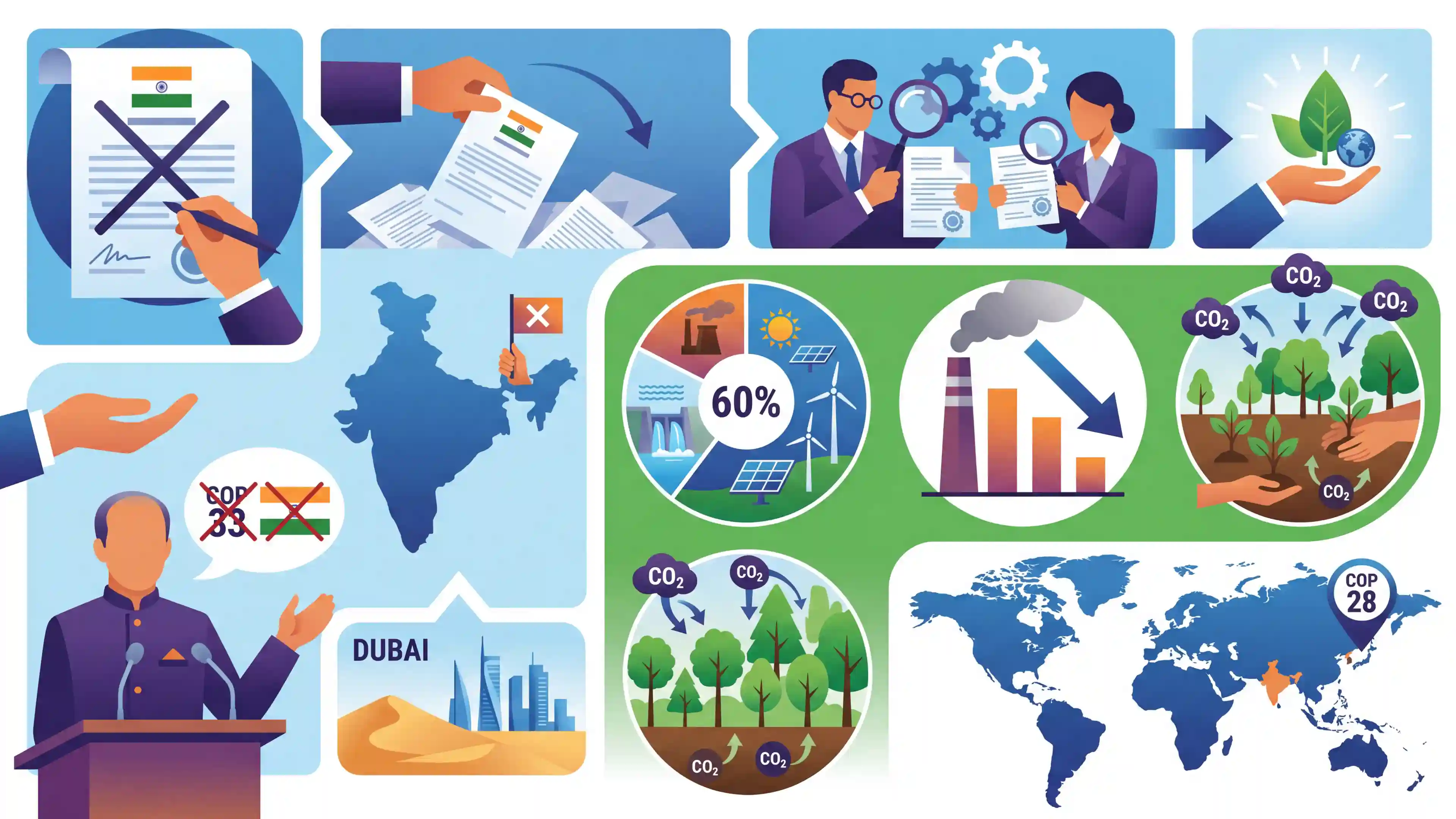
India has officially withdrawn its candidacy to host the 2028 UN Climate Change Conference (COP 33), a proposal originally announced by Prime Minister Narendra Modi at COP 28 in Dubai. Following a review of its commitments by the MoEFCC, India communicated its decision to the UNFCCC. Despite this administrative withdrawal, the government reaffirmed its strong dedication to the Paris Agreement, highlighting recent updates to its Nationally Determined Contributions (NDCs). These updated targets include achieving 60% of installed electricity capacity from non-fossil sources by 2035, reducing emission intensity by 47%, and creating an additional carbon sink of 3.5-4 billion tonnes of CO2 equivalent. South Korea is currently the only country seeking to host the 2028 summit.
Key Points
- The Indian government confirmed it has withdrawn its offer to host the 33rd edition of the UN Climate Change Conference (COP 33) in 2028.
- The MEA stated the withdrawal followed a 'review of commitments,' though India remains fully dedicated to its climate mitigation responsibilities.
- India recently announced updated Nationally Determined Contributions (NDCs), aiming for 60% of installed electricity capacity from non-fossil sources by 2035 and reducing emission intensity by 47%.
- South Korea is currently the sole nation expressing interest in hosting the rotating Asia Pacific regional slot for COP 33.
Important Terms
Paris Agreement

A landmark 2015 global treaty aimed at limiting global warming to well below 2°C, preferably 1.5°C, compared to pre-industrial levels through voluntary national commitments.
UPSC context
GS Paper III (Environment); core framework for all climate-related questions and international environmental diplomacy.
Nationally Determined Contributions (NDC)
Self-defined climate action plans submitted every five years by signatories of the Paris Agreement, outlining their specific targets for emission reductions and adaptation.
UPSC context
GS Paper III; tests India's specific policy commitments and its role as a responsible global actor.
UNFCCC
The international environmental treaty adopted in 1992 at the Rio Earth Summit to stabilize greenhouse gas concentrations and prevent dangerous human interference with the climate.
UPSC context
GS Paper II (International Relations) & GS Paper III; the primary institutional framework for global climate governance.
Conference of the Parties (COP)
The supreme decision-making body of the UNFCCC, meeting annually to review treaty implementation; hosting duties rotate among five UN regional groups.
UPSC context
GS Paper II & III; tests knowledge of global summits and India's diplomatic positioning.
Emission Intensity
A measure of the greenhouse gas emissions produced per unit of a country's Gross Domestic Product (GDP), indicating the carbon efficiency of an economy.
UPSC context
GS Paper III (Economics and Environment); key metric for tracking India's decoupling of growth from emissions.
Carbon Sink
A natural or artificial reservoir (like forests or soil) that absorbs and stores more carbon dioxide from the atmosphere than it releases.
UPSC context
GS Paper III (Environment); relates to India's afforestation goals and sequestration technology.
Prelims Trap
"India's updated NDCs mandate a 60% reduction in emission intensity by 2035."
The 60% target applies to non-fossil electricity capacity, while the emission intensity reduction target is 47%. UPSC frequently swaps these percentages to confuse candidates.
Static Concepts Connected
What is the Ratchet Mechanism under the Paris Agreement?
- Five-year cycle: Countries must submit updated, progressively more ambitious Nationally Determined Contributions (NDCs) every five years.
- No backsliding: Each successive NDC must represent a progression beyond the current one, preventing any scaling down of climate commitments.
- Global Stocktake link: It is informed by the Global Stocktake, which assesses collective worldwide progress toward long-term climate goals.
How is the host country for UNFCCC COPs selected?
- Regional rotation: The presidency rotates annually among five UN regional groups: Africa, Asia-Pacific, Eastern Europe, LAC (Latin America and the Caribbean), and WEOG.
- Consensus requirement: The regional group must reach a consensus on a candidate, which is then formally accepted by the broader COP.
- Bonn fallback: If no nation offers to host, the conference defaults to the UNFCCC headquarters in Bonn, Germany.
Cross-Topic Patterns
NDCs + Green Financing
Achieving 60% non-fossil capacity by 2035 directly connects to India's Sovereign Green Bonds and RBI's green deposit framework to finance massive renewable infrastructure.
Carbon Sinks + CAMPA Funds
Creating a 3.5-4 billion tonne carbon sink bridges India's international climate commitments with domestic afforestation policies, particularly the statutory utilization of CAMPA funds.

Expect a comparative Prelims question testing India's 2030 NDC targets against the newly updated 2035 targets (60% non-fossil, 47% intensity).
Linked PYQs · 5
Linked PYQs · 5
- 2022PrelimsGS1
"Climate Action Tracker" which monitors the emission reduction pledges of different countries is a :
- 2025PrelimsGS1
Consider the following statements : Statement I: Article 6 of the Paris Agreement on climate change is frequently discussed in global discussions on sustainable development and climate change. Statement II: Article 6 of the Paris Agreement on climate change sets out the principles of carbon markets. Statement III : Article 6 of the Paris Agreement on climate change intends to promote inter-country non-market strategies to reach their climate targets. Which one of the following is correct in respect of the above statements?
- 2016PrelimsGS1
The term 'Intended Nationally Determined Contributions' is sometimes seen in the news in the context of
- 2025MainsGS3
Write a review on India's climate commitments under the Paris Agreement (2015) and mention how these have been further strengthened in COP26 (2021). In this direction, how has the first Nationally Determined Contribution intended by India been updated in 2022?
- 2022MainsGS3
Discuss global warming and mention its effects on the global climate. Explain the control measures to bring down the level of greenhouse gases which cause global warming, in the light of the Kyoto Protocol, 1997.
