India New Zealand Free Trade Agreement and Strategic Investment Terms
Source:The Hindu ↗
Why It Matters
This FTA exemplifies India's evolving approach to international trade negotiations—balancing the need for global market access and FDI integration with the strict protection of vulnerable domestic sectors like dairy and agriculture. The $20 billion investment mandate reflects a growing trend in India's economic diplomacy of coupling trade concessions with binding investment commitments. This is directly relevant for GS3 (Trade Policy, Economy, Agriculture) and GS2 (Bilateral Relations, Indian Diaspora).
Summary
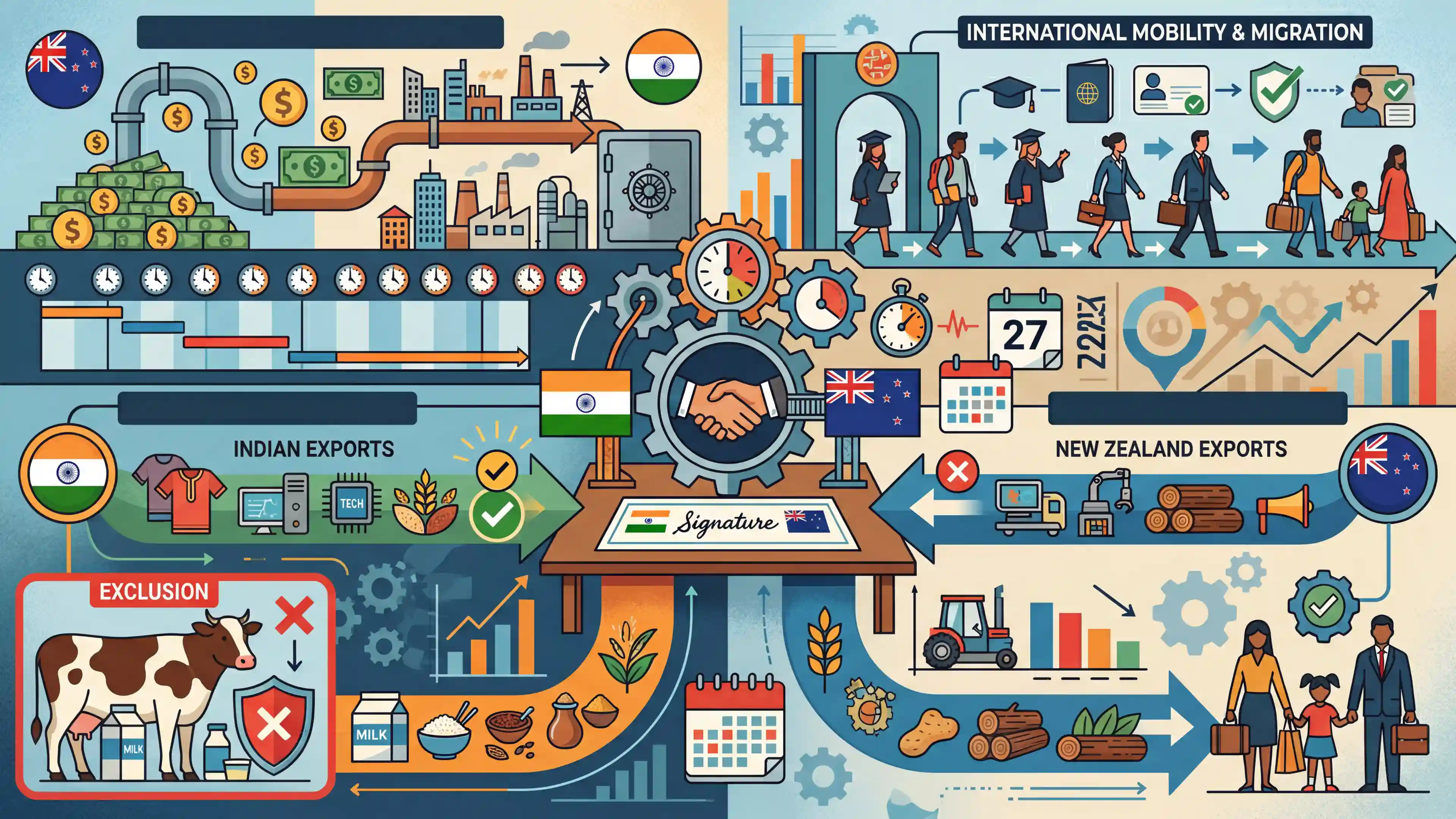
India and New Zealand are scheduled to sign a comprehensive Free Trade Agreement (FTA) on April 27, 2026. Negotiated in a record time of nine months, the agreement eliminates duties on all Indian exports to New Zealand while removing or reducing tariffs on 95% of New Zealand's current exports to India. Key elements of the pact include India's deliberate exclusion of sensitive agricultural sectors like dairy, a $20 billion foreign direct investment commitment from New Zealand over 15 years, and improved visa and mobility rules for Indian students and professionals.
Key Points
- The bilateral pact guarantees 100% duty-free access for Indian exports to New Zealand, boosting sectors like textiles, leather, ceramics, and automobiles.
- India successfully protected its sensitive domestic agricultural sectors by excluding dairy products, sheep meat, and vegetable products from the agreement.
- New Zealand has committed to a $20 billion foreign direct investment (FDI) in India over 15 years, a strategy mirroring India's recent deal with the EFTA.
- The agreement introduces enhanced mobility options, including extended working hours for Indian students and specific visa quotas for skilled professionals and working holidays.
- The FTA includes Most Favoured Nation (MFN) clauses, ensuring New Zealand automatically receives any better concessions India might offer future trade partners in areas like services and dairy.
Important Terms
India-New Zealand Free Trade Agreement (IN-NZ FTA)

A comprehensive trade pact signed in 2026 to eliminate tariffs on all Indian exports and 95% of New Zealand's, while protecting India's dairy and agricultural sectors.
UPSC context
GS Paper II (Bilateral Relations) and GS Paper III (Economy). Tests knowledge of trade diplomacy and sector-specific protections.
Most Favoured Nation (MFN)
A WTO principle requiring a country to provide equal trade advantages to all member nations; FTAs like the India-NZ pact are a recognized exception.
UPSC context
GS Paper III (Economy). Fundamental for understanding international trade laws and non-discriminatory trade practices under WTO.
European Free Trade Association (EFTA)
A trade bloc of Iceland, Liechtenstein, Norway, and Switzerland that signed a landmark $100 billion investment-linked trade deal (TEPA) with India in 2024.
UPSC context
GS Paper II (International Groups) and GS III (Economy). Important for comparative analysis of India’s modern investment-heavy trade agreements.
Foreign Direct Investment (FDI)
Investment made by a firm or individual in one country into business interests located in another country, often through establishing business operations or acquiring assets.
UPSC context
GS Paper III (Economy). Tests understanding of capital inflows and their role in national economic growth and trade pacts.
Sensitive Sectors
Industries (like dairy and poultry in India) shielded from tariff cuts in trade deals to protect domestic livelihoods, food security, and small-scale producers.
UPSC context
GS Paper III (Agriculture and Trade). Relevant for questions on trade liberalization vs. domestic protectionism and rural economy safeguards.
Prelims Trap
The India-New Zealand FTA guarantees mutual 100% duty-free access, including for New Zealand's major dairy exports.
India actively excluded dairy and other sensitive agricultural goods to protect domestic farmers. The 100% duty-free access applies only to Indian exports to NZ, not vice versa.
Static Concepts Connected
What are the four modes of services trade under WTO GATS?
- Mode 1 (Cross-border): Services flow from one country to another without people moving (e.g., telemedicine, BPO services).
- Mode 2 (Consumption): A consumer travels to the supplying country to consume the service (e.g., international tourism, students studying abroad).
- Mode 3 (Commercial presence): A service provider establishes a physical branch or subsidiary in another country (e.g., a foreign bank).
- Mode 4 (Natural persons): Individuals travel temporarily to another country to provide services (e.g., IT professionals, consultants working onsite).
How does the Most Favoured Nation (MFN) principle operate?
- Core Rule: The core WTO principle requiring a country to offer the same trade concessions to all WTO members equally, without discrimination.
- FTA Exception: Regional and Free Trade Agreements (RTAs/FTAs) are permitted as legitimate exceptions to the MFN principle under GATT Article XXIV.
- Treaty Clause: In bilateral treaties, an MFN clause ensures a partner automatically receives any better terms subsequently offered to a third party.
Cross-Topic Patterns
Investment-linked Trade Pacts
The $20B FDI commitment mirrors the India-EFTA TEPA, marking a structural shift in India's contemporary FTA strategy: making tariff concessions conditional on binding, long-term foreign investment targets.
Dairy Protectionism vs. Free Trade
India's red-line on dairy (seen in this NZ pact and the 2019 RCEP withdrawal) highlights the socio-economic weight of its unorganized cooperative milk sector against highly subsidized global agro-exporters.

Expect a comparative mains question on India's new-gen FTAs (EFTA, UAE, Aus, NZ) focusing on binding FDI targets and Mode 4 mobility.
Linked PYQs · 4
Linked PYQs · 4
- 2018PrelimsGS1
Consider the following countries: 1. Australia 2. Canada 3. China 4. India 5. Japan 6. USA Which of the above are among the 'free-trade partners' of ASEAN?
- 2016MainsGS3
Justify the need for FDI for the development of the Indian economy. Why there is gap between MOUs signed and actual FDIs? Suggest remedial steps to be taken for increasing actual FDIs in India.
- 2016MainsGS2
The broader aims and objectives of WTO are to manage and promote international trade in the era of globalization. But the Doha round of negotiations seem doomed due to differences between the developed and the developing countries." Discuss in the Indian perspective.
- 2023MainsGS3
What are the direct and indirect subsidies provided to farm sector in India? Discuss the issues raised by the World Trade Organization (WTO) in relation to agricultural subsidies.
