India and New Zealand Sign Free Trade Agreement
Source:The Hindu ↗
Why It Matters
FTAs are critical to India's economic diplomacy and efforts to integrate into global value chains. This pact is significant for UPSC aspirants as it illustrates India's expanding footprint in the Pacific, demonstrates the linking of trade with foreign direct investment (FDI) and domestic manufacturing (Make in India), and highlights the growing importance of service sectors and human mobility in modern bilateral agreements.
Summary
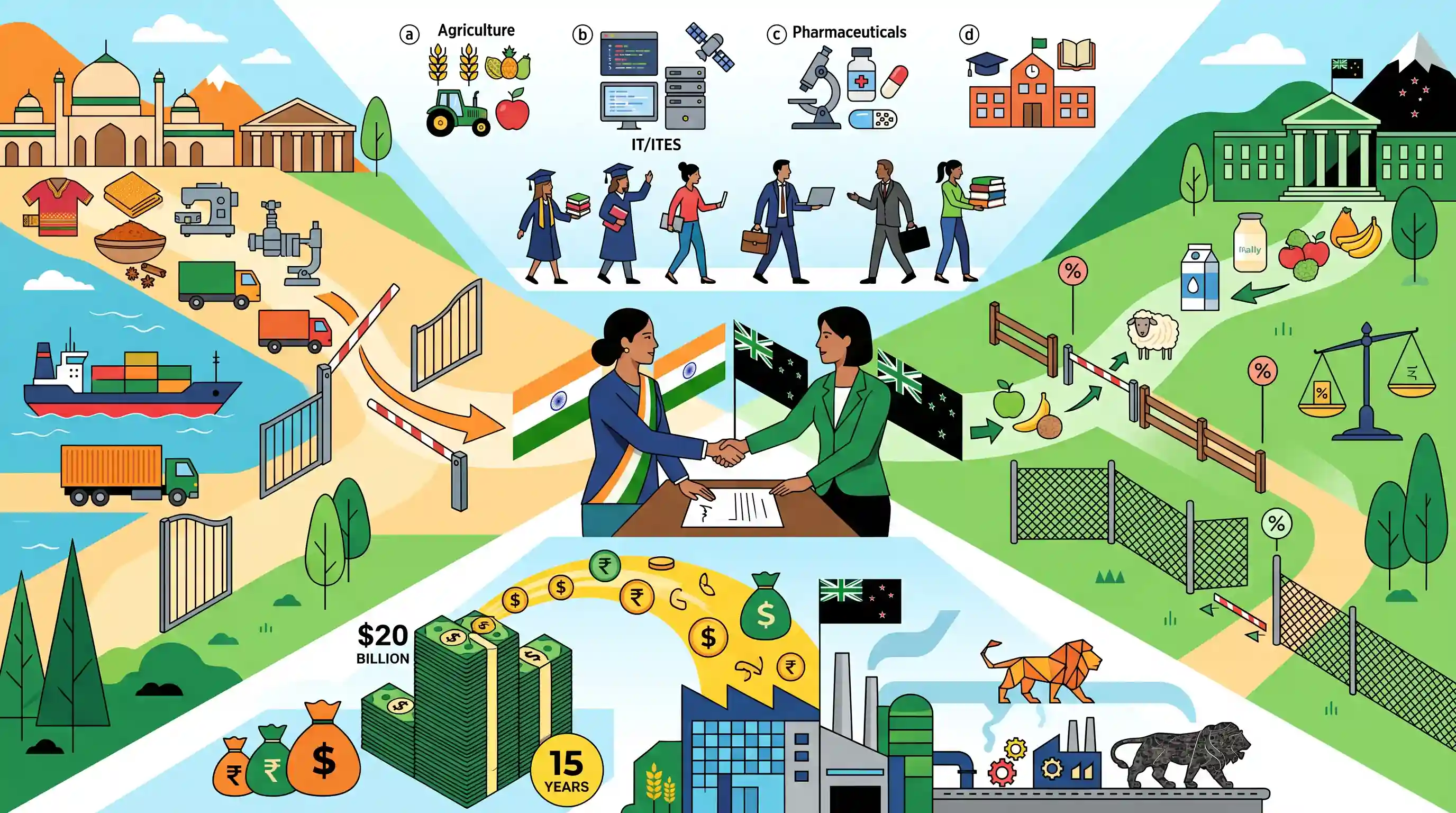
India and New Zealand officially signed a comprehensive Free Trade Agreement (FTA) on April 27, 2026. The agreement eliminates tariffs on all Indian goods entering New Zealand and significantly reduces tariffs on New Zealand imports to India. Distinguishing itself from conventional trade pacts, the FTA encompasses enhanced mobility for professionals and students and secures a $20 billion investment commitment from New Zealand over 15 years to support India's manufacturing sector under the 'Make in India' banner. Billed as India's first 'women-led' FTA, it caps a period of surging bilateral trade and deepens economic ties across crucial sectors such as agriculture, IT/ITES, pharmaceuticals, and education.
Key Points
- India and New Zealand signed a Free Trade Agreement (FTA) on April 27, 2026, following a rapid negotiation process from March to December 2025.
- New Zealand will remove tariffs on all goods imported from India, while India will eliminate or reduce tariffs on 95% of its current imports from New Zealand.
- The agreement includes a commitment of $20 billion in investment from New Zealand over the next 15 years, synergizing with the 'Make in India' initiative.
- Bilateral trade saw substantial growth in 2024-25, with Indian exports to New Zealand increasing by 32.1% to $711.1 million, and imports growing by 75.2% to $587.1 million.
- The FTA goes beyond goods, enhancing mobility for working professionals and students, and covers sectors like agriculture, textiles, pharma, engineering goods, IT, and education.
- It is highlighted as India's 'first women-led Free Trade Agreement.'
Important Terms
India-New Zealand Free Trade Agreement (FTA)

A pact between two nations to eliminate tariffs on goods and services, easing market access. This specific 2026 agreement grants India 100% duty-free access to New Zealand.
UPSC context
GS Paper II (International Relations) & GS Paper III (Economy); tests bilateral diplomacy and trade liberalization impacts.
Make in India
A flagship 2014 initiative to transform India into a global manufacturing hub by encouraging domestic and foreign investment in the secondary sector.
UPSC context
GS Paper III (Economic Development); essential for questions on industrial policy and economic self-reliance (Atmanirbhar Bharat).
Women-led FTA
A landmark status for the 2026 FTA where women predominantly led the negotiating team, reflecting 'Nari Shakti' (women's power) in Indian economic diplomacy and governance.
UPSC context
GS Paper II; relates to gender-inclusive diplomacy and women's participation in high-level decision-making.
Professional Mobility
The movement of skilled professionals across borders for work. This FTA secures a 5,000-visa quota and post-study work rights for Indian STEM graduates in New Zealand.
UPSC context
GS Paper III; critical for India's services-led growth and the 'Global South' leadership narrative.
Rules of Origin
Criteria used to determine the national source of a product. This FTA employs strict rules to prevent third-party countries from unfairly benefiting from tariff preferences.
UPSC context
GS Paper III (Economy); tests understanding of trade safeguards and anti-dumping mechanisms in international commerce.
Foreign Direct Investment (FDI)
Direct investment into business interests in another country. Under this FTA, New Zealand committed $20 billion in FDI to India over 15 years.
UPSC context
GS Paper III; important for capital account analysis and industrial development funding.
Prelims Trap
"The India-New Zealand FTA guarantees the reciprocal elimination of 100% of tariffs on all bilateral trade."
It is an asymmetric agreement. While New Zealand removes 100% of tariffs on Indian goods, India eliminates tariffs on only 95% of imports, protecting sensitive sectors like dairy.
Static Concepts Connected
What are the four modes of services supply under the WTO GATS?
- Mode 1: Cross-border supply (e.g., software services, telemedicine) flowing from the territory of one Member into another.
- Mode 2: Consumption abroad, where a consumer travels to another country to avail services (e.g., tourism, education).
- Mode 3: Commercial presence, where a service provider establishes a branch or subsidiary in another country.
- Mode 4: Presence of natural persons, where individuals travel temporarily to another country to provide a service (crucial for India).
How do comprehensive trade pacts differ from traditional Free Trade Agreements (FTAs)?
- Goods focus: Traditional FTAs primarily focus on reducing or eliminating tariff and non-tariff barriers on trade in goods.
- Broader scope: Comprehensive pacts (CECA/CEPA) encompass goods, services, investments, intellectual property, and regulatory harmonization, reflecting deeper economic integration.
Cross-Topic Patterns
Shift to investment-linked FTAs
Following the EFTA TEPA's $100B pledge, India is now making binding foreign investment (like NZ's $20B) a prerequisite for market access, tightly coupling trade strategy with domestic manufacturing.
WTO GATS Mode 4 and Emigration
The specific inclusion of enhanced mobility for working professionals underlines India's persistent strategy of leveraging its demographic dividend to secure Mode 4 services access under WTO GATS.
Gender-inclusive trade diplomacy
Billed as a 'women-led' pact, this aligns with emerging WTO-level discourses (like the Buenos Aires Declaration) on making trade policies responsive to gender empowerment and inclusive growth.

Expect a multi-statement Prelims question comparing recent FTAs (NZ, EFTA, UAE) focusing on investment bindings and Mode 4 access.
Linked PYQs · 3
Linked PYQs · 3
- 2011MainsGS2
Compared to the South Asian Free Trade Area (SAFTA), the Bay of Bengal Initiative for Multisectoral Technical and Economic Cooperation Free Trade Area (BIMSTEC FTA) seems to be more promising." Critically evaluate.
- 2020MainsGS2
Quadrilateral Security Dialogue (Quad)' is transforming itself into a trade bloc from a military alliance, in present times - Discuss.
- 2016MainsGS3
Justify the need for FDI for the development of the Indian economy. Why there is gap between MOUs signed and actual FDIs? Suggest remedial steps to be taken for increasing actual FDIs in India.
