India and New Zealand successfully conclude comprehensive trade pact
Source:The Hindu ↗
Why It Matters
This development highlights India's accelerated strategy to forge bilateral economic partnerships globally. Understanding FTAs is crucial for analyzing India's foreign trade policy, the impact of tariff reductions on domestic sectors (like MSMEs and agriculture), and the mechanisms driving long-term foreign investment and strategic geopolitical ties.
Summary
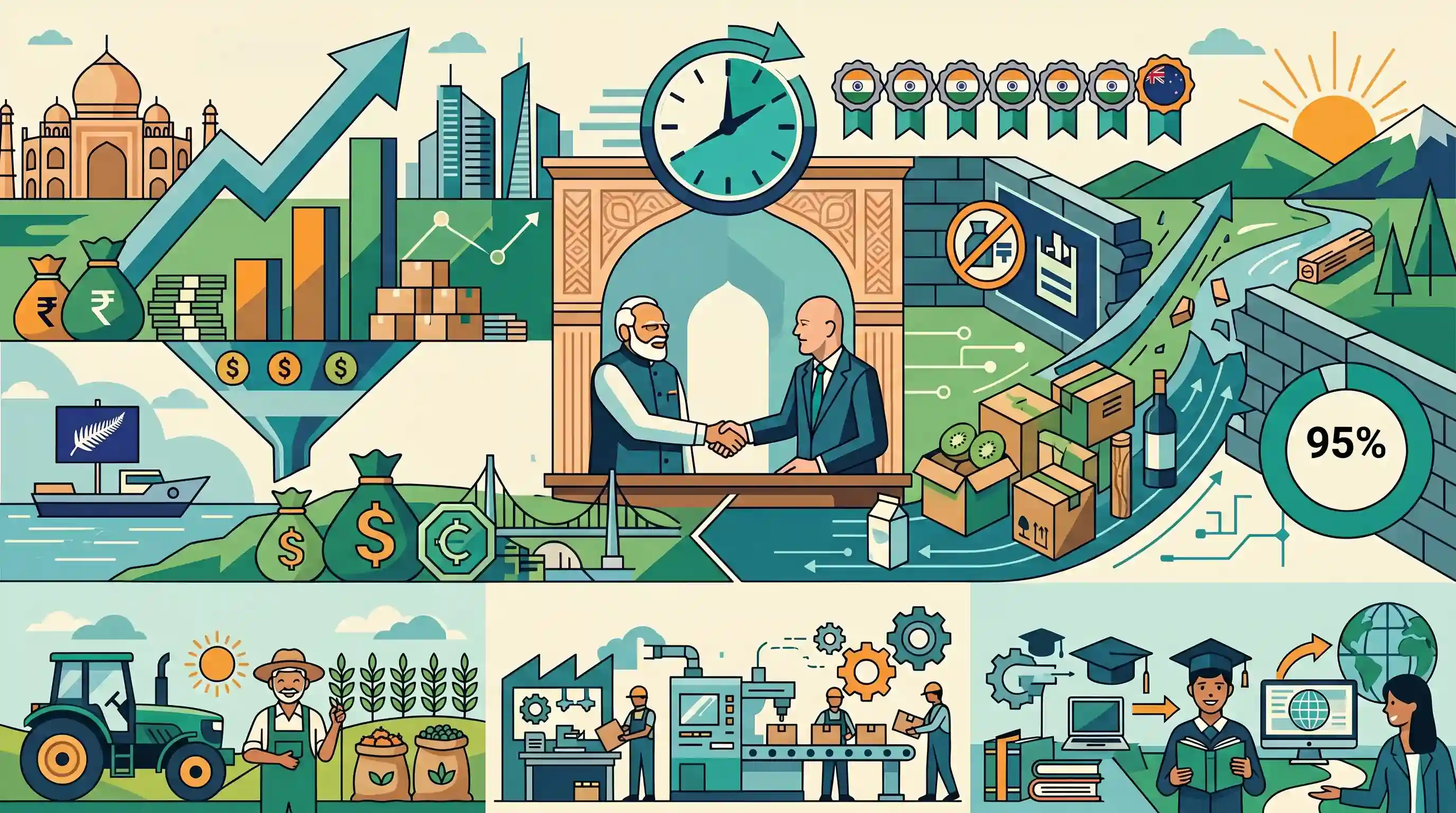
India and New Zealand have successfully concluded a Comprehensive Free Trade Agreement (FTA) in a record time of nine months, marking India's seventh such agreement in recent years. Announced by PM Narendra Modi and New Zealand PM Christopher Luxon, the FTA aims to double bilateral trade over the next five years and facilitate $20 billion in investments from New Zealand into India over the next 15 years. The deal will eliminate or reduce tariffs on 95% of New Zealand's exports to India, while deepening strategic cooperation and enhancing market access to benefit key domestic sectors such as MSMEs, farmers, and students.
Key Points
- India and New Zealand concluded negotiations for a Comprehensive Free Trade Agreement on December 22, 2025, taking a record time of just nine months.
- The deal marks India's seventh major recent trade pact, following agreements with Oman, the UK, EFTA, the UAE, Australia, and Mauritius.
- The FTA will reduce or eliminate tariffs on 95% of New Zealand's exports to India, which is projected to boost their exports by $1.1 billion to $1.3 billion annually.
- The agreement sets ambitious economic targets: doubling bilateral trade over the next five years and drawing $20 billion in investments from New Zealand into India over the next 15 years.
- Beyond tariffs, the partnership deepens bilateral economic engagement, expands market access, and enhances strategic cooperation benefiting MSMEs, farmers, and students.
Important Terms
Comprehensive Free Trade Agreement (CEPA)

A broad-based trade pact covering goods, services, investment, intellectual property, and regulatory cooperation, aiming for deeper economic integration than traditional FTAs.
UPSC context
GS Paper-III: Trade agreements; tests understanding of different economic integration levels (PTA vs FTA vs CEPA).
India-New Zealand FTA
The 2026 bilateral pact eliminating tariffs on 100% of Indian exports and 95% of New Zealand's, while securing a $20 billion investment commitment.
UPSC context
GS Paper-II: Bilateral relations; tests knowledge of India's strategic partnerships in the Indo-Pacific.
Labour Mobility
Provisions in a trade deal that facilitate the movement of skilled professionals and students across borders via visas and work permits.
UPSC context
GS Paper-II/III: Impact of FTAs on the services sector and Indian diaspora.
Exclusion List
A schedule of sensitive goods (e.g., dairy, sugar) exempted from tariff concessions in a trade agreement to protect domestic producers.
UPSC context
GS Paper-III: Agriculture/Economy; tests ability to analyze how India balances trade with food security.
Foreign Direct Investment (FDI)
An investment made by an entity from one country into business interests in another, often involving management participation and long-term capital flow.
UPSC context
GS Paper-III: Investment models; crucial for the $20 billion commitment mentioned in the deal.
MSMEs (Micro, Small and Medium Enterprises)
Small-scale businesses defined by specific investment and turnover limits, which form the core of India's labour-intensive export sectors.
UPSC context
GS Paper-III: Indian Economy; tests understanding of how trade deals impact domestic employment and industry.
Rules of Origin
Criteria used to determine the national source of a product, ensuring that only goods originating from FTA partners receive preferential tariff treatment.
UPSC context
GS Paper-III: Trade; essential for preventing 'trade diversion' where third-party goods exploit bilateral benefits.
Prelims Trap
The India-New Zealand FTA provides duty-free market access to New Zealand's dairy and agricultural products.
Aspirants might assume a comprehensive FTA covers all goods. However, India intentionally excluded sensitive sectors like dairy and agriculture to protect its domestic farmers from major global producers like NZ.
Static Concepts Connected
What are the core features of India's recent 'FTA 2.0' agreements?
- Binding FDI targets: Recent pacts (like EFTA and NZ) legally link domestic market access and tariff reductions to specific foreign investment commitments over a defined period.
- Sensitive sector protection: India utilizes negative lists to firmly protect politically sensitive and labor-intensive domestic sectors, such as dairy and agriculture, from heavily subsidized global competitors.
- Service mobility: Negotiations explicitly focus on securing easier visa rules, mutual recognition of qualifications, and mobility for Indian professionals, students, and workers.
How does a Free Trade Agreement differ from a Customs Union?
- Free Trade Agreement: Member countries eliminate tariffs on internal trade but independently maintain their own individual tariff rates against non-member nations.
- Customs Union: A deeper integration where members not only eliminate internal tariffs but also adopt a uniform, common external tariff against non-members.
- Common Market: Goes beyond a Customs Union by also allowing the free, unrestricted movement of capital and labor among member countries.
Cross-Topic Patterns
RCEP Ghosts & Dairy Protection
India withdrew from RCEP in 2019 largely over fears of cheap dairy imports from NZ and Australia. This bilateral FTA succeeds by explicitly keeping dairy off the table.
FDI-linked Trade Pacts (FTA 2.0)
Like the recent EFTA deal ($100B target), the New Zealand pact mandates $20B in investments. This signals a structural policy shift linking tariff concessions directly to job-creating FDI.
Pacific Island Strategy Integration
The FTA positions New Zealand as India's gateway to the Pacific Island Countries (PICs), amplifying strategic outreach seen in FIPIC summits and the Indo-Pacific Oceans Initiative.

India's 'FTA 2.0' model—pairing tariff concessions with binding FDI targets while excluding dairy—is highly likely in 2026 Prelims.
Linked PYQs · 3
Linked PYQs · 3
- 2016MainsGS3
Justify the need for FDI for the development of the Indian economy. Why there is gap between MOUs signed and actual FDIs? Suggest remedial steps to be taken for increasing actual FDIs in India.
- 2014MainsGS2
The aim of Information Technology Agreements (ITAs) is to lower all taxes and tariffs on information technology products by signatories to zero. What impact would such agreements have on India's interests?
- 2023MainsGS3
Faster economic growth requires increased share of the manufacturing sector in GDP, particularly of MSMEs. Comment on the present policies of the Government in this regard.
