India and New Zealand Hold Fourth Round of Free Trade Agreement Talks
Source:The Hindu ↗
Why It Matters
This development is important for UPSC aspirants as it illustrates India's proactive economic diplomacy and its strategy to secure favorable Free Trade Agreements (FTAs). Understanding technical trade barriers like 'rules of origin' is essential for analyzing the complexities of international trade negotiations and India's global economic integration efforts.
Summary
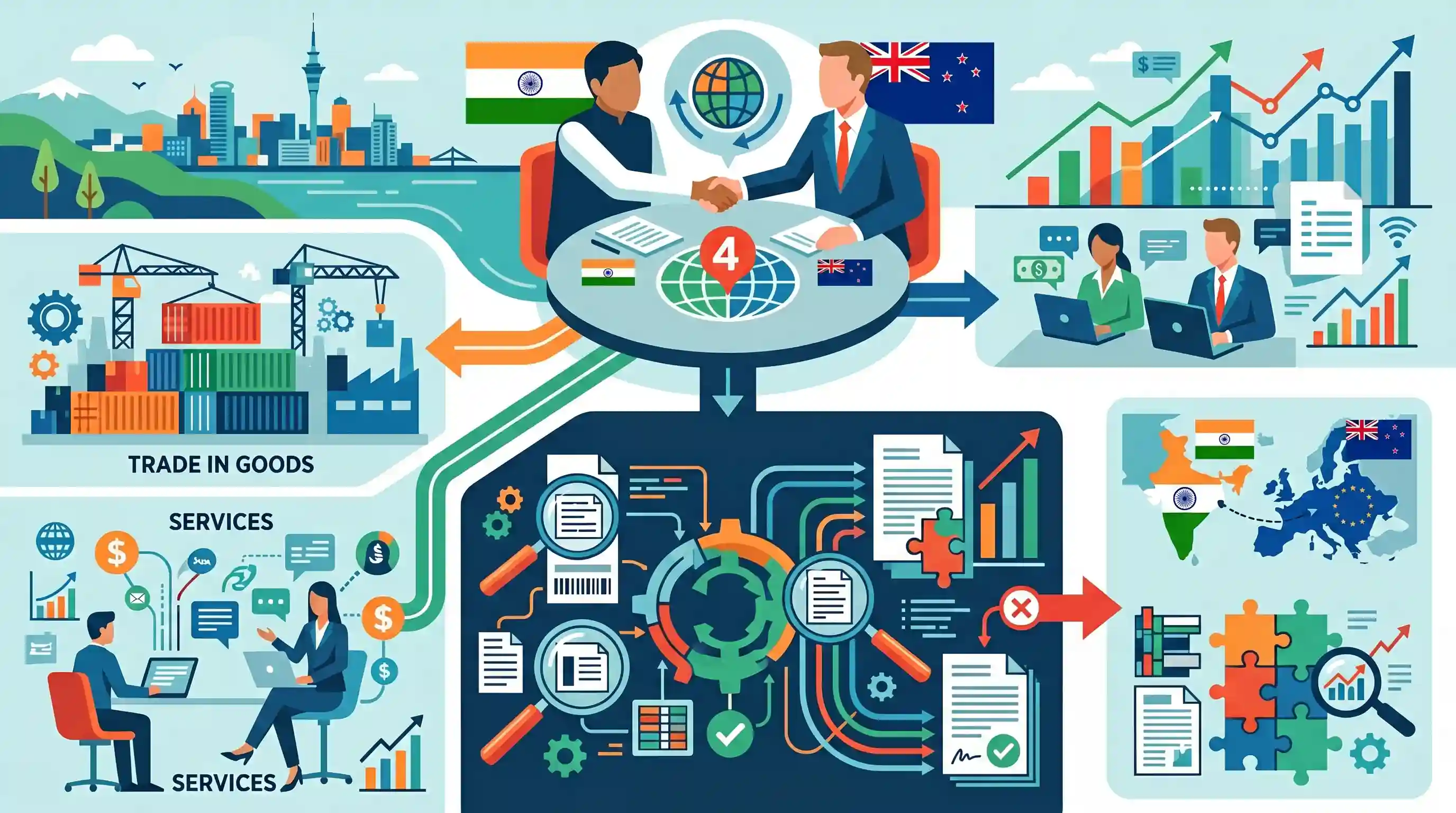
India and New Zealand have commenced the fourth round of Free Trade Agreement (FTA) negotiations in Auckland, concentrating on trade in goods, services, and the critical framework of 'rules of origin.' Inaugurated by Indian Commerce Minister Piyush Goyal and New Zealand's Trade Minister Todd McClay, the talks aim to deepen bilateral economic integration. A key obstacle in the discussions is establishing mutually agreeable rules of origin, which dictate the source criteria for products—a challenge that also persists in India's ongoing FTA negotiations with the European Union.
Key Points
- India and New Zealand have launched the fourth round of Free Trade Agreement (FTA) negotiations in Auckland.
- The talks are focused on trade in goods, trade in services, and the complex issue of 'rules of origin.'
- Rules of origin determine the national source of a product and represent a significant hurdle, similar to India's FTA negotiations with the European Union.
- The negotiations were inaugurated by India's Commerce and Industry Minister Piyush Goyal and New Zealand's Minister for Trade and Investment Todd McClay.
Important Terms
Free Trade Agreement (FTA)

An arrangement between two or more countries to reduce or eliminate trade barriers like tariffs and quotas. It facilitates market access for goods and services, promoting economic cooperation and bilateral trade growth.
UPSC context
GS Paper II (Bilateral Agreements) & III (Economy); tests knowledge of India's trade policy and economic diplomacy.
Rules of Origin (RoO)
Criteria used to determine the "economic nationality" of a product. They ensure that preferential trade benefits apply only to goods produced within member countries, preventing third-party transshipment or "trade deflection."
UPSC context
GS Paper III (Economy); crucial for understanding non-tariff barriers and safeguarding domestic industries in trade negotiations.
Bilateral Economic Integration
The process of deepening economic ties between two countries through policy coordination and trade barrier removal. It aims for seamless movement of goods, services, and capital to enhance mutual growth and prosperity.
UPSC context
GS Paper II (International Relations); focuses on how economic partnerships strengthen geopolitical ties and strategic interests.
Trade in Services
The exchange of intangible products like telecommunications or consultancy. In FTAs, it involves commitments on market access and national treatment, often including labor mobility (Mode 4) for Indian professionals.
UPSC context
GS Paper III (Economy); significant given India's service-led growth and its demands for professional mobility in pacts.
European Union (EU)
A supranational political and economic union of 27 European countries. As a major global trade bloc, its ongoing FTA negotiations with India are pivotal for India's market access in the West.
UPSC context
GS Paper II (Global Groupings); essential for studying India's trade architecture and engagement with developed-market regional blocs.
Prelims Trap
Goods shipped directly from an FTA partner country automatically qualify for preferential zero-duty tariffs.
Rules of Origin require substantial value addition (typically 35%) in the partner country to prevent trade deflection. Mere transshipment or final packaging does not qualify.
Static Concepts Connected
What are Rules of Origin and how does CAROTAR 2020 prevent trade deflection?
- Economic Nationality: They determine the national source of a product to ensure only genuinely produced goods receive preferential FTA tariffs.
- Value Addition: Requires 'substantial transformation' or a minimum domestic value addition in the partner country, preventing third-party routing.
- CAROTAR 2020: Shifts the burden of proof to Indian importers, mandating strict due diligence beyond just holding a basic Certificate of Origin.
What are the key modes of service supply under the WTO GATS framework?
- Modes 1 & 2: Cross-border supply (like software BPOs) and consumption abroad (like medical tourism and international students).
- Mode 3: Commercial presence, which involves setting up a foreign branch or subsidiary in another country.
- Mode 4: Movement of natural persons. India heavily negotiates this in FTAs to secure easy visas for its STEM and healthcare professionals.
Cross-Topic Patterns
Agri-protectionism vs. FTA integration
India's defensive stance on dairy imports from New Zealand/EU showcases the tension between shielding millions of domestic unorganized farmers and securing wider market access abroad.
Trade deflection and Chinese circumvention
Rules of Origin discussions in FTAs are implicitly aimed at blocking third countries like China from exploiting zero-duty routes via partner nations.

Expect a multi-statement Prelims question linking CAROTAR 2020, Rules of Origin, and WTO GATS Mode 4 to India's recent FTA negotiations.
Linked PYQs · 3
Linked PYQs · 3
- 2011MainsGS2
Compared to the South Asian Free Trade Area (SAFTA), the Bay of Bengal Initiative for Multisectoral Technical and Economic Cooperation Free Trade Area (BIMSTEC FTA) seems to be more promising." Critically evaluate.
- 2017PrelimsGS1
Consider the following statements: 1. India has ratified the Trade Facilitation Agreement (TFA) of WTO. 2. TFA is a part of WTO's Bali Ministerial Package of 2013. 3. TFA came into force in January 2016. Which of the statements given above is/are correct?
- 2020MainsGS2
Quadrilateral Security Dialogue (Quad)' is transforming itself into a trade bloc from a military alliance, in present times - Discuss.
