New GDP Data Series to Improve Economic Accuracy
Source:The Hindu ↗
Why It Matters
Accurate GDP and national income accounting form the bedrock of economic policy formulation, fiscal targeting, and sovereign credit ratings. The previous major shift in GDP calculation (base year 2011-12) was explicitly tested in the UPSC Mains (2021). This upcoming statistical overhaul directly addresses long-standing criticisms regarding the measurement of India's vast informal economy, inflation-adjustments (double-deflation), and corporate sector data quality, making it a highly probable topic for both Prelims (methodology concepts) and Mains (economic structural realities).
Summary
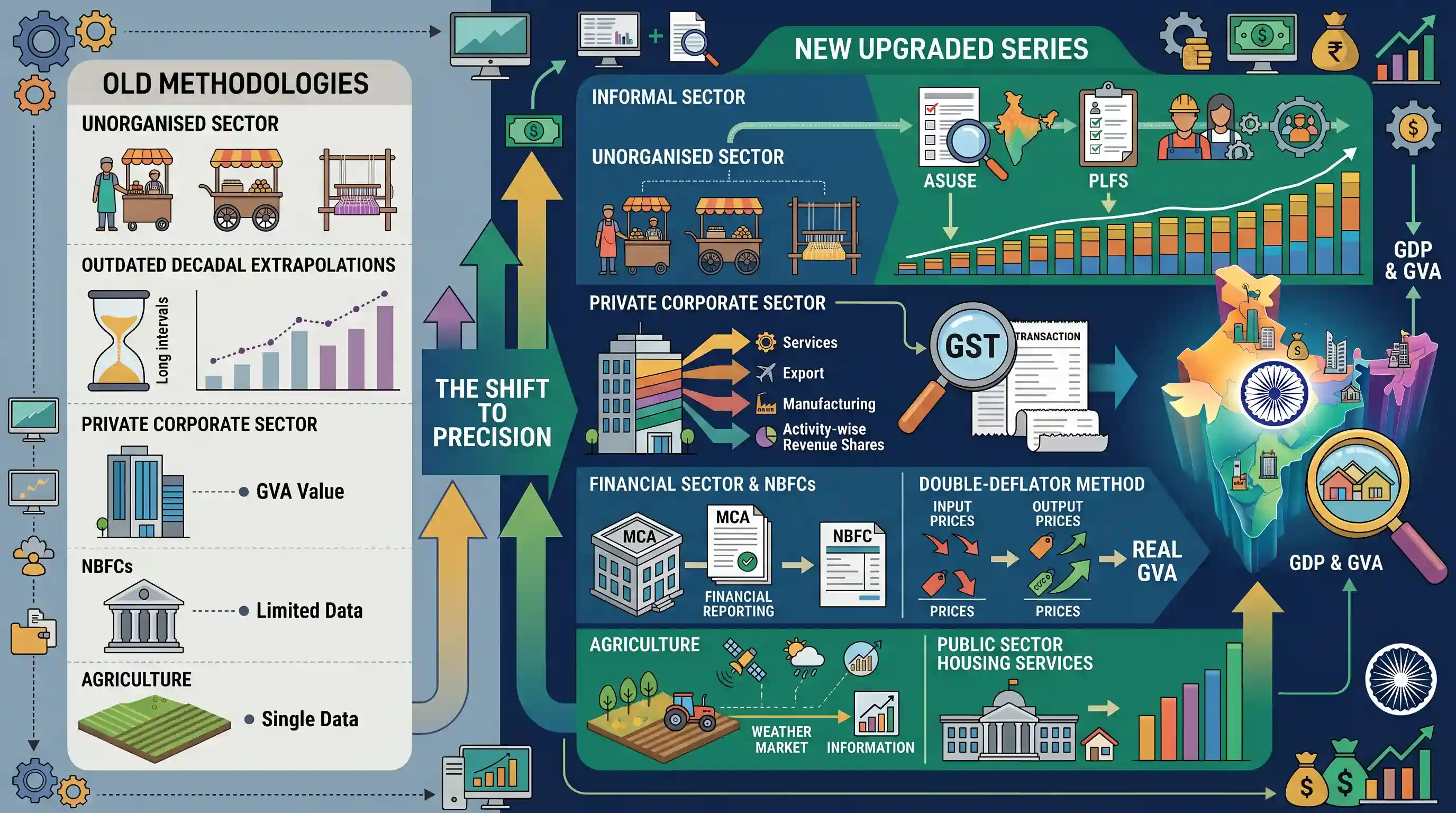
India is preparing a new national accounts data series that significantly upgrades the methodologies used to estimate Gross Domestic Product (GDP) and Gross Value Added (GVA). The revisions address previous statistical blindspots by replacing outdated decadal extrapolations in the unorganised sector with annual data from ASUSE and PLFS. Calculations for the private corporate sector are being refined using GST databases and activity-wise revenue share mapping. Other critical upgrades include a wider application of the double-deflator method to adjust for price changes, the integration of actual financial reporting for NBFCs via the MCA, improved agricultural tracking, and enhanced inclusion of public sector housing services. These changes aim to reflect the structural realities of the Indian economy with far greater precision.
Key Points
- India's upcoming GDP data series introduces major methodology upgrades to calculate Gross Value Added (GVA) and GDP more accurately.
- Unorganised/Household Sector: Decadal extrapolation is replaced with annual indicators derived from the Annual Survey of Unincorporated Sector Enterprises (ASUSE) and the Periodic Labour Force Survey (PLFS).
- Private Corporate Sector: GVA calculation is refined using activity-wise revenue shares instead of broad industry classifications, while GST data will be leveraged to track active companies and estimate regional output.
- Additional upgrades include the comprehensive application of the double-deflator method, the use of actual MCA financial data for NBFCs, and incorporating RBI statistics for banking activities.
Important Terms
Ministry of Statistics and Programme Implementation (MoSPI)

Nodal ministry for India's core statistical activities. It oversees the National Statistical Office (NSO), which calculates critical macroeconomic indicators like GDP, CPI, and the Index of Industrial Production (IIP).
UPSC context
GS-III (Economy); tests knowledge of institutional frameworks for national income accounting and statistical governance.
Goods and Services Tax (GST)
A comprehensive destination-based indirect tax. In national accounts, its database provides real-time administrative data to track sectoral revenue shares and identify active private corporations for precise GVA mapping.
UPSC context
GS-III (Fiscal Policy); tests the integration of digital tax data for improving macroeconomic data reliability.
Annual Survey of Unincorporated Sector Enterprises (ASUSE)
An annual MoSPI survey measuring the economic performance of unincorporated, non-agricultural enterprises. It replaces decadal extrapolations to provide actual, yearly data on the informal sector's contribution to GDP.
UPSC context
GS-III (Informal Sector); crucial for analyzing the unorganized sector’s role in growth and evidence-based policymaking.
Double-Deflator Method
A statistical method where output and input prices are deflated separately by specific price indices. It prevents GVA distortion when raw material costs fluctuate differently from final product prices.
UPSC context
GS-III (Growth and Measurement); tests understanding of technical refinements and alignment with global national accounting standards.
Ministry of Corporate Affairs (MCA)
The government body regulating India's corporate sector. Its MCA-21 database serves as the primary data source for estimating the Gross Value Added (GVA) of organized private companies.
UPSC context
GS-III (Economic Development); tests awareness of administrative datasets used to capture corporate activity for national accounts.
Periodic Labour Force Survey (PLFS)
An annual survey by the NSO providing labor market indicators. It is used in the new GDP series to replace outdated proxies for estimating household and informal sector output.
UPSC context
GS-III (Employment); tests the use of labor data for quantifying sectoral contributions to the national economy.
Reserve Bank of India (RBI)
India’s central bank and financial regulator. In GDP calculation, it provides actual financial reporting for NBFCs and other regulated entities to ensure precise estimation of the financial services sector.
UPSC context
GS-III (Financial Sector); tests the role of regulators in contributing granular data for macroeconomic stability.
Prelims Trap
The introduction of the double-deflator method mathematically guarantees an increase in India's official GDP growth rate.
It actually prevents overestimation. By adjusting input and output prices separately, it stops GDP from artificially inflating when intermediate input prices fall faster than final output prices.
Static Concepts Connected
What is the double-deflation method in National Income accounting?
- Single Deflation: Uses a single price index to deflate nominal GVA (Gross Output minus Intermediate Consumption) to arrive at real GVA.
- Double Deflation: Deflates gross output and intermediate inputs separately using their respective, distinct price indices before calculating the real Gross Value Added.
- The Advantage: Accurately captures real value added during commodity price shocks, preventing growth overestimation when raw material costs drop drastically.
How is Gross Value Added (GVA) distinct from GDP?
- Supply vs Demand: GVA measures the supply-side (producer's perspective) value of goods and services, while GDP maps the demand/consumer side of the economy.
- The Formula: GDP = GVA at basic prices + Product Taxes - Product Subsidies. This links producer-level output to final market prices.
Cross-Topic Patterns
Formalisation via Data Integration
Leveraging GSTN and MCA21 databases for GDP calculation shows how digital tax and corporate compliance infrastructures are now doubling as real-time macroeconomic measurement architecture.
Measuring the Missing Informal Sector
Shifting from outdated decadal proxies to annual PLFS and ASUSE surveys directly addresses long-standing academic critiques regarding India's inability to accurately capture informal sector distress post-economic shocks.

Expect a 2026 prelims multi-statement question contrasting single vs double deflation alongside the new datasets (PLFS, ASUSE, MCA21).
Linked PYQs · 3
Linked PYQs · 3
- 2021MainsGS3
Explain the difference between computing methodology of India's Gross Domestic Product (GDP) before the year 2015 and after the year 2015.
- 2023MainsGS3
Most of the unemployment in India is structural in nature. Examine the methodology adopted to compute unemployment in the country and suggest improvements.
- 2020MainsGS3
Define potential GDP and explain its determinants. What are the factors that have been inhibiting India from realizing its potential GDP?
