India Nepal Joint Vision Document and Bilateral Cooperation
Source:Indian Express ↗
Why It Matters
This meeting underscores the multifaceted nature of India-Nepal relations, incorporating sub-national leadership into strategic framework agreements like the Joint Vision Document, which is vital for regional stability and energy security in South Asia.
Summary
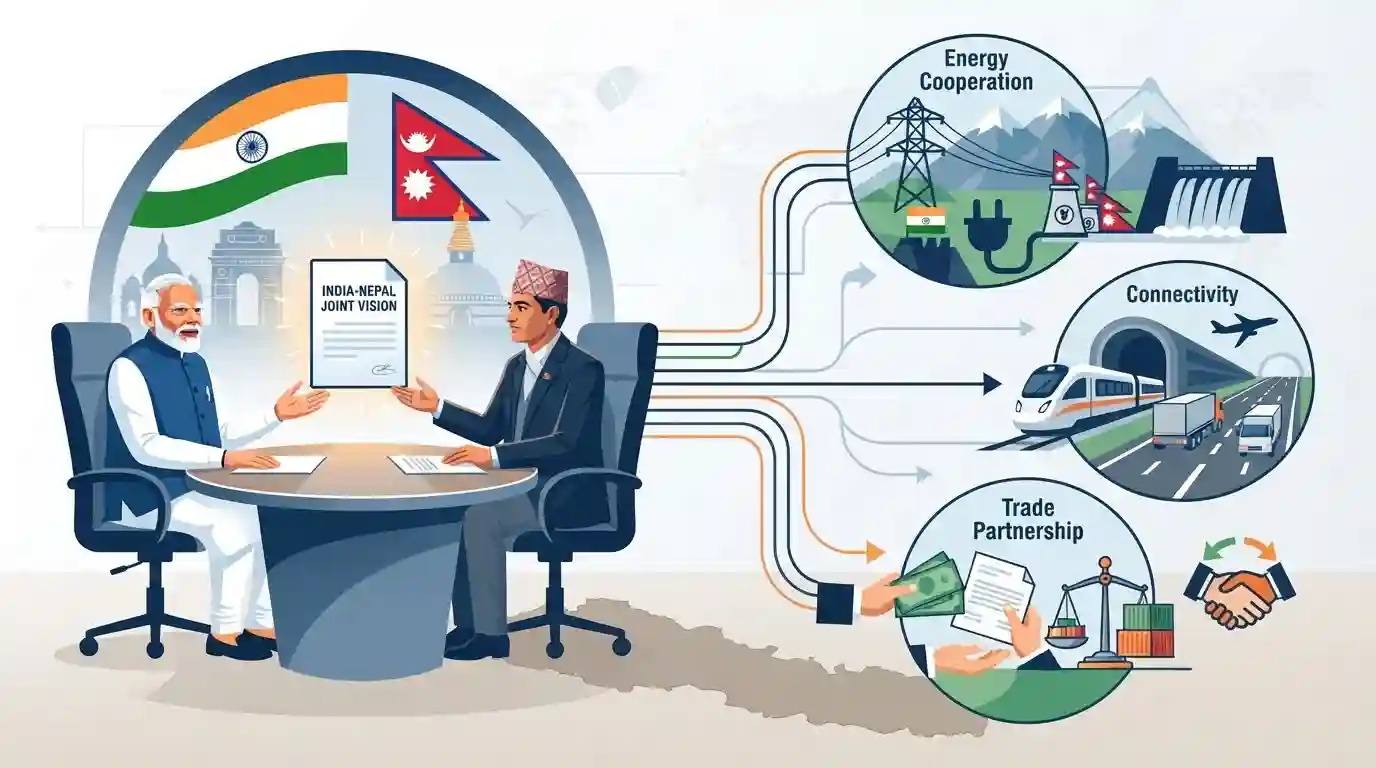
Indian Prime Minister Narendra Modi met with Kathmandu Mayor Balendra Shah to review bilateral relations and discuss the implementation of the India-Nepal Joint Vision Document, focusing on cross-border energy cooperation, connectivity, and trade partnership.
Key Points
- Indian Prime Minister Narendra Modi and Kathmandu Mayor Balendra Shah met to discuss strengthening bilateral ties between India and Nepal.
- The discussions focused on the implementation of the India-Nepal Joint Vision Document, emphasizing cooperation in energy, connectivity, and trade.
- The high-level engagement highlights the importance of sub-national and municipal diplomatic channels alongside traditional state-to-state relations.
- Both leaders reviewed ongoing collaborative projects aimed at mutual economic development and regional stability.
Important Terms
India-Nepal Joint Vision Document

A bilateral roadmap adopted by India and Nepal to deepen collaboration across economic development, cross-border energy cooperation, connectivity, trade, and technology.
UPSC context
UPSC GS Paper II (International Relations - India and its Neighborhood): Evaluates bilateral groupings, agreements, and strategic partnerships with neighboring nations.
Kathmandu Metropolitan City
The local self-government body of Nepal's capital city, Kathmandu, involved in municipal administration, urban governance, and diplomatic engagements.
UPSC context
UPSC GS Paper II (International Relations / Governance): Highlights sub-national diplomacy, urban governance structures, and municipal level interactions between neighboring nations.
Prelims Trap
Municipal leaders cannot engage in bilateral diplomatic discussions or implement joint vision documents under constitutional norms.
Aspirants often assume diplomatic engagements are restricted exclusively to central executives; sub-national and mayoral diplomacy plays an active role in contemporary bilateral outreach.
Static Concepts Connected
What are the key institutional frameworks governing India-Nepal bilateral trade and transit?
- Treaty of Trade: Bilateral mechanism providing duty-free access for Nepalese goods into the Indian market with certain exceptions.
- Treaty of Transit: Facilitates transit of Nepalese third-country trade through Indian territory using designated rail and port routes.
- Mahakali Treaty: Bilateral framework signed to jointly develop water resources, flood control, and hydel power generation.
Cross-Topic Patterns
Cross-Border Power Grids & BIMSTEC Integration
Cross-border energy grids like the India-Nepal power exchange link directly to BIMSTEC grid connectivity master plans and sub-regional South Asian integration.

India-Nepal Joint Vision Document and power cooperation likely to feature in prelims match-the-following or statement-based questions.
Linked PYQs · 1
Linked PYQs · 1
- 2012MainsGS2
Do you think that China's emergence as one of the largest trading partners of India has adversely affected the settlement of the outstanding border problem?
