Agricultural Input Subsidies Fiscal Burden and Structural Reform Needs
Source:Indian Express ↗
Why It Matters
This article is crucial for GS3 as it connects agricultural economics (subsidies, MSP) with broader macroeconomic challenges (fiscal deficit, foreign exchange). It provides critical arguments against the current subsidy regime, which are highly relevant for questions analyzing the distortions caused by farm subsidies and the political economy of agricultural reforms in India.
Summary
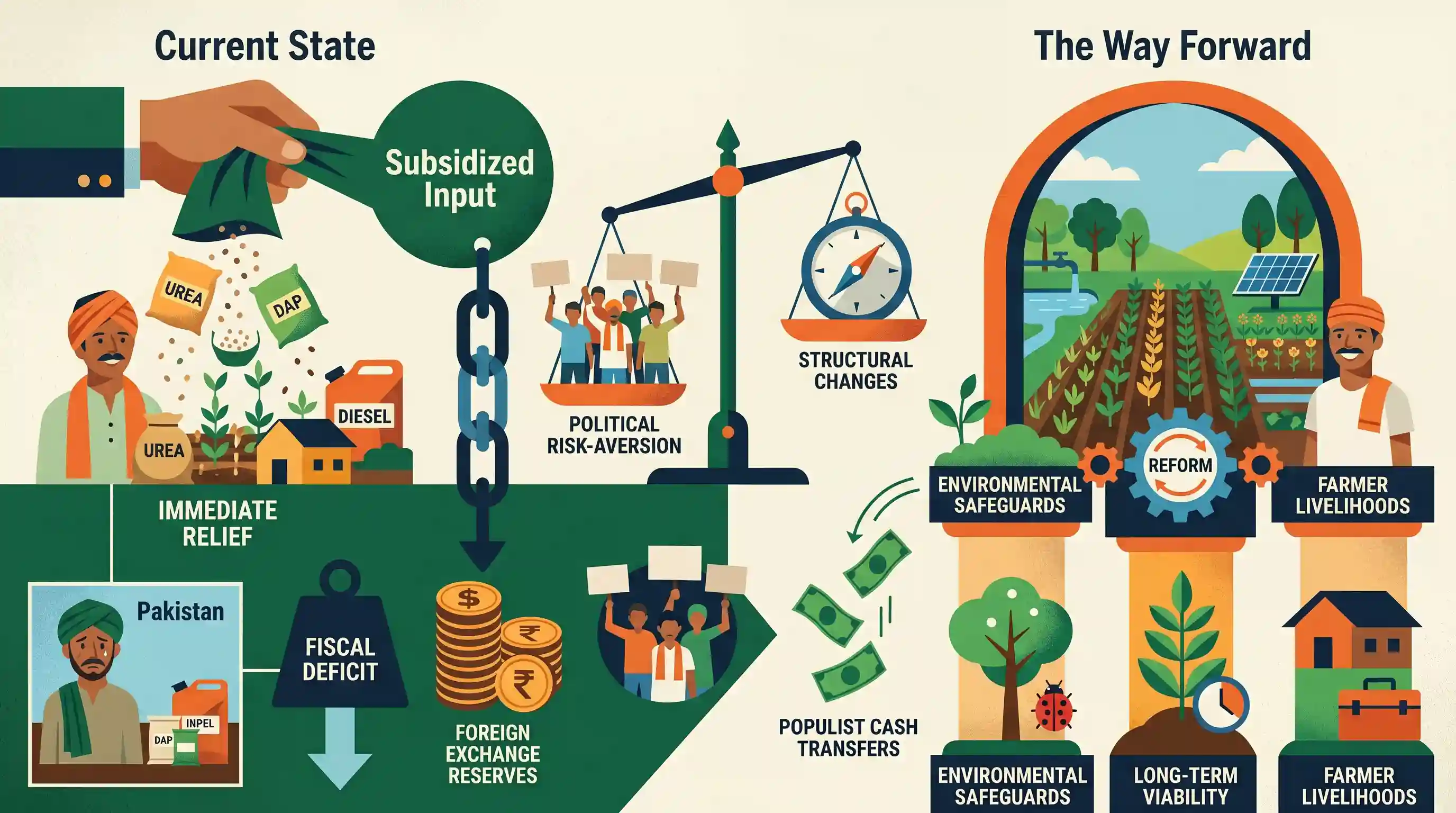
The article critically examines India's burgeoning agricultural subsidy regime, contrasting the heavily subsidized input costs of Indian farmers with the stark realities faced in neighboring Pakistan. While subsidies on urea, DAP, and diesel offer immediate relief, they impose a massive and unsustainable burden on India's fiscal deficit and foreign exchange reserves. The author argues that political risk-aversion—driven by fear of farmer backlash—has stalled necessary structural changes. To ensure long-term agricultural viability, the government must move beyond populist measures and cash transfers, pivoting instead towards comprehensive reforms that safeguard both the environment and farmer livelihoods.
Key Points
- Indian farmers benefit from heavily subsidized inputs like urea and diesel compared to counterparts in Pakistan, highlighting India\'s vast agricultural support system.
- The fertilizer subsidy burden is immense, potentially reaching Rs 1,10,000 for a typical 2.5-acre agricultural household, far exceeding direct cash transfers like PM-Kisan.
- Endless subsidies threaten India\'s fiscal stability and foreign exchange reserves, risking severe macroeconomic imbalances.
- The government is trapped in a 'paradox of risk', avoiding crucial agricultural reforms due to fears of political backlash and a perceived narrative of farmer resistance.
- There is an urgent need to transition away from a pure subsidy or cash-transfer model towards structural reforms that prioritize environmental sustainability and long-term farmer livelihoods.
Important Terms
Minimum Support Price (MSP)

A government-guaranteed price floor for agricultural produce to protect farmers from market volatility. It is recommended by the Commission for Agricultural Costs and Prices (CACP) for 22 mandated crops.
UPSC context
GS Paper III (Agriculture). Tests price support mechanisms, food security, and impacts on fiscal deficit and cropping patterns.
PM Kisan
A central sector scheme providing ₹6,000 annual direct income support to landholding farmer families in three installments via Direct Benefit Transfer (DBT) to ensure financial stability.
UPSC context
GS Paper II (Social Justice) & III (Agriculture). Tests knowledge of welfare schemes, DBT, and farmer income support policies.
Bharatiya Janata Party (BJP)
India's ruling national party since 2014, adhering to Hindutva (cultural nationalism) and integral humanism; it currently leads the National Democratic Alliance (NDA) government.
UPSC context
GS Paper II (Polity). Relevant for understanding the party system, governance, and ideology in policy formulation.
Indian National Congress (INC)
India's oldest political party, founded in 1885, which led the independence movement. It represents a secular, social-democratic ideology and serves as the principal national opposition.
UPSC context
GS Paper II (Polity). Important for history of political parties and the role of opposition in a democracy.
Rashtriya Swayamsevak Sangh (RSS)
A Hindu nationalist volunteer organization and ideological parent of the BJP. In a UPSC context, it is studied as a significant religious and cultural pressure group.
UPSC context
GS Paper II (Polity). Tests the role of pressure groups and non-state actors in influencing public policy.
Aam Aadmi Party (AAP)
A national party (recognized in 2023) originating from the 2011 anti-corruption movement. It is known for a welfarist governance model focusing on health, education, and subsidies.
UPSC context
GS Paper II (Polity). Tests criteria for National Party status and the impact of populist welfare models on fiscal policy.
All India Trinamool Congress (TMC)
A major regional party based in West Bengal. It was a national party until losing that status in 2023 and remains a key force in federal opposition politics.
UPSC context
GS Paper II (Polity). Relevant for federalism, regionalism, and Election Commission rules on party recognition.
Samajwadi Party (SP)
A socialist-leaning regional party based in Uttar Pradesh that advocates for Backward Classes and minorities. It plays a significant role in India’s coalition politics and regional representation.
UPSC context
GS Paper II (Polity). Tests knowledge of regional parties and identity politics within India’s multi-party system.
Prelims Trap
Urea is covered under the Nutrient Based Subsidy (NBS) scheme along with DAP and MOP fertilizers.
While Phosphorus and Potassium (P&K) fertilizers are under the NBS, Urea remains under statutory price control. This makes it disproportionately cheaper, driving highly skewed NPK usage.
Static Concepts Connected
How does the Nutrient Based Subsidy (NBS) scheme function?
- Coverage: Applies to P&K fertilizers (like DAP, MOP), but specifically excludes Urea.
- Pricing mechanism: The subsidy amount is fixed annually based on nutrient content (N, P, K, S); the MRP is market-determined.
- Objective: Intended to balance NPK consumption ratios (ideal 4:2:1) and reduce the government's fiscal burden.
What constitutes the WTO Aggregate Measurement of Support (AMS) for agriculture?
- Amber Box: AMS calculates trade-distorting domestic support (Amber Box), which is subject to reduction commitments.
- Product-specific: Subsidies for specific crops, calculated as (MSP minus international reference price) multiplied by total production.
- Non-product specific: Input subsidies on fertilizers, electricity, and irrigation provided to farmers across all crops.
Cross-Topic Patterns
Agri-subsidies draining Forex reserves
Fertilizer imports (DAP/MOP) and LNG for domestic urea directly consume foreign exchange, inextricably linking agricultural input policy to India's macroeconomic stability and current account dynamics.
Power subsidies and groundwater depletion
Indirect subsidies on rural electricity and diesel incentivize the cultivation of water-guzzling crops like paddy and sugarcane in semi-arid regions, severely stressing critical groundwater tables.
Transitioning from Price Support to Income Support
PM-KISAN represents a vital transition towards direct benefit transfers (Green Box under WTO), which are fiscally predictable and far less trade-distorting than traditional input subsidies.

Expect a multi-statement question on the NPK consumption ratio, NBS scheme coverage, and WTO AMS constraints in 2026 Prelims.
Linked PYQs · 3
Linked PYQs · 3
- 2023MainsGS3
What are the direct and indirect subsidies provided to farm sector in India? Discuss the issues raised by the World Trade Organization (WTO) in relation to agricultural subsidies.
- 2013MainsGS3
What are the different types of agriculture subsidies given to farmers at the national and at state levels ? Critically analyse the agricultural subsidy regime with reference to the distortions created by it.
- 2017MainsGS3
How do subsidies affect the cropping pattern, crop diversity and economy of farmers? What is the significance of crop insurance, minimum support price and food processing for small and marginal farmers?
