CII Advocates Speed of Doing Business Reforms
Source:The Hindu ↗
Why It Matters
This article highlights the ongoing debate between the government and private sector regarding private capital expenditure trends, and identifies the next frontier for economic reforms—regulatory speed and multimodal logistics—which are crucial for India's manufacturing competitiveness and MSME resilience.
Summary
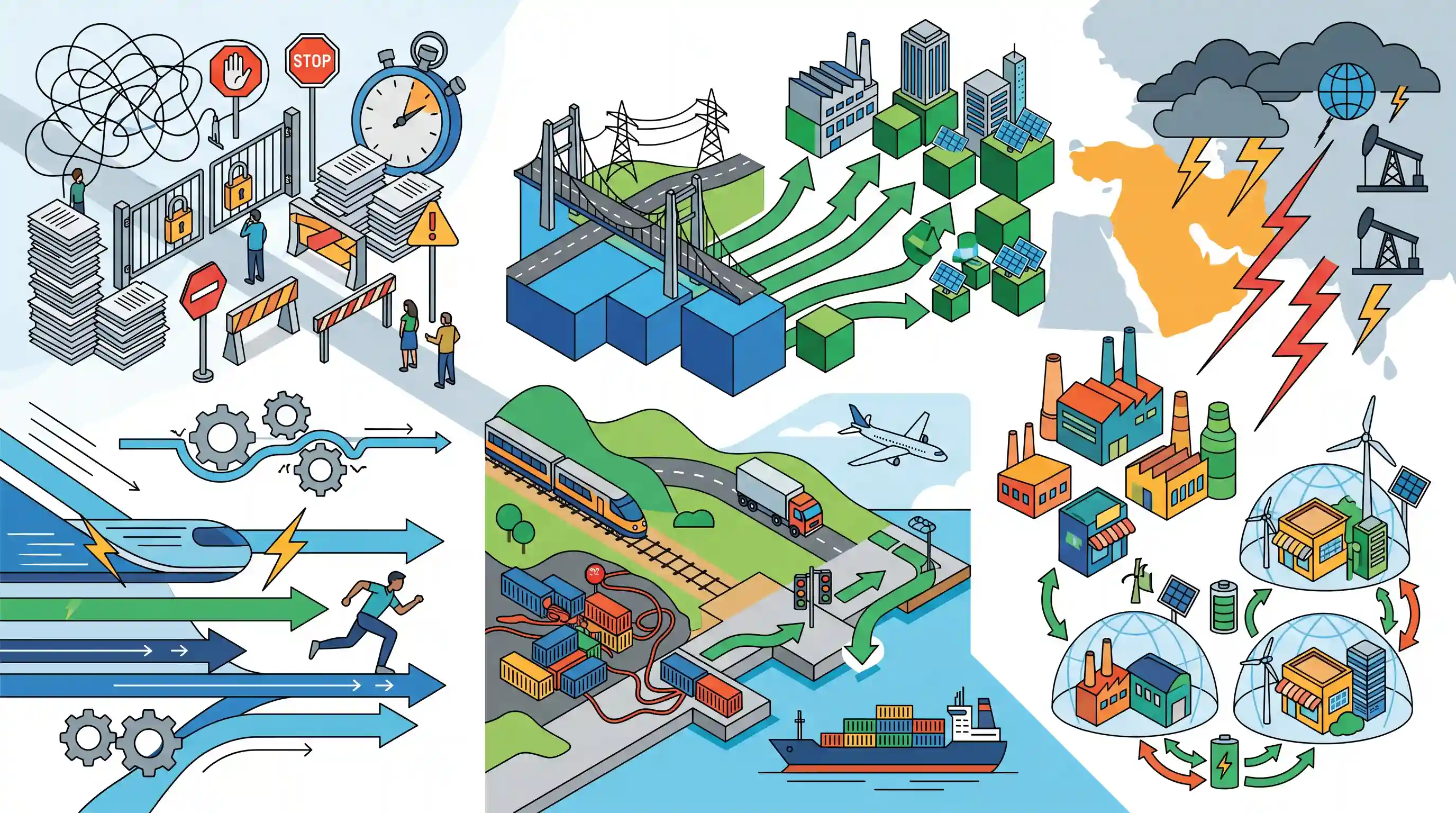
Confederation of Indian Industry (CII) President R. Mukundan has urged a shift in policy focus from the "ease and cost of doing business" to the "speed of doing business." He noted that administrative friction, such as delays in land demarcation and bureaucratic approvals, continues to hamper industrial growth. Mukundan also emphasized the need to resolve logistical bottlenecks at handover points in multimodal transport to improve efficiency. Responding to concerns from government officials regarding sluggish private investment despite high corporate profits, Mukundan argued that private capital expenditure is, in fact, rising, spurred by the "crowding-in" effect of sustained public investment. Furthermore, he highlighted the importance of building resilience in Micro, Small, and Medium Enterprises (MSMEs), which are particularly vulnerable to energy and supply chain shocks stemming from geopolitical issues like the West Asia crisis.
Key Points
- CII President R. Mukundan advocated for a paradigm shift in Indian economic policy from focusing on the 'ease and cost' to the 'speed' of doing business to eliminate administrative friction.
- He highlighted that logistical delays often occur at multimodal handover points (e.g., ship to rail, rail to road), creating bottlenecks despite improvements in primary infrastructure.
- Countering the Chief Economic Adviser's assertion of sluggish private capex, Mukundan argued that private sector investment is actively growing, driven by the 'crowding-in' effect of government capital expenditure.
- The article stresses the necessity of building resilience in MSMEs, as large manufacturing companies are highly dependent on them, making supply chains vulnerable to external shocks like the West Asia crisis.
Important Terms
Confederation of Indian Industry (CII)

A premier non-government, not-for-profit, industry-led advocacy group founded in 1895. it works to create a conducive environment for India's industrial development through policy advisory and networking.
UPSC context
GS-III: Role of business associations in policy-making; relevant for topics on industrial growth and government-industry partnership.
Crowding-in effect
An economic phenomenon where increased public investment (e.g., in infrastructure) enhances private sector productivity and confidence, leading to a subsequent rise in private capital expenditure.
UPSC context
GS-III: Indian Economy & Investment Models. Tests understanding of how public spending influences private investment cycles.
Ease of Doing Business (EoDB)
An index (formerly by World Bank) measuring the simplicity of regulations for businesses. In current policy, it refers to reducing compliance burdens and improving regulatory transparency.
UPSC context
GS-III: Economic Development and Infrastructure. A core metric for evaluating investment climate and administrative reforms.
Multimodal Transport
The integration of different modes of transport (road, rail, air, sea) under a single contract to improve efficiency, reduce transit times, and lower overall logistics costs.
UPSC context
GS-III: Infrastructure (Ports, Roads, Railways). Vital for discussing the PM Gati Shakti National Master Plan and logistics efficiency.
MSME Sector
Enterprises classified by investment and turnover limits. They are the 'backbone' of the Indian economy, contributing significantly to GDP, employment, and exports while remaining vulnerable to global shocks.
UPSC context
GS-III: Industrial Policy and Inclusive Growth. Frequently tested regarding their contribution to employment and challenges in the global supply chain.
Speed of Doing Business
An emerging policy paradigm focusing on the velocity of administrative approvals and land demarcation, aiming to eliminate 'administrative friction' that delays project execution despite regulatory ease.
UPSC context
GS-III: Government Budgeting and Economy. Represents the evolution of reform focus from 'rules' to 'implementation efficiency'.
Prelims Trap
"High public capital expenditure invariably leads to the crowding-out of private investment."
Government infrastructure spending can trigger a "crowding-in" effect by lowering logistics costs and boosting demand, stimulating private sector investment rather than displacing it.
Static Concepts Connected
What distinguishes the crowding-in and crowding-out effects of public expenditure?
- Crowding Out: Occurs when high government borrowing increases market interest rates, choking off available credit for private sector investment.
- Crowding In: Occurs when government spending (especially on physical infrastructure) boosts systemic productivity and demand, encouraging private sector capital expenditure.
How do structural interventions address multimodal transport bottlenecks?
- Handover Points: Nodes where cargo switches modes (e.g., ship-to-rail). These are frequent sites of administrative friction and logistical delays.
- PM Gati Shakti: Aims to break departmental silos by bringing 16 ministries onto a single GIS platform to synchronize infrastructure planning and eliminate transit friction.
Cross-Topic Patterns
MSME resilience + Geopolitical Crises
The vulnerability of Indian MSMEs to the West Asia crisis highlights the deep intersection between international relations (Red Sea maritime disruptions) and domestic industrial supply-chain inflation.
Corporate Profitability vs. Capex Cycle
India has transitioned from a 'Twin Balance Sheet Crisis' to healthy corporate balance sheets. However, the delayed transmission of these high profits into private gross fixed capital formation remains heavily debated.

A conceptual prelims question differentiating 'crowding-in' via infrastructure capex vs 'crowding-out' via fiscal deficit is highly likely.
Linked PYQs · 3
Linked PYQs · 3
- 2023MainsGS3
Faster economic growth requires increased share of the manufacturing sector in GDP, particularly of MSMEs. Comment on the present policies of the Government in this regard.
- 2020MainsGS3
Explain the meaning of investment in an economy in terms of capital formation. Discuss the factors to be considered while designing a concession agreement between a public entity and a private entity.
- 2021MainsGS3
“Investment in infrastructure is essential for more rapid and inclusive economic growth.” Discuss in the light of India's experience.
