India Needs Five Hundred Billion Annually for Net Zero Target
Source:The Hindu ↗
Why It Matters
Provides crucial data points on India's climate finance needs ($500 billion/year) for its 2070 net-zero targets and outlines practical steps for renewable energy integration through grid modernization, DISCOM revamps, and non-lithium storage innovations. Highly relevant for GS-3 answers on energy transitions and climate commitments.
Summary
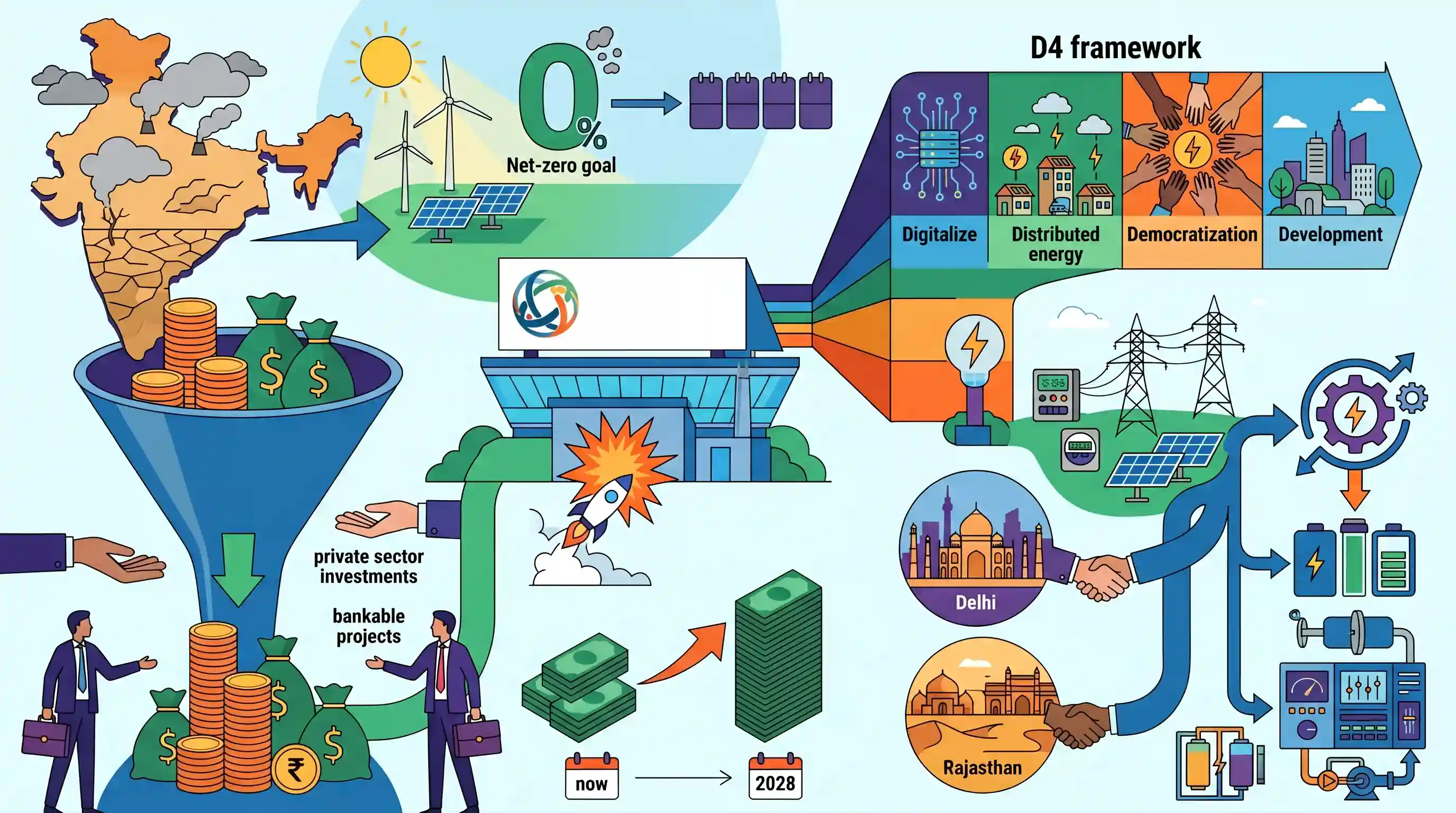
India requires $500 billion annually to meet its 2070 net-zero emissions goal, primarily demanding massive private sector investments and bankable projects, according to the Global Energy Alliance for People and Planet (GEAPP). To support this transition beyond basic energy access, GEAPP launched the 'India Grids of the Future Accelerator' at the Mumbai Climate Week 2026. The initiative will deploy up to $25 million initially—with an aim to scale to $100 million by 2028—to modernize power distribution (DISCOMs), integrate renewables, and upgrade the grid using a 'D4' framework (digitalization, distributed energy, democratization, and development). MoUs were signed with DISCOMs in Delhi and Rajasthan. Additionally, the ENTICE 3.0 challenge was launched to promote non-lithium energy storage and grid digitization.
Key Points
- India must mobilise approximately $500 billion annually ($22 trillion total) to achieve its net-zero ambition by 2070.
- Achieving this goal requires strict alignment between governments, multilateral development banks, private finance, and philanthropy to ensure project bankability.
- The Global Energy Alliance for People and Planet (GEAPP) launched the 'India Grids of the Future Accelerator' at Mumbai Climate Week 2026 with a $25 million initial outlay to modernize power grids.
- The Accelerator uses a D4 framework: Digitalization, Distributed energy resources, Democratization, and Development of an innovation ecosystem.
- GEAPP signed MoUs with DISCOMs in Delhi and Rajasthan, and launched ENTICE 3.0 to focus on non-lithium energy storage solutions and rapid grid digitization.
Important Terms
Global Energy Alliance for People and Planet (GEAPP)

A global philanthropic-led alliance (including Rockefeller and IKEA Foundations) that partners with governments to accelerate equitable green energy transitions and end energy poverty in emerging economies like India.
UPSC context
GS Paper III (Environment/Climate Finance); tests international cooperation models for achieving India's 2070 Net-Zero targets.
India Grids of the Future Accelerator
A national platform launched to modernize India’s power distribution networks using the 'D4' framework: Digitalization, Distributed energy, Democratization, and Development to integrate renewable energy and storage.
UPSC context
GS Paper III (Infrastructure: Energy); relevant for grid modernization, DISCOM reforms, and private-sector investment in energy infrastructure.
Energy Transitions Innovation Challenge (ENTICE 3.0)
A flagship clean-tech innovation platform by GEAPP and Startup India; its 3.0 edition specifically targets non-lithium energy storage and AI-driven hyperlocal demand forecasting for power grids.
UPSC context
GS Paper III (Science & Technology); focuses on indigenization of energy storage and AI applications in power sector management.
All India DISCOM Association (AIDA)
A collaborative body representing public and private power distribution utilities in India, focusing on policy advocacy, standardizing technical specifications, and building institutional capacity for energy transition.
UPSC context
GS Paper III (Economy: Energy Sector); crucial for understanding institutional reforms needed to improve DISCOM financial health and operational efficiency.
Multilateral Development Banks (MDBs)
International financial institutions (e.g., World Bank, ADB) that provide capital and technical expertise to developing nations; they are essential for de-risking climate projects and providing blended finance.
UPSC context
GS Paper III (Economy/Investment Models); tests knowledge of international financial architecture and its role in bridging India's multi-trillion dollar climate-finance gap.
Prelims Trap
GEAPP is an intergovernmental specialized agency of the United Nations focused on climate finance.
GEAPP is actually a multi-stakeholder platform launched at COP26, backed primarily by philanthropic foundations (Rockefeller, IKEA, Bezos Earth Fund), not a UN agency.
Static Concepts Connected
What are India's primary Panchamrit climate targets leading up to the 2070 Net-Zero goal?
- Non-Fossil Capacity: Reach 500 GW of non-fossil energy capacity by the year 2030.
- Renewable Energy Share: Meet 50% of the country's energy requirements from renewable energy sources by 2030.
- Emission Intensity: Reduce the carbon emissions intensity of the economy by 45% by 2030 compared to 2005.
What are the emerging non-lithium grid energy storage technologies being promoted?
- Sodium-Ion Batteries: Utilizes abundant sodium, offering a significantly cheaper and safer alternative to lithium, especially suited for stationary grid storage.
- Vanadium Flow Batteries: Liquid electrolyte batteries that provide highly scalable, long-duration energy storage without degrading over thousands of cycles.
- Pumped Hydro Storage: Mechanical storage that pumps water to a higher elevation during low demand, releasing it through turbines during peak grid demand.
Cross-Topic Patterns
Non-lithium shift & Critical Minerals security
Focusing on non-lithium storage (ENTICE 3.0) links climate goals with geopolitics, reducing India's supply chain vulnerability and over-reliance on a few countries for critical minerals processing.
Climate Finance vs DISCOM health
Clean energy targets are bottlenecked by grid readiness. The D4 framework's focus on distribution aligns with India's Revamped Distribution Sector Scheme (RDSS) to fix the chronic financial unviability of DISCOMs.

GEAPP's philanthropic origin will likely be tested as a trap against UN bodies, paired with non-lithium storage advantages for Prelims.
Linked PYQs · 3
Linked PYQs · 3
- 2022MainsGS3
Do you think India will meet 50 percent of its energy needs from renewable energy by 2030 ? Justify your answer. How will the shift of subsidies from fossil fuels to renewables help achieve the above objective ? Explain.
- 2021MainsGS3
Explain the purpose of the Green Grid Initiative launched at World Leaders Summit of the COP26 UN Climate Change Conference in Glasgow in November, 2021. When was this idea first floated in the International Solar Alliance (ISA)?
- 2024PrelimsGS1
Consider the following statements: Statement-I : The European Parliament approved The Net-Zero Industry Act recently. Statement-II: The European Union intends to achieve carbon neutrality by 2040 and therefore aims to develop all of its own clean technology by that time. Which one of the following is correct in respect of the above statements?
