India Energy Security Strategy Needs Structural Policy Shift
Source:Indian Express ↗
ఇది ఎందుకు ముఖ్యం
It addresses India's core developmental challenge of ensuring long-term energy security and structural reforms required to balance rapid economic growth with clean energy transition.
సారాంశం
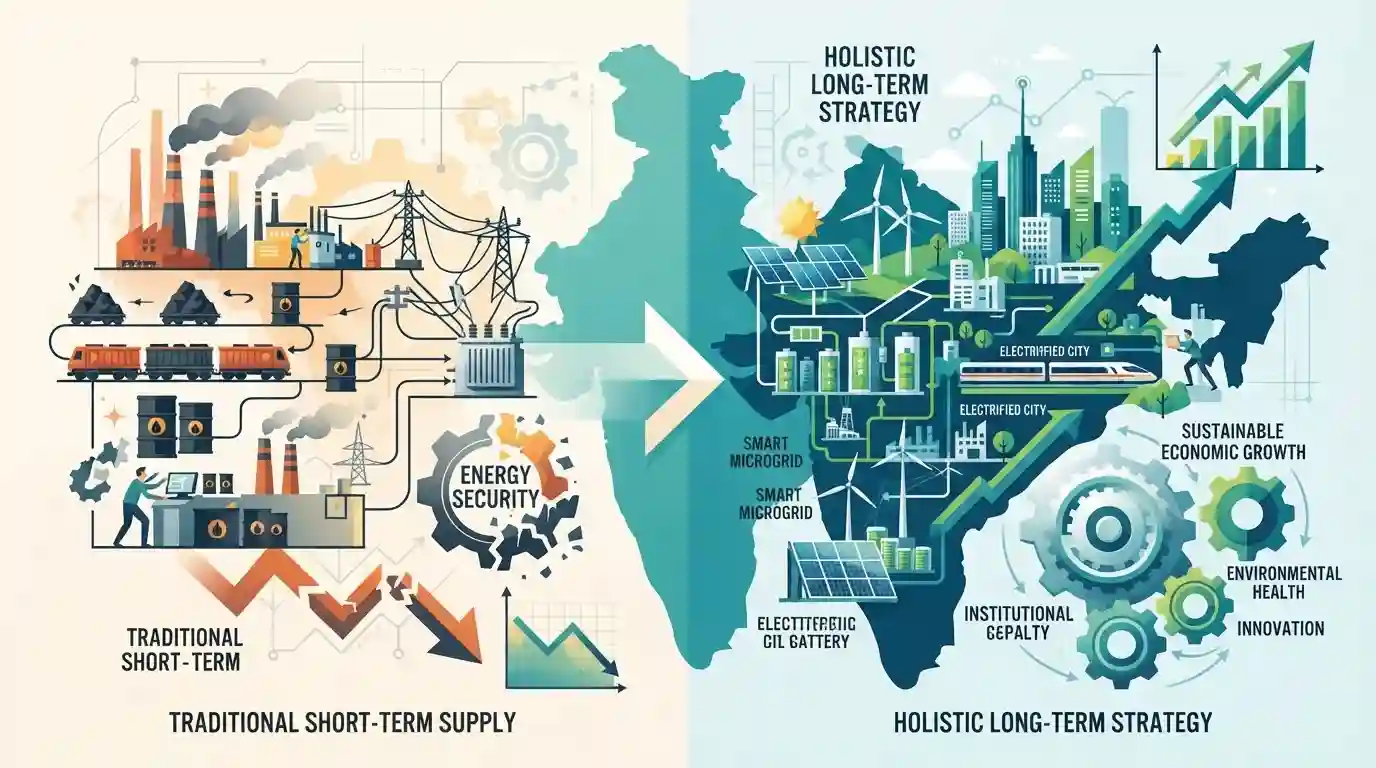
The article discusses how India's approach to energy planning needs a fundamental paradigm shift. It stresses that energy security must move beyond short-term supply management to address long-term structural, environmental, and institutional challenges necessary for sustainable economic growth.
ముఖ్య అంశాలు
- India needs to transition from viewing energy strictly through a supply-scarcity lens to a comprehensive strategic framework encompassing security, sustainability, and technological self-reliance.
- Institutional fragmentation across different energy ministries and departments creates hurdles for cohesive long-term policy formulation.
- Balancing rapid economic expansion with decarbonization goals requires integrated policy architecture rather than isolated sectoral interventions.
ముఖ్యమైన పదాలు
Long-Term Low Emission Development Strategy (LT-LEDS)

A comprehensive national roadmap submitted under the Paris Agreement detailing a country's pathway toward low-carbon transition and net-zero targets while safeguarding energy security and developmental priorities.
UPSC context
UPSC Prelims/Mains (GS Paper III): Environment, Climate Change commitments, and India's net-zero transition strategy under international treaties.
UNFCCC
The primary international environmental treaty negotiated at the 1992 Earth Summit to stabilize greenhouse gas concentrations in the atmosphere at a level preventing dangerous anthropogenic interference with the climate system.
UPSC context
UPSC Prelims/Mains (GS Paper III): International environmental conventions, global climate governance, and principles like CBDR-RC.
ప్రిలిమ్స్ ఉచ్చు
Achieving non-fossil capacity targets eliminates India's external energy vulnerabilities and import dependencies.
Aspirants often assume achieving the 50% non-fossil capacity target means India is entirely self-reliant in energy, ignoring import dependencies on critical minerals and fossil fuels.
అనుసంధానమైన స్థిర భావనలు
What are the key institutional pillars and governance challenges of India's energy sector?
- Institutional split: Fragmented governance spread across Power, Petroleum, Coal, and New & Renewable Energy ministries.
- DISCOM fragility: State-level DISCOM financial distress creating bottlenecks for grid integration and renewable absorption.
- Import vulnerability: Heavy import dependency on crude oil (approx 90%) exposing the macroeconomy to external price shocks.
అంతర-అంశ నమూనాలు
Energy Security vs Critical Mineral Dependence
Transitioning from fossil fuels to renewables replaces oil import dependency with severe foreign supply chain vulnerabilities for critical minerals like lithium and cobalt.
Climate Targets vs Fiscal Federalism
The massive financial distress of state DISCOMs acts as a primary transmission channel bottleneck for achieving India's international climate commitments.

Energy security + critical mineral supply chains + DISCOM distress likely to feature as a multi-statement Mains/Prelims linkage.
అనుసంధాన PYQలు · 2
అనుసంధాన PYQలు · 2
- 2026PrelimsGS1
Consider the following statements with reference to India's response to climate change : I. India's Long-Term Low Emission Development Strategy (LT-LEDS) is a crucial tool for achieving net-zero emissions by 2070. II. India's 4th Biennial Update Report (BUR-4) submitted in December, 2024 recorded around 8% decrease in Greenhouse gas emissions in 2020 over 2019. III. Climate-resilient development necessarily depends on quick and short-term achievement of emission reduction targets. Which of the following relationships among the above statements is/are correct ? 1. Statement I is empirically supported by statement II. 2. Statement III contradicts the approach implicit in statement I. 3. Statement I and statement III together establish the premise of long-term sustainability. Select the answer using the code given below :
- 2020MainsGS2
Institutional quality is a crucial driver of economic performance". In this context suggest reforms in Civil Service for strengthening democracy.
