Strategic Trade Navigation in a Protectionist Global Economy
Source:Indian Express ↗
Why It Matters
Understanding the macroeconomic fallout of trade wars and protectionist policies is highly relevant for GS-3, while the strategic navigation of bilateral relationships falls directly under GS-2. These themes frequently appear in Mains questions concerning the WTO's relevance and India's economic resilience.
Summary
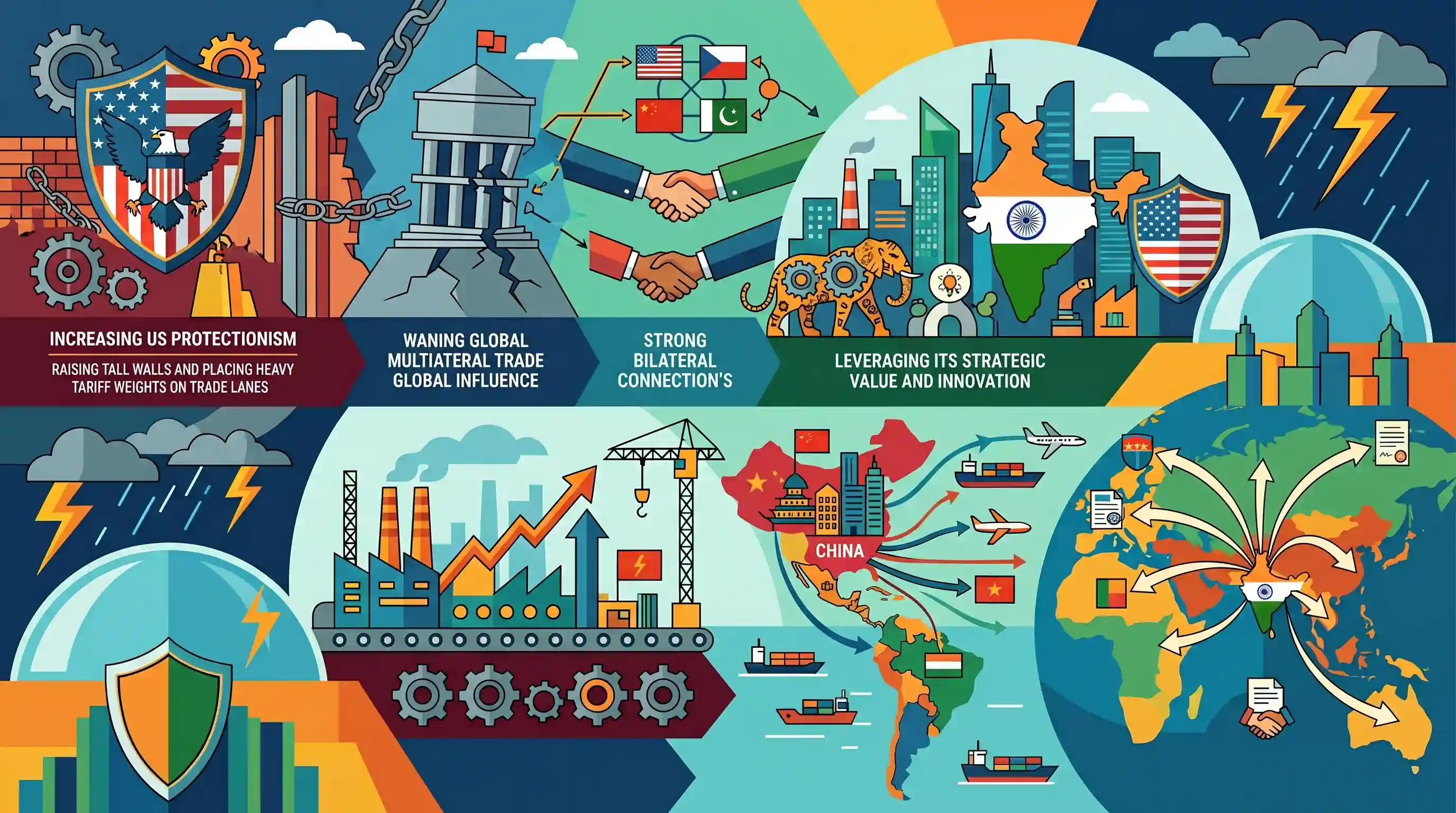
The article analyzes how India must strategically position itself in a global trade environment increasingly dominated by US protectionism and the prospect of steep tariffs under a Trump administration. As multilateralism gives way to bilateralism and the WTO's influence wanes, the piece argues that India should leverage its strategic value to the US to protect its trade interests. Furthermore, it emphasizes the necessity for India to boost domestic manufacturing competitiveness, capitalize on the 'China plus one' supply chain shift, and aggressively diversify its export markets through smart Free Trade Agreements (FTAs) to mitigate global economic shocks.
Key Points
- The anticipated shift towards aggressive US protectionism and tariffs under a Trump administration poses significant challenges to global trade norms and export-driven economies.
- As multilateral institutions like the WTO lose efficacy, the global economic order is pivoting towards bilateralism and inward-looking trade policies.
- India must strategically leverage its geopolitical relationship with the US to negotiate favorable bilateral trade terms or exemptions from broader tariff walls.
- To navigate the fallout of a US-China trade war, India should accelerate its integration into alternative global supply chains via the "China plus one" strategy.
- Sustaining economic growth requires India to enhance domestic manufacturing competitiveness and aggressively diversify its export markets through balanced FTAs.
Important Terms
Free Trade Agreements (FTAs)

Formal pacts between two or more nations to reduce or eliminate customs duties and trade barriers on goods and services, facilitating easier market access.
UPSC context
GS Paper II/III: Tests understanding of trade diplomacy, export diversification, and India's strategy to navigate global protectionism.
Production-Linked Incentive (PLI) scheme
A flagship industrial policy providing financial incentives to domestic manufacturers based on incremental production/sales to boost local manufacturing and reduce import dependency.
UPSC context
GS Paper III: Vital for questions on industrial growth, 'Aatmanirbhar Bharat', and enhancing global competitiveness in key sectors.
World Trade Organization (WTO)
A global intergovernmental organization that regulates and facilitates international trade, aiming for a rules-based, non-discriminatory multilateral trading system.
UPSC context
GS Paper II/III: Focuses on multilateralism vs. bilateralism and the impact of institutional paralysis on developing economies.
China Plus One Strategy
A global business strategy where companies diversify supply chains by establishing manufacturing hubs in countries other than China to mitigate geopolitical and supply risks.
UPSC context
GS Paper III: Relevant for supply chain resilience, FDI inflows, and India's emergence as an alternative global manufacturing hub.
Protectionism
Economic policies, such as high tariffs or quotas, designed to restrict imports to protect domestic industries from foreign competition.
UPSC context
GS Paper III: Tests analysis of trade wars, deglobalization, and their impact on India’s macroeconomic stability and export growth.
Prelims Trap
Free Trade Agreements (FTAs) violate the WTO's Most-Favored-Nation (MFN) principle and are strictly prohibited under general WTO rules.
FTAs are an explicit exception to the MFN principle under Article XXIV of the GATT, provided they eliminate duties on 'substantially all trade' between members.
Static Concepts Connected
How do bilateral FTAs legally bypass the WTO's Most-Favored-Nation (MFN) principle?
- Article XXIV: GATT Article XXIV allows countries to form customs unions or FTAs, creating a legal exemption from the MFN rule.
- Coverage Condition: The agreement must eliminate tariffs and restrictions on 'substantially all the trade' between the participant nations.
- Enabling Clause: Provides an additional MFN exception exclusively for developing countries to form preferential trade agreements among themselves.
What are the three legitimate trade remedy measures permitted under WTO framework?
- Anti-Dumping Duty: Imposed on imports priced below their normal value in the exporting country's domestic market, causing material injury to domestic industry.
- Countervailing Duty: Levied to neutralize the negative effects of specific unfair subsidies provided by the exporting country to its producers.
- Safeguard Measures: Temporary restrictions to protect a domestic industry from a sudden, unforeseen surge in imports that threatens serious injury.
Cross-Topic Patterns
Tariff barriers and currency dynamics
Rising US tariffs often trigger competitive currency devaluation by targeted nations like China to maintain export parity, indirectly impacting India's forex reserves and Real Effective Exchange Rate (REER).
PLI + Infrastructure Pipeline Integration
The success of the 'China plus one' PLI strategy depends heavily on executing the National Infrastructure Pipeline (NIP) to reduce India's logistics costs from 14% to the global average of 8%.

Protectionism + WTO Dispute Settlement crisis + India's strategic FTA shift likely to form a 15-marker GS3 Mains question in 2026.
Linked PYQs · 3
Linked PYQs · 3
- 2018MainsGS3
How would the recent phenomena of protectionism and currency manipulations in world trade affect macroeconomic stability of India?
- 2025MainsGS3
What are the challenges before the Indian economy when the world is moving away from free trade and multilateralism to protectionism and bilateralism? How can these challenges be met?
- 2018MainsGS2
What are the key areas of reform if the WTO has to survive in the present context of "Trade War', especially keeping in mind the interest of India?
