Innovative strategies required for tuberculosis elimination by 2025
Source:The Hindu ↗
Why It Matters
Tuberculosis remains a defining public health crisis in India. The government's aggressive target to eliminate TB by 2025 makes this a highly relevant topic for the UPSC examination, testing candidates on the intersection of public healthcare systems, welfare policies (GS2), and the management of drug-resistant diseases (GS3).
Summary
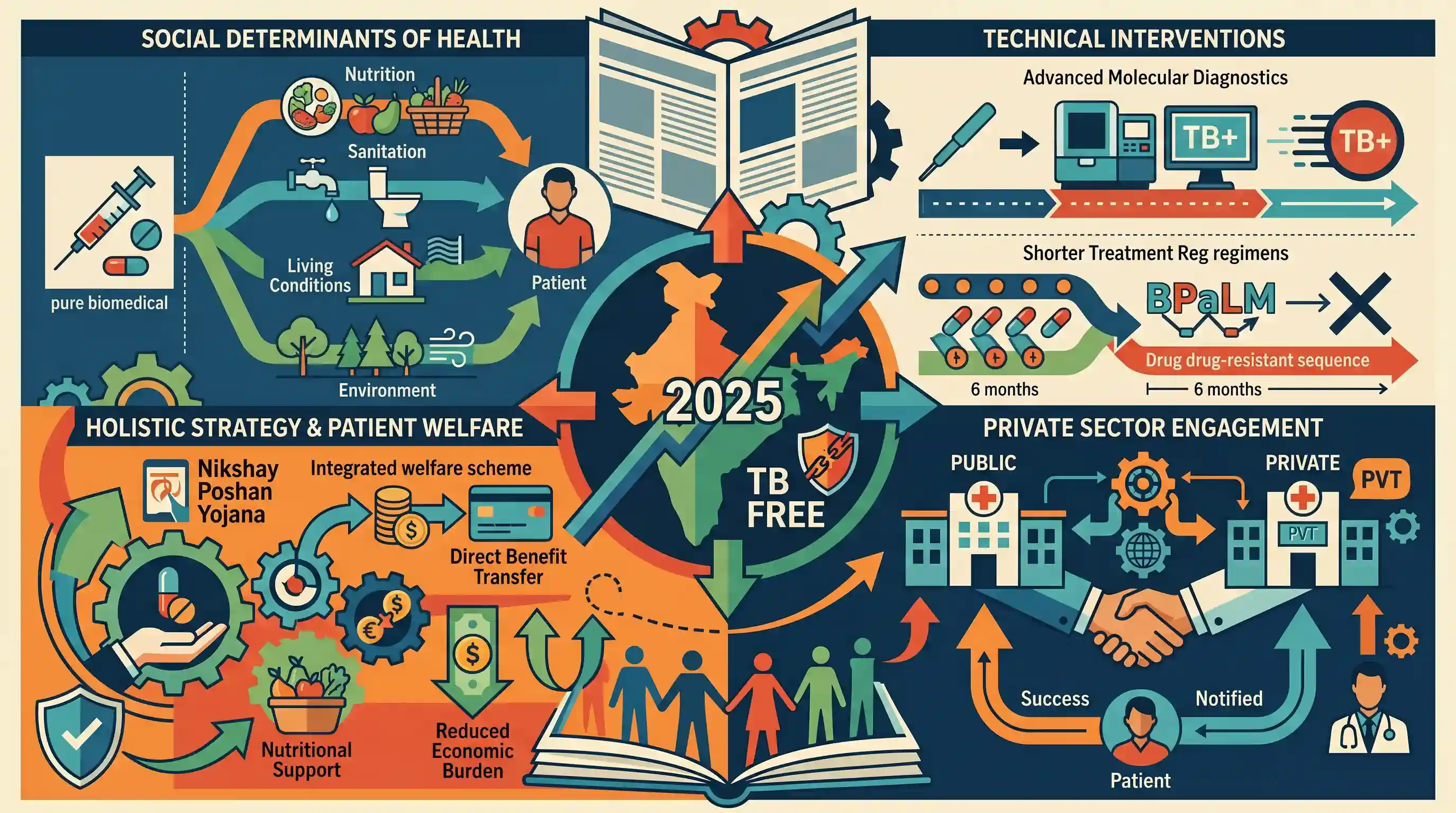
The article emphasizes the urgency of adopting innovative and multi-sectoral strategies to meet India’s ambitious target of eliminating tuberculosis by 2025. It underscores the necessity of moving beyond purely biomedical approaches by addressing social determinants of health, such as nutrition, sanitation, and living conditions. Accelerating the deployment of advanced molecular diagnostics, improving private healthcare sector engagement, and rapidly adopting shorter treatment regimens for drug-resistant TB (like BPaLM) are highlighted as crucial technical interventions. Ultimately, a holistic public health strategy integrating patient welfare schemes, like the Nikshay Poshan Yojana, is advocated to reduce the socio-economic burden on patients, ensure treatment success, and curb disease transmission.
Key Points
- India has set an ambitious target to eliminate Tuberculosis (TB) by 2025, five years ahead of the global Sustainable Development Goal (SDG) target.
- Addressing social determinants of health, such as undernutrition, poverty, and poor living conditions, is just as critical as biomedical interventions in controlling TB incidence.
- The emergence of drug-resistant strains (MDR-TB and XDR-TB) poses a severe challenge, requiring the rapid adoption and scaling of shorter, more effective treatment regimens like BPaLM.
- Expanding active case finding through advanced molecular diagnostics (CBNAAT, Truenat) and formalizing private sector engagement are essential to identify 'missing' cases.
- Patient-centric approaches, including direct benefit transfers via the Nikshay Poshan Yojana, are vital to ensure treatment adherence and mitigate the catastrophic financial impact on affected families.
Important Terms
End TB Strategy

A WHO global framework targeting a 95% reduction in TB deaths and 90% in incidence by 2035. It emphasizes patient-centered care, bold policies, and intensified research to eliminate the disease's socio-economic burden.
UPSC context
GS-II/III: Tests understanding of international health targets and India's commitment to global infectious disease elimination goals.
National Tuberculosis Elimination Programme (NTEP)
India’s flagship health program (formerly RNTCP) aiming to eliminate TB by 2025. It utilizes the "Detect-Treat-Prevent-Build" strategy, focusing on universal molecular diagnosis and enhanced private sector engagement.
UPSC context
GS-II: Essential for questions on domestic health infrastructure, programmatic shifts, and India’s target-driven health governance.
Nikshay Poshan Yojana
A 2018 Indian government scheme providing a monthly financial incentive (recently increased to ₹1,000) via Direct Benefit Transfer to all notified TB patients for nutritional support during treatment.
UPSC context
GS-II: Evaluates knowledge of social security and welfare schemes targeting the synergy between malnutrition and infectious diseases.
BPaLM regimen
A six-month, all-oral treatment regimen for drug-resistant TB comprising Bedaquiline, Pretomanid, Linezolid, and Moxifloxacin. It offers a shorter, more effective alternative to traditional 18-24 month injectable treatments.
UPSC context
GS-III: Tests awareness of medical breakthroughs and the adoption of advanced clinical protocols for antimicrobial resistance.
World Health Organization (WHO)
The United Nations' specialized agency for international health. It sets global standards, coordinates pandemic responses, and publishes the Global TB Report to monitor progress toward elimination.
UPSC context
GS-II: Crucial for understanding global health governance and the role of international bodies in national policy-making.
Prelims Trap
"Nikshay Poshan Yojana provides financial assistance only to TB patients receiving treatment in government facilities."
The scheme provides DBT financial assistance for nutrition to ALL notified TB patients, including those diagnosed and treated in the private sector.
Static Concepts Connected
What defines Multidrug-Resistant (MDR-TB) and Extensively Drug-Resistant (XDR-TB)?
- MDR-TB: Caused by bacteria resistant to at least Isoniazid and Rifampicin, the two most potent first-line anti-TB drugs.
- XDR-TB: A rare type of MDR-TB that is additionally resistant to any fluoroquinolone and at least one second-line injectable drug.
- Primary causes: The primary drivers are incorrect prescription practices, poor quality drugs, and patients prematurely stopping treatment.
What are CBNAAT and Truenat in public health diagnostics?
- Molecular Diagnostics: They are rapid molecular tests utilized to quickly detect Mycobacterium tuberculosis and its resistance to Rifampicin.
- Truenat: An indigenously developed, portable, battery-operated device that enables rapid TB testing at decentralized primary healthcare centers.
Cross-Topic Patterns
AMR crisis & MDR-TB overlap
The rise of MDR-TB connects directly to the broader Antimicrobial Resistance (AMR) crisis, linking GS2 public health challenges with GS3 biotechnology and regulatory issues.
Social Determinants of Health
TB elimination requires addressing poverty and undernutrition. This links GS2 Health interventions with GS2 Social Justice topics, emphasizing multi-sectoral approaches over purely biomedical ones.

Expect a multi-statement Prelims question in 2026 linking indigenous Truenat, the BPaLM regimen, and the definitions of MDR/XDR-TB.
Linked PYQs · 3
Linked PYQs · 3
- 2024MainsGS2
In a crucial domain like the public healthcare system the Indian State should play a vital role to contain the adverse impact of marketisation of the system. Suggest some measures through which the State can enhance the reach of public healthcare at the grassroots level.
- 2014MainsGS3
Can overuse and free availability of antibiotics without Doctor's prescription, be contributors to the emergence of drug-resistant diseases in India? What are the available mechanisms for monitoring and control? Critically discuss the various issues involved.
- 2021MainsGS2
“Besides being a moral imperative of a Welfare State, primary health structure is a necessary precondition for sustainable development.” Analyze.
