Second Generation Decentralisation Reforms for Local Governance
Source:The Hindu ↗
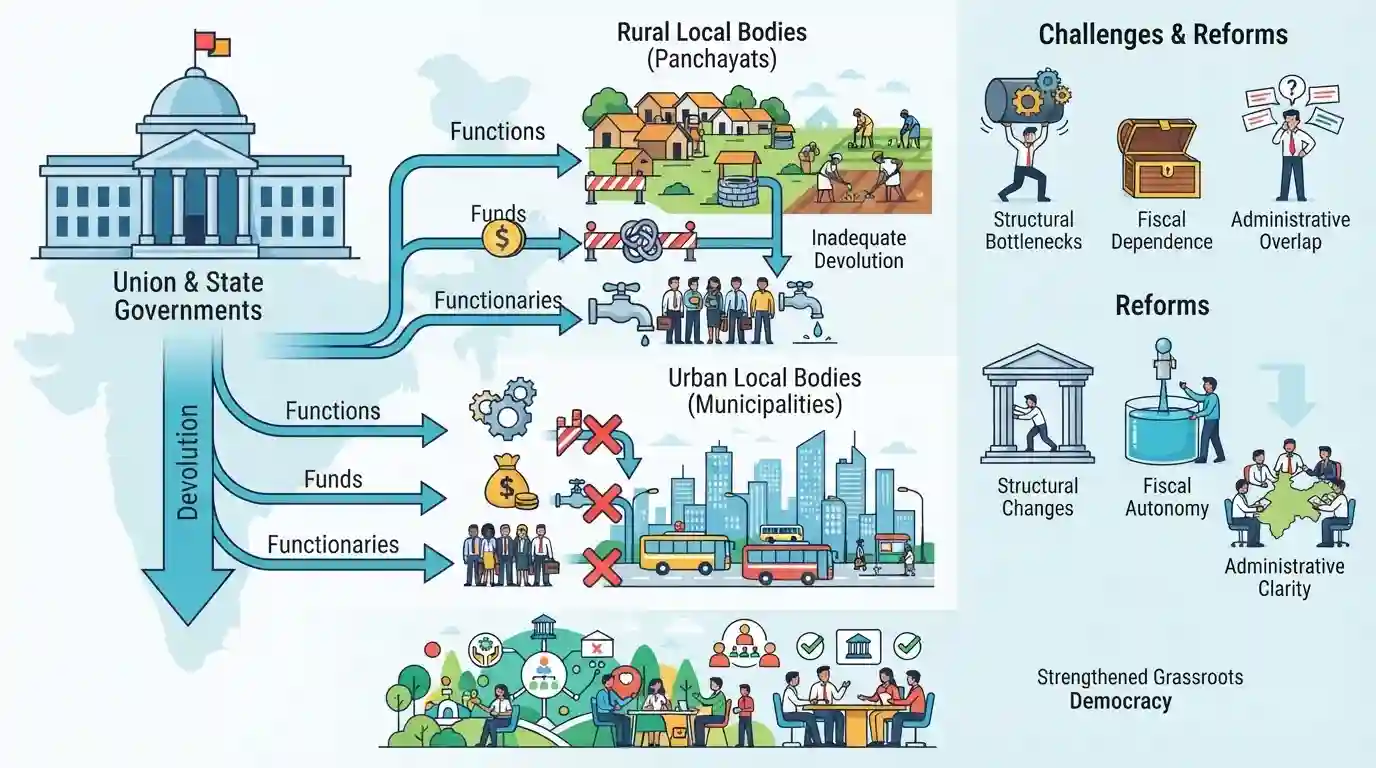
આ શા માટે મહત્વનું છે
Local government reform is central to deepening Indian democracy, effective last-mile public service delivery, and addressing the systemic challenges of urbanisation and rural development outlined in GS Paper II.
સારાંશ
The article discusses the necessity for India to implement second-generation decentralisation reforms. It highlights the systemic bottlenecks plaguing rural and urban local bodies—specifically the inadequate devolution of funds, functions, and functionaries (3Fs)—and calls for robust structural, fiscal, and administrative changes to strengthen grassroots democracy and local governance.
મુખ્ય મુદ્દા
- India requires a second generation of decentralisation reforms to move beyond token local governance to empowered grassroots democracy.
- Despite the 73rd and 74th Amendments, local bodies suffer from inadequate devolution of funds, functions, and functionaries (3Fs).
- Fiscal federalism at the local level needs strengthening through autonomous revenue-generating powers and predictable state-local financial transfers.
- Enhancing local capacity, bureaucratic accountability to elected local leaders, and citizen participation are essential for effective local governance.
મહત્વપૂર્ણ શબ્દો
73rd and 74th Constitutional Amendment Acts

Landmark 1992 constitutional amendments that provided a formal framework for rural panchayats and urban local bodies, institutionalising grassroots democracy through regular elections and reservations.
UPSC context
Core syllabus topic for GS Paper II under 'Devolution of Powers and Finances up to Local Levels'.
Finance Commission
A constitutional body under Article 280 that recommends the distribution of tax revenues between the Union and States, and suggests grants to augment local body resources.
UPSC context
Important for GS Paper II under 'Centre-State Financial Relations and Fiscal Federalism'.
પ્રિલિમ્સ ટ્રેપ
The 73rd and 74th Constitutional Amendment Acts automatically ensure complete and mandatory devolution of funds, functions, and functionaries to local bodies across all states.
The 73rd and 74th Amendments made local body elections and constitution mandatory, but actual devolution of the 3Fs (Funds, Functions, Functionaries) remains entirely at the discretion of respective State Legislatures, not constitutionally mandated in an absolute manner.
સંલગ્ન સ્થિર ખ્યાલો
What are the constitutional provisions regarding State Finance Commissions in India?
- Constitutional Basis: Mandated under Article 243-I (for panchayats) and Article 243-Y (for municipalities).
- Composition & Tenure: Constituted every five years by the Governor of the state.
- Core Function: Recommends the principles governing the distribution of net proceeds of taxes between the state and local bodies, and grants-in-aid.
આંતર-વિષય પેટર્ન
Local Governance + Central Welfare Delivery
Local body fiscal stress directly impacts the execution and last-mile delivery of central welfare schemes like MGNREGA and AMRUT, creating a structural implementation gap.
Fiscal Federalism + Multi-tier Financial Architecture
State Finance Commissions must align with recommendations of the Union Finance Commission to streamline vertical and horizontal fiscal transfers down to the third tier.

Local bodies' 3Fs devolution and Fiscal Federalism are prime candidates for a Mains GS-2 analytical question on cooperative federalism.
સંલગ્ન PYQ · 2
સંલગ્ન PYQ · 2
- 2024MainsGS2
Analyse the role of local bodies in providing good governance at local level and bring out the pros and cons merging the rural local bodies with the urban local bodies.
- 2020MainsGS2
The strength and sustenance of local institutions in India has shifted from their formative phase of 'Functions, Functionaries and Funds' to the contemporary stage of 'Functionality'. Highlight the critical challenges faced by local institutions in terms of their functionality in recent times.
