WTO Special and Differential Treatment and India Negotiating Strategy
Source:Indian Express ↗
Why It Matters
S&DT is foundational to India's economic diplomacy and domestic policy space. Understanding the debate over developing country status is crucial for UPSC aspirants as it directly ties into India's ability to maintain food security initiatives (like MSP and PDS) and shield emerging industries from global market volatility.
Summary
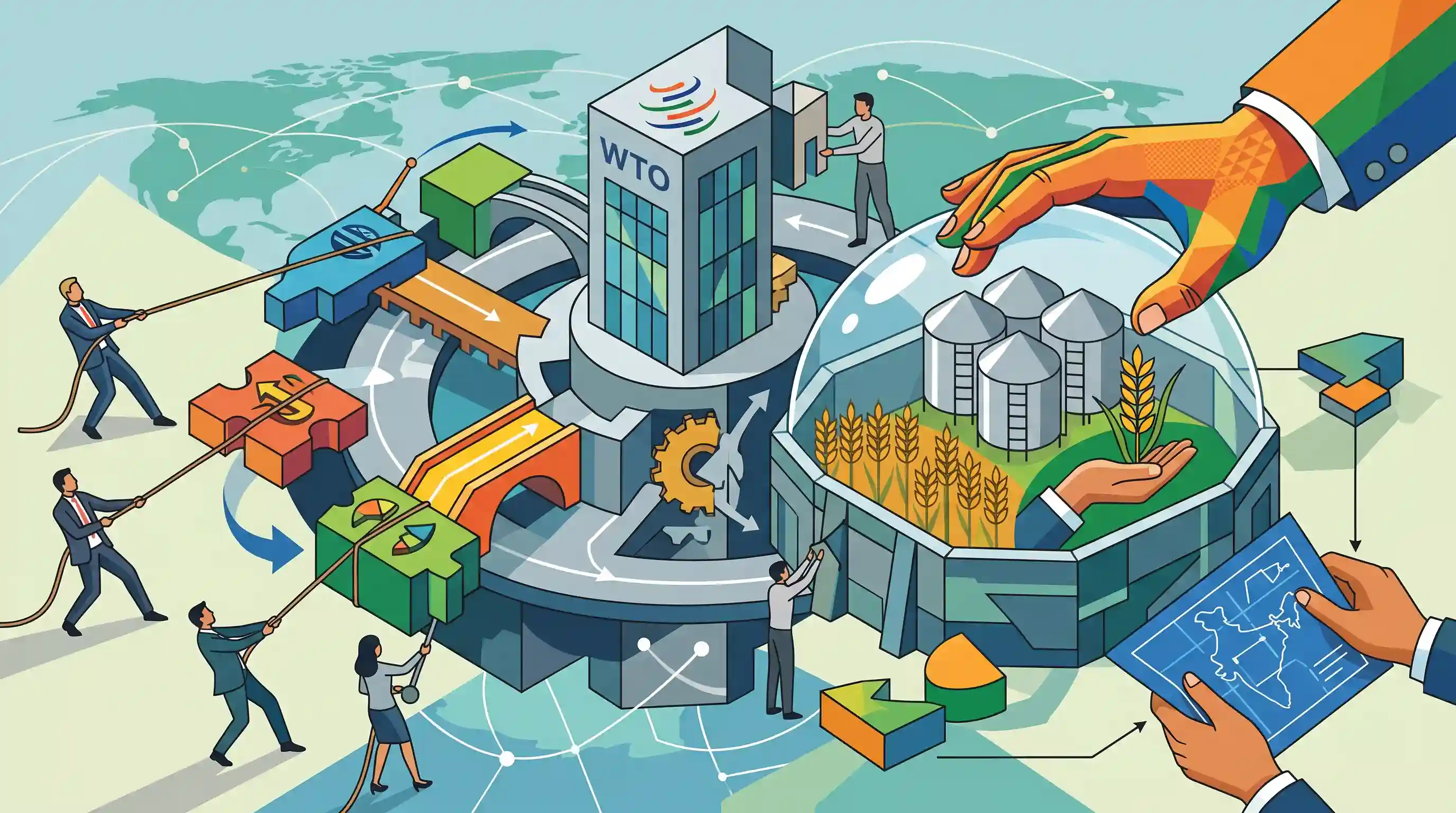
The article underscores the critical need for India to formulate a clear, strategic plan regarding Special and Differential Treatment (S&DT) at the World Trade Organization (WTO). As developed countries push to reform the self-declaration of 'developing country' status, seeking to strip large emerging economies of blanket trade exemptions, India's core interests are at stake. A well-crafted strategy is necessary to defend S&DT in vulnerable sectors—such as agricultural subsidies and public stockholding for food security—while navigating the broader push for WTO structural reforms.
Key Points
- Special and Differential Treatment (S&DT) provisions allow developing nations longer transition periods and greater policy flexibility when implementing WTO agreements.
- Developed nations, notably the US, are heavily contesting the 'self-declaration' mechanism for developing country status, aiming to graduate large economies like India and China out of S&DT benefits.
- India relies on S&DT to safeguard its vulnerable domestic sectors, particularly to maintain minimum support prices (MSP) and public stockholding for food security without breaching WTO subsidy limits.
- India needs a proactive and comprehensive negotiating strategy at the WTO rather than purely defensive posturing, to balance its domestic developmental needs with necessary global trade reforms.
Important Terms
World Trade Organization (WTO)

An international organization (est. 1995) that regulates global trade, provides a forum for negotiations, and settles trade disputes under a rules-based system.
UPSC context
GS Paper 2: Important International Institutions; tests understanding of global governance and India's role in multilateral trade negotiations.
Special and Differential Treatment (S&DT)
WTO provisions granting developing and least-developed nations flexibilities, such as longer transition periods and softer obligations, to implement trade agreements.
UPSC context
GS Paper 2 & 3: International Relations and Economy; critical for understanding trade equity and India's defensive strategy at the WTO.
Agreement on Agriculture (AoA)
A 1995 WTO treaty aimed at reforming agricultural trade by reducing trade-distorting subsidies and improving market access via three pillars: domestic support, market access, and export competition.
UPSC context
GS Paper 3: Issues related to direct and indirect farm subsidies and MSP; essential for analyzing India's food security policies.
Doha Development Round
A WTO negotiation round launched in 2001 (Doha Development Agenda) intended to prioritize the needs of developing countries in the global trading system.
UPSC context
GS Paper 2: Bilateral, regional, and global groupings; tests knowledge of stalled multilateral negotiations and North-South trade divides.
Amber Box Subsidies
Agricultural subsidies considered trade-distorting (e.g., MSP, input subsidies) that are subject to reduction commitments under the WTO Agreement on Agriculture.
UPSC context
GS Paper 3: Farm subsidies and MSP; key for evaluating WTO compliance of Indian agricultural support schemes.
Public Stockholding (PSH)
A policy where governments procure and store food grains to ensure food security, often causing conflict with WTO subsidy limits.
UPSC context
GS Paper 3: Food security and buffer stocks; central to India's demand for a "permanent solution" at the WTO.
Prelims Trap
The WTO classifies developing countries based on per capita income thresholds determined by the World Bank.
The WTO does not officially define "developed" or "developing" countries. Members self-declare their status, though this mechanism is increasingly contested by developed nations.
Static Concepts Connected
What are the three subsidy "boxes" under the WTO Agreement on Agriculture (AoA)?
- Amber Box: Trade-distorting subsidies (like MSP linked to production volumes) that must be reduced. Capped by "de minimis" limits.
- Blue Box: Amber Box-type subsidies that come with conditions designed to limit production (e.g., quotas). These are currently permitted without limits.
- Green Box: Non-trade-distorting subsidies (e.g., agricultural R&D, environmental protection, direct income support decoupled from production). Permitted without limits.
How does the WTO calculate the 'de minimis' limit for agricultural subsidies?
- De minimis limits: Caps on Amber Box subsidies are set at 5% of the total value of agricultural production for developed nations and 10% for developing nations.
- FERP Benchmark: Subsidy levels are mathematically calculated against a Fixed External Reference Price (FERP) based on 1986-1988 global prices, completely ignoring decades of inflation.
Cross-Topic Patterns
NFSA mandates vs. WTO limits
India’s domestic obligations under the National Food Security Act require massive public stockholding, creating perennial friction with WTO’s Amber Box caps and relying heavily on the precarious Peace Clause.
Voice of the Global South diplomacy
Defending S&DT is crucial for India’s geopolitical positioning. Leading the resistance against stripping 'developing' status reinforces India's claim as the premier advocate for the Global South.

Expect a multi-statement Prelims question merging the WTO's 'self-declaration' status, 10% Amber Box limits, and 1986-88 base year.
Linked PYQs · 4
Linked PYQs · 4
- 2018MainsGS2
What are the key areas of reform if the WTO has to survive in the present context of "Trade War', especially keeping in mind the interest of India?
- 2016MainsGS2
The broader aims and objectives of WTO are to manage and promote international trade in the era of globalization. But the Doha round of negotiations seem doomed due to differences between the developed and the developing countries." Discuss in the Indian perspective.
- 2023MainsGS3
What are the direct and indirect subsidies provided to farm sector in India? Discuss the issues raised by the World Trade Organization (WTO) in relation to agricultural subsidies.
- 2014MainsGS2
WTO is an important international institution where decisions taken affect countries in a profound manner. What is the mandate of WTO and how binding are their decisions ? Critically analyse India's stand on the latest round of talks on Food security.
