Prime Minister inaugurates Rajasthan refinery complex in Pachpadra
Source:The Hindu ↗
Why It Matters
This development illustrates how India integrates energy security with foreign policy trajectories, utilizing diplomatic maneuvering to manage external resource shocks (such as West Asia tensions). Economically, it showcases how fiscal policies (excise duty cuts) and state-directed resource planning shield domestic consumers from international inflation. Geographically and industrially, the creation of a massive greenfield refinery-cum-petrochemical complex in Rajasthan relates to the location factors of petroleum refineries and downstream petrochemical industries.
Summary
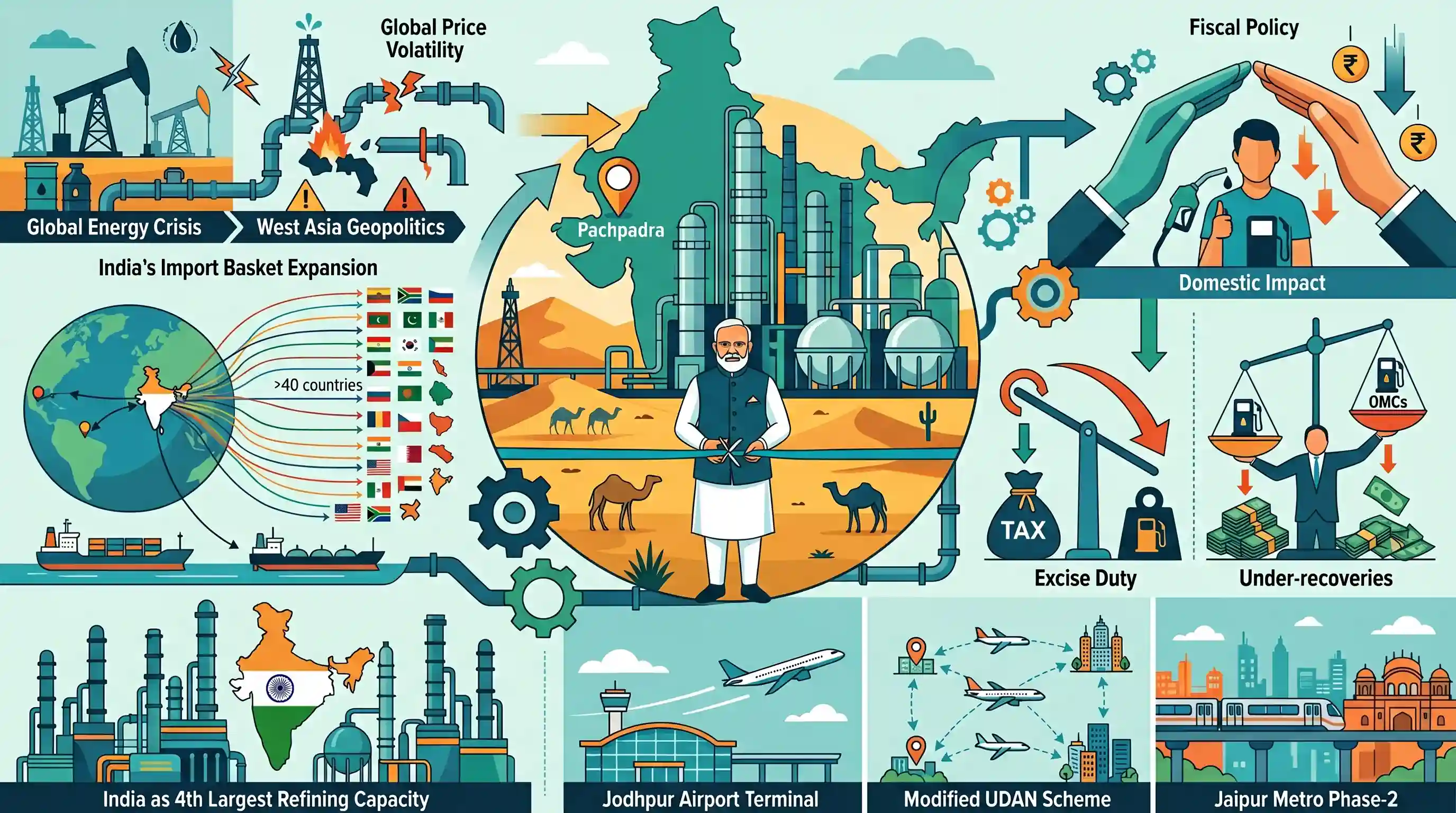
Prime Minister Narendra Modi inaugurated India's first greenfield integrated refinery-cum-petrochemical complex in Pachpadra, Rajasthan. During the event, he highlighted India's successful management of a severe global energy crisis (triggered by West Asia conflicts) without overburdening citizens. India secured its oil supplies by expanding its import basket from 25–26 countries to over 40 countries using proactive energy diplomacy. To prevent domestic inflation and cushion consumers from global price volatility, the central government reduced fuel excise duties by ₹10 per litre, absorbing the financial impact even as domestic Oil Marketing Companies recorded over ₹75,000 crore in under-recovery losses from April to June. India is now the world’s fourth-largest in refining capacity. Modi also inaugurated the Jodhpur airport terminal, launched the Modified UDAN scheme, and inaugurated Jaipur Metro Phase-2.
Key Points
- Inauguration of Pachpadra Refinery: PM Narendra Modi inaugurated India's first greenfield integrated refinery-cum-petrochemical complex in Pachpadra, Balotra district, which is also Rajasthan's first refinery of any kind.
- Diversification of Energy Imports: During the West Asia energy crisis (sparked by the Iran-US-Israel conflict), India proactively expanded its fuel sourcing from 25–26 countries to more than 40 countries, leveraging strong diplomatic ties to secure oil supplies.
- Insulating Citizens from Price Shocks: To protect domestic consumers from rising global oil prices, the Union government absorbed the fiscal burden. It reduced excise duty on fuel by ₹10 per litre, even as domestic Oil Marketing Companies (OMCs) suffered losses exceeding ₹75,000 crore between April and June.
- Refining Capacity Growth: With the continuous expansion of domestic refining infrastructure, India has emerged as the world's fourth-largest country in terms of petroleum refining capacity.
- Additional Infrastructure Projects: Alongside the refinery, the PM inaugurated the new Jodhpur airport terminal, launched the Modified UDAN scheme to boost regional aviation connectivity, and inaugurated Jaipur Metro Phase-2.
Important Terms
Modified UDAN scheme

The revamped regional air connectivity initiative approved for a ten-year period (FY 2026-27 to FY 2035-36), focusing on sustainable aviation infrastructure, helipads, and long-term operational viability through government budget support.
UPSC context
GS Paper III (Infrastructure: Aviation); tests concepts of regional connectivity, public-private transport funding, and last-mile accessibility.
UDAN (Ude Desh ka Aam Nagrik)
India's flagship regional airport development and connectivity program launched in 2016, aimed at making air travel affordable and connecting unserved and underserved Tier-2 and Tier-3 cities via subsidies.
UPSC context
GS Paper III (Infrastructure: Civil Aviation); relevant for analyzing government initiatives in infrastructural development and democratization of transport.
Oil Under-recovery
The financial loss or shortfall incurred by state-run Oil Marketing Companies (OMCs) when domestic retail fuel prices are frozen or kept lower than the actual international cost of importing and refining crude oil.
UPSC context
GS Paper III (Indian Economy & Energy Pricing); tests understanding of subsidies, fiscal deficit, inflation, and pricing mechanisms of essential resources.
Pachpadra Refinery (HRRL)
An integrated greenfield oil refinery-cum-petrochemical complex in Rajasthan, owned by a joint venture of HPCL and the Rajasthan government, designed to boost India’s petroleum refining and self-reliance in downstream petrochemicals.
UPSC context
GS Paper I & III (Location of Industries, Energy Security); tests factors influencing the location of primary/secondary industries and refining capabilities.
Energy Diplomacy
The strategic use of foreign policy and bilateral/multilateral negotiations to secure reliable, diversified sources of energy imports, protect transit routes, and shield the domestic economy from global price volatility.
UPSC context
GS Paper II & III (Foreign Policy, Energy Security); evaluates India’s diplomatic strategies to mitigate geopolitical supply-side shocks and ensure resource safety.
Jaipur Metro
A rapid transit system serving Jaipur, Rajasthan, representing urban transport infrastructure development crucial for reducing vehicular congestion, air pollution, and improving public transport efficiency in Tier-2 Indian cities.
UPSC context
GS Paper III (Infrastructure: Urban Transport); relevant for studying Mass Rapid Transit Systems (MRTS) and sustainable urban infrastructure development.
Prelims Trap
India’s high crude oil import dependency of over 80% makes it a net importer of refined petroleum products.
India is actually a major net exporter of refined petroleum, oil, and lubricants (POL) due to its massive domestic refining capacity.
Static Concepts Connected
What are 'under-recoveries' in the Indian oil sector and how do they impact public finances?
- Definition: The difference between the internationally benchmarked cost of crude and the actual regulated retail price at which public sector OMCs sell products.
- Fiscal Nature: They are not direct budgetary subsidies but represent operational losses initially absorbed by OMCs, impacting their balance sheets and capital expenditure.
What major factors govern the geographical distribution of petroleum refineries in India?
- Coastal Proximity: Located near coastlines (e.g., Jamnagar, Kochi) to minimize transportation costs of imported crude oil.
- Inland/Market Linkage: Located inland (e.g., Mathura, Pachpadra) to serve major domestic consumption centers or tap local oilfields (like Rajasthan's Thar desert crude).
Cross-Topic Patterns
Energy diplomacy and strategic autonomy
How India's diversified oil procurement during geopolitical crises reflects multi-alignment, balancing ties with Russia, Western nations, and West Asian states to protect national economic sovereignty.
Industrial location and corridor planning
Connects the economic geography of petroleum refinery locations with national infrastructure initiatives like the PM Gati Shakti framework to optimize supply chains.

Expect questions linking OMC under-recoveries, crude import diversification, and the infrastructure shift under the Modified UDAN scheme.
Linked PYQs · 3
Linked PYQs · 3
- 2025MainsGS2
"Energy security constitutes the dominant kingpin of India's foreign policy, and is linked with India's overarching influence in Middle Eastern countries.” How would you integrate energy security with India's foreign policy trajectories in the coming years?
- 2017MainsGS2
The question of India's Energy Security constitutes the most important part of India's economic progress. Analyze India's energy policy cooperation with West Asian countries.
- 2017MainsGS1
Petroleum refineries are not necessarily located nearer to crude oil producing areas, particularly in many of the developing countries. Explain its implications.
