Geopolitical Shifts and India Strategic Outlook on the Arctic Region
Source:The Hindu ↗
Why It Matters
The Arctic is rapidly transforming from a pristine scientific domain into a critical geopolitical theater. For UPSC aspirants, understanding India's evolving approach—balancing scientific endeavors with energy security and strategic maneuvering against the backdrop of changing global alliances—is essential for answering questions on international relations and the geopolitical impacts of climate change.
Summary
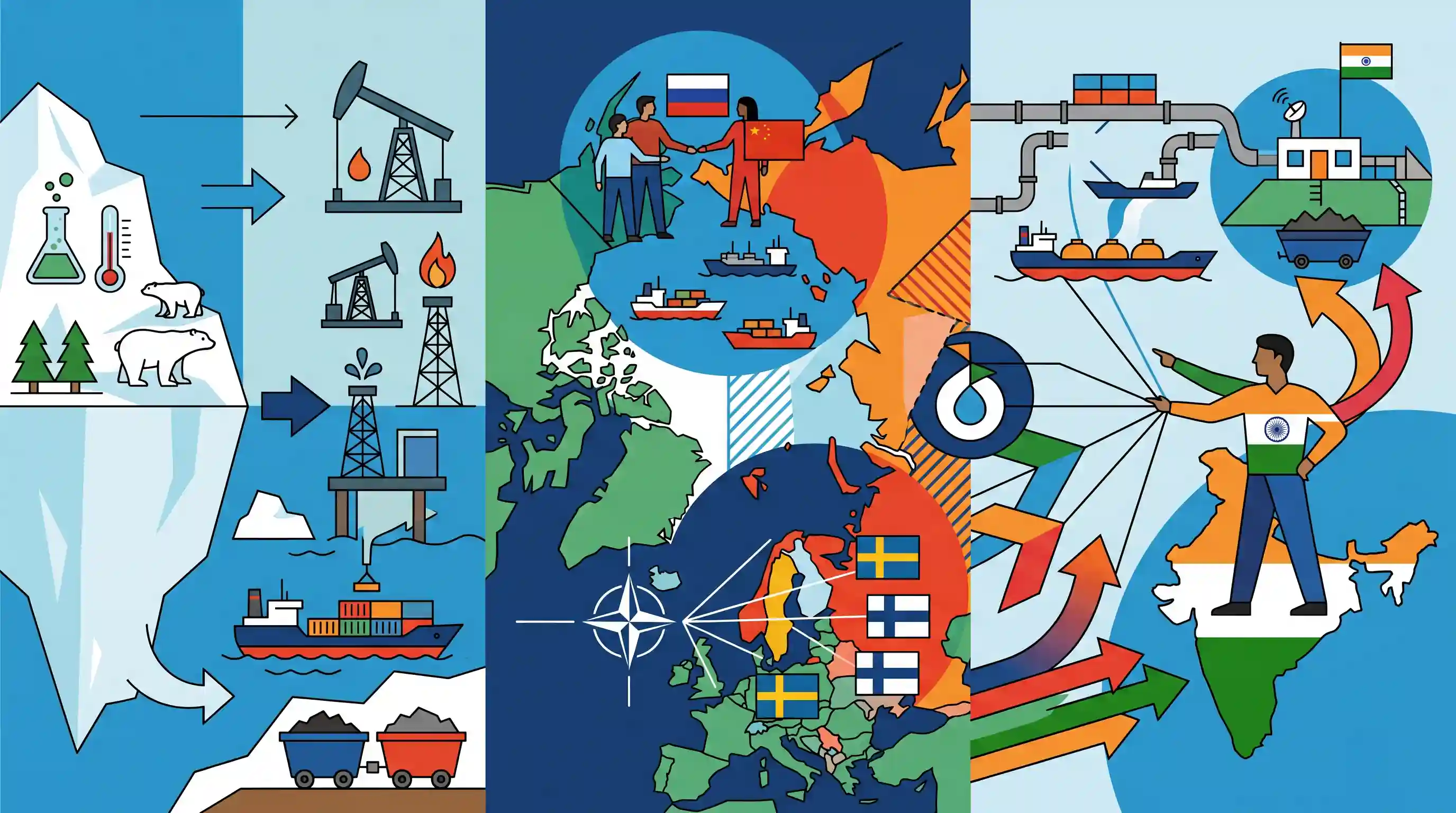
The article argues that India must recalibrate its Arctic strategy from a predominantly scientific and environmental focus to one that accounts for the region's rapidly changing geopolitics. While India's 2022 Arctic Policy emphasizes climate research and sustainability, the melting of Arctic sea ice has unveiled lucrative economic opportunities, particularly the Northern Sea Route (NSR) and access to vast energy and mineral reserves. Consequently, the Arctic is witnessing heightened strategic contestation, marked by closer Sino-Russian collaboration and NATO's expansion via Sweden and Finland. To protect its economic and energy security interests, India is urged to engage more proactively in the region's geopolitics, strengthen partnerships with Arctic nations, and ensure it maintains a strategic foothold amidst emerging Great Power competition.
Key Points
- India's current Arctic Policy (2022) leans heavily toward scientific research, climate change mitigation, and environmental protection.
- The melting of Arctic sea ice is opening up the Northern Sea Route (NSR), which drastically cuts shipping transit times between Europe and Asia.
- The region contains vast, untapped reserves of oil, natural gas, and rare earth minerals, making it highly significant for global energy security.
- Geopolitics in the Arctic are intensifying, underscored by growing Sino-Russian strategic alignment and the expansion of NATO to include Sweden and Finland.
- To safeguard its energy and strategic interests, India must transition from a purely scientific outlook to a more proactive, geopolitically driven Arctic strategy.
Important Terms
Arctic Council

The primary intergovernmental forum established in 1996 for cooperation between Arctic states and indigenous groups on sustainable development and environmental protection. It excludes military security from its mandate.
UPSC context
GS Paper II (International Relations). Essential for understanding regional governance and India's role in multilateral forums beyond its immediate neighborhood.
Northern Sea Route (NSR)
A shipping lane along Russia's Arctic coast connecting the Atlantic and Pacific. As ice melts, it offers a 50% shorter alternative to the traditional Suez Canal route for Europe-Asia trade.
UPSC context
GS Paper I (Geography) and II (International Relations). Relevant for global trade routes, energy security, and Indo-Russian strategic cooperation.
India's Arctic Policy (2022)
India's 2022 framework focusing on six pillars: science, climate, economics, transportation, governance, and capacity building. It emphasizes understanding Arctic-monsoon linkages and securing resource interests.
UPSC context
GS Paper II (Policies) and III (Environment). Tests knowledge of India's strategic positioning and climate-related diplomatic initiatives.
Observer Status
A non-voting role in the Arctic Council held by 13 countries, including India (since 2013). Observers contribute to scientific research and working groups while respecting the sovereignty of Arctic states.
UPSC context
GS Paper II (IR). Tests understanding of India's level of participation and diplomatic constraints within non-regional intergovernmental bodies.
Svalbard Treaty
A 1920 agreement granting Norway sovereignty over the Svalbard archipelago while allowing signatories equal rights to commercial activity and scientific research, serving as the basis for India's Himadri station.
UPSC context
GS Paper I (History/Geography). Important for the legal history of India’s polar engagement and scientific presence in the Arctic.
NATO (Arctic Expansion)
A military alliance whose recent inclusion of Finland and Sweden has brought most Arctic states under its security umbrella, intensifying the region's geopolitics and strategic competition with Russia.
UPSC context
GS Paper II (International Relations). Relevant for analyzing shifts in global security architecture and their impact on India’s neutral strategic posture.
Prelims Trap
The Arctic Council acts as a dispute resolution body for geopolitical and military conflicts in the region.
The 1996 Ottawa Declaration explicitly excludes military and security issues from the Arctic Council's mandate, limiting it to environmental protection and sustainable development.
Static Concepts Connected
What is the Arctic Council and its institutional structure?
- Eight Member States: Comprises only the eight states with Arctic territory: Canada, Denmark, Finland, Iceland, Norway, Russia, Sweden, and the US.
- Observer Status: India became an Observer in 2013 (renewed in 2019). Observers contribute to working groups but have no voting or decision-making rights.
- Ottawa Declaration: Established by the 1996 Ottawa Declaration to promote cooperation on sustainable development and environmental protection.
What is the Northern Sea Route (NSR) and its geographic significance?
- Geographic Location: A shipping lane running entirely along the Russian Arctic coast, connecting the Barents Sea (near Europe) to the Bering Strait (near Asia-Pacific).
- Distance Reduction: It cuts Europe-Asia maritime transit distances by nearly 50% (saving roughly 8,000 km) compared to the traditional Suez Canal route.
- Geopolitical Control: Russia heavily regulates the route, claiming significant sections as its internal waters, which sparks freedom of navigation disputes with the US and NATO.
Cross-Topic Patterns
NSR + Chennai-Vladivostok Maritime Corridor
India's interest in the Northern Sea Route directly complements the Eastern Maritime Corridor (Chennai-Vladivostok), positioning India to bypass traditional choke points like the Suez Canal for Russian trade.
Arctic warming + Indian Monsoon predictability
Scientific studies increasingly link Arctic sea ice anomalies to fluctuations in the Indian summer monsoon, making India's Himalayan (Third Pole) and Arctic research deeply interdependent.

The Northern Sea Route, Arctic Council observer status, and Chennai-Vladivostok corridor will likely form a composite 2026 Prelims MCQ.
Linked PYQs · 4
Linked PYQs · 4
- 2018MainsGS1
Why is India taking keen interest in resources of Arctic Region?
- 2015MainsGS1
What are the economic significances of discovery of oil in Arctic Sea and its possible environmental consequences?
- 2021MainsGS1
How do the melting of the Arctic ice and glaciers of the Antarctic differently affect the weather patterns and human activities on the Earth? Explain.
- 2022MainsGS2
‘Clean energy is the order of the day.’ Describe briefly India's changing policy towards climate change in various international fora in the context of geopolitics.
