India Urged to Renegotiate Indus Waters Treaty
Source:Indian Express ↗
Why It Matters
The Indus Waters Treaty is widely cited as a benchmark for international water sharing. India's formal attempt to modify it marks a strategic shift in South Asian hydro-politics and India-Pakistan bilateral relations. It connects deeply with geography (Indus river system), economy (run-of-the-river projects), and international relations (treaty mechanics and World Bank mediation).
Summary
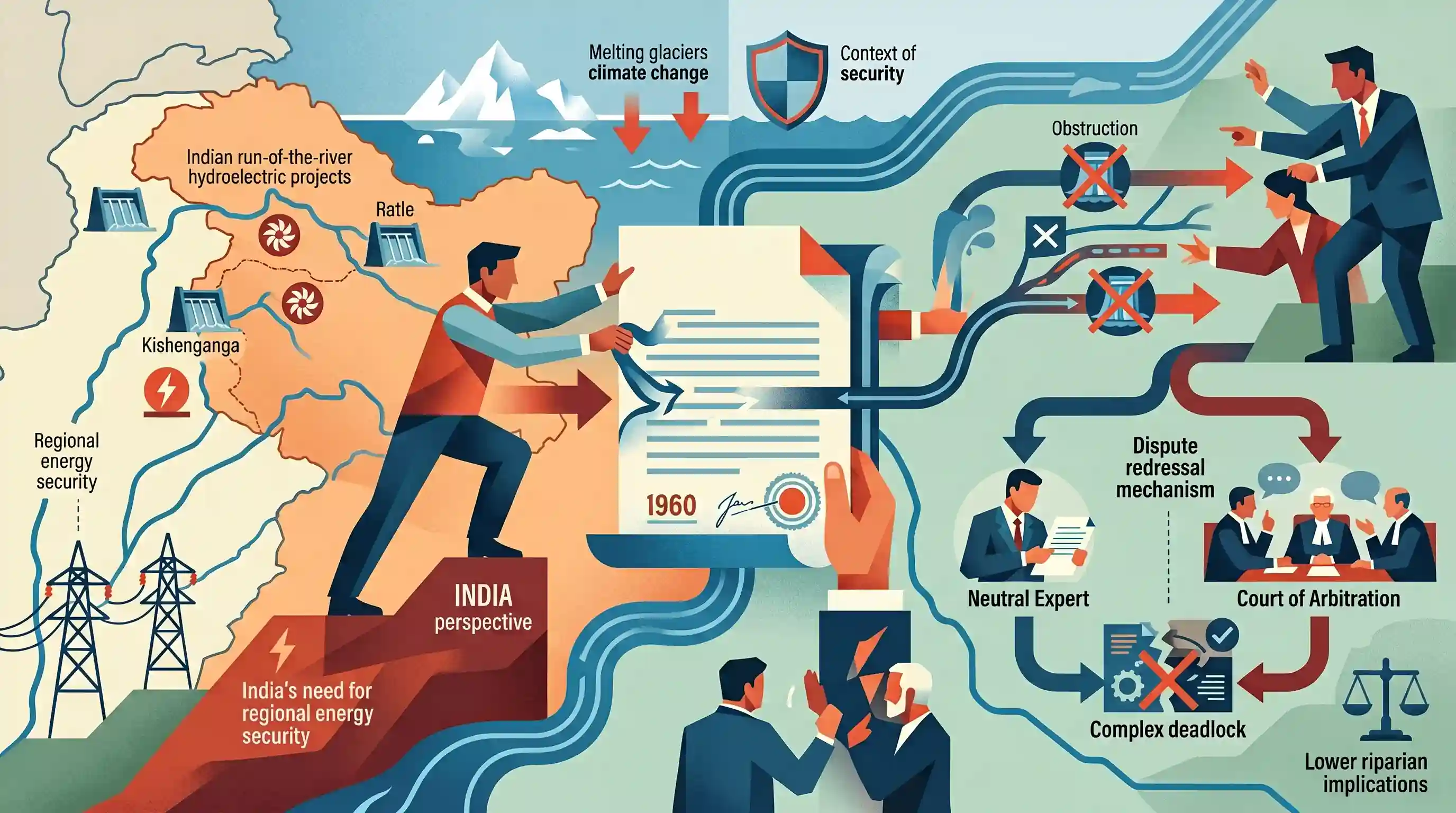
The article highlights India's ongoing diplomatic push to modify the 60-year-old Indus Waters Treaty (IWT) with Pakistan. Speaking at an Explained.Live session, expert Uttam Kumar Sinha emphasizes that India should renegotiate the pact on its own terms by leveraging its upper riparian advantage. The push for modification is a response to Pakistan's continuous obstruction of Indian run-of-the-river hydroelectric projects (such as Kishenganga and Ratle on the Jhelum and Chenab rivers) and its controversial invocation of parallel dispute mechanisms (Neutral Expert and Court of Arbitration) simultaneously. Updating the treaty is viewed as necessary to account for modern realities like climate change, regional energy security needs, and the context of state-sponsored terrorism.
Key Points
- India has issued formal notices to Pakistan seeking the modification of the Indus Waters Treaty (IWT), citing Pakistan's prolonged 'intransigence' over India's run-of-the-river hydroelectric projects like Kishenganga and Ratle.
- Water security expert Uttam Kumar Sinha advocates that India must leverage its geographic advantage as the upper riparian state to renegotiate the 1960 pact on its own terms.
- The treaty's graded dispute resolution mechanism has been compromised by Pakistan's simultaneous pursuit of parallel proceedings—a Neutral Expert and a Court of Arbitration—for the same dispute.
- A modernized treaty needs to address contemporary challenges absent in 1960, including climate change impacts on basin hydrology, the energy requirements of Jammu & Kashmir, and the geopolitical backdrop of cross-border terrorism.
- Under the original IWT, the eastern rivers (Ravi, Beas, Sutlej) are allocated to India, while the western rivers (Indus, Jhelum, Chenab) are allocated to Pakistan, though India is permitted non-consumptive usage such as run-of-the-river hydropower generation.
Important Terms
Indus Waters Treaty 1960

A 1960 water-sharing agreement between India and Pakistan, brokered by the World Bank, dividing the Indus system's six rivers to ensure equitable resource distribution.
UPSC context
GS Paper II (International Relations). Tests knowledge of transboundary water governance and India-Pakistan bilateral ties.
World Bank
The international financial institution that brokered the IWT and remains a signatory, exercising procedural roles like appointing experts or arbitrators during disputes.
UPSC context
GS Paper II. Focuses on the role of international organizations in mediating regional conflicts.
Permanent Indus Commission (PIC)
A bilateral body of officials from India and Pakistan mandated to meet annually to manage treaty implementation and resolve technical questions.
UPSC context
GS Paper II. Tests understanding of primary bilateral institutional frameworks for conflict resolution.
Court of Arbitration (CoA)
The highest tier in the IWT's three-step dispute mechanism, an ad hoc tribunal for resolving serious 'disputes' after technical mediation fails.
UPSC context
GS Paper II. Relevant for studying international legal mechanisms and parallel jurisdiction challenges.
Neutral Expert
A World Bank-appointed specialist who adjudicates technical 'differences' (Step 2 of the IWT) regarding project designs and treaty interpretation.
UPSC context
GS Paper II. Crucial for understanding technical vs. legal tiers of international dispute resolution.
Run-of-the-river projects
Hydroelectric plants that generate power using the river's natural flow without large reservoirs, permitted for India on western rivers under specific IWT constraints.
UPSC context
GS Paper I & III. Tests technical rights of upper riparians and energy infrastructure in sensitive regions.
Prelims Trap
India cannot build any hydroelectric power projects on the Western rivers (Indus, Jhelum, Chenab).
India is permitted to build run-of-the-river (RoR) hydroelectric projects on Western rivers. The treaty only restricts consumptive water storage, not non-consumptive uses like RoR generation.
Static Concepts Connected
What are the core provisions of the Indus Waters Treaty (1960)?
- Eastern Rivers: Allocated to India for unrestricted use (Ravi, Beas, Sutlej).
- Western Rivers: Allocated to Pakistan (Indus, Jhelum, Chenab), but India has limited non-consumptive rights like run-of-the-river hydro.
- Dispute Resolution: Sequential three-tier mechanism: Permanent Indus Commission, World Bank-appointed Neutral Expert, and Court of Arbitration.
Where are the disputed Kishenganga and Ratle hydroelectric projects located?
- Kishenganga Project: Located on the Kishanganga river, a key tributary of the Jhelum river in Jammu and Kashmir.
- Ratle Project: A run-of-the-river hydroelectric power station situated on the Chenab river in Jammu and Kashmir.
Cross-Topic Patterns
IWT modification + Vienna Convention doctrines
India's push to modify the treaty implicitly links to international law doctrines like 'rebus sic stantibus' (fundamental change of circumstances), specifically citing climate change and state-sponsored terrorism.
Himalayan Hydrology + J&K Energy Security
Climate-induced glacial melt alters seasonal water flows in the Himalayas, directly affecting the generation capacity of Run-of-the-River projects and merging physical geography with regional energy security.

A 2026 Prelims question will likely combine IWT's 3-tier dispute mechanism with geographic matching of Jhelum/Chenab tributaries.
Linked PYQs · 4
Linked PYQs · 4
- 2012MainsGS2
The situation today is far different to that prevalent fifty years back when the Indus Water Treaty was signed." Highlight the complexity of the current challenges on both sides of the border in this regard. Do you think that a review of the Treaty is in India's best interests?
- 2013MainsGS3
What do you understand by Run-of-river hydroelectricity project ? How is it different from any other hydroelectricity project?
- 2021PrelimsGS1
With reference to the Indus river system, of the following four rivers, three of them pour into one of them which joins the Indus direct. Among the following, which one is such river that joins the Indus direct?
- 2009PrelimsGS1
The Dul Hasti Power Station is based on which one of the following rivers?
