National Shipping Board Roadmap for Indian Merchant Fleet Expansion
Source:The Hindu ↗
Why It Matters
The article highlights crucial bottlenecks in India's maritime logistics sector, specifically the high cost of operating domestic vessels, which drains foreign exchange and compromises trade security. It is highly relevant for GS Paper 3 questions on infrastructure development, trade policy, and economic self-reliance.
Summary
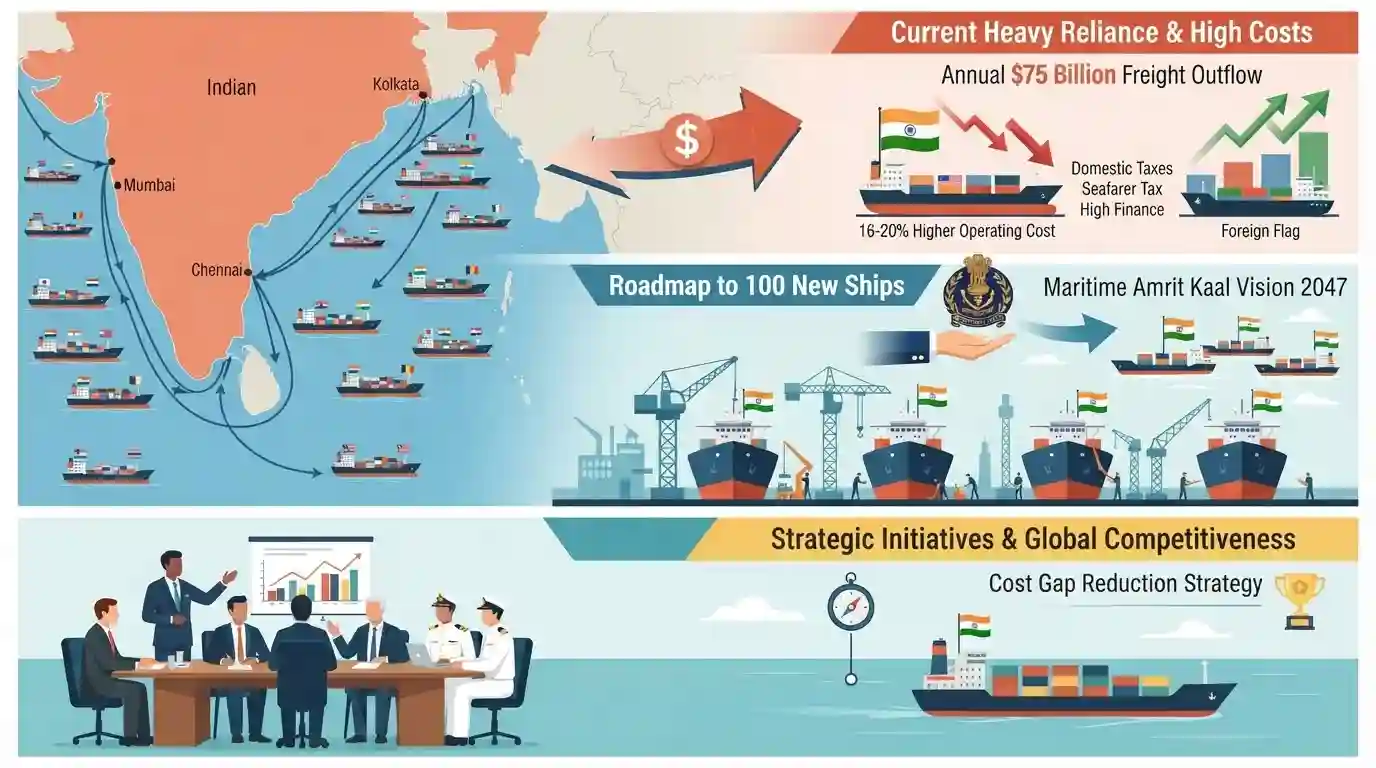
The National Shipping Board (NSB) has introduced a five-point roadmap aiming to add 100 ships to India's merchant fleet over the next five years. This initiative aligns with the Maritime Amrit Kaal Vision 2047, which seeks to position India among the top five ship-owning nations. Currently, India heavily relies on foreign vessels for its trade, resulting in an annual outflow of $75 billion in freight charges. Shipping Minister Sarbananda Sonowal highlighted that operating an Indian-flagged ship is 16-20% more expensive than a foreign one, primarily due to domestic taxes, taxes on seafarers' wages, and high financing costs. To address this, the NSB plans to form a committee to devise strategies for closing the cost gap and enhancing the global competitiveness of the Indian shipping industry.
Key Points
- The National Shipping Board (NSB) has proposed a five-point roadmap to add 100 vessels to India's merchant fleet over the next five years, aligning with the Maritime Amrit Kaal Vision 2047.
- India currently relies heavily on foreign shipping lines for transporting cargo, paying an estimated $75 billion annually in freight charges.
- Operating under the Indian flag is 16-20% more expensive than foreign flags, creating a significant barrier to the growth of the domestic fleet.
- The cost differential is primarily due to taxes on ship imports and maintenance, taxation of seafarers' wages, and higher domestic financing costs.
- The NSB will establish a committee to analyze and address the cost gap, aiming to make Indian-flagged vessels more competitive globally.
Important Terms
Maritime Amrit Kaal Vision 2047

A comprehensive government roadmap containing over 300 initiatives to transform India into a premier global maritime hub by 2047. It targets port modernization, green shipping, enhanced logistics, and domestic shipbuilding capacity.
UPSC context
GS Paper 3 (Infrastructure). Tests knowledge of India's long-term economic strategies, port-led development, and self-reliance in global trade.
National Shipping Board (NSB)
A statutory advisory body established under the Merchant Shipping Act to counsel the government on maritime policies, seafarer welfare, and port-linked development. It includes parliamentary members and industry stakeholders.
UPSC context
GS Paper 2 (Statutory Bodies) & GS Paper 3. Important for evaluating institutional frameworks governing India's shipping and maritime sector.
Indian-flagged Vessel
A merchant ship registered in India, complying with Indian maritime laws and taxes. The current tax structure makes operating them 16-20% costlier than foreign vessels, hindering domestic fleet expansion.
UPSC context
GS Paper 3 (Economy/Trade). Highlights structural bottlenecks, the $75 billion annual forex outflow, and the need for fiscal reforms.
Sagar Samvad
An inaugural "ocean dialogue" organized by the National Shipping Board, uniting policymakers, financiers, and shipowners to strategize on reducing foreign fleet reliance and advancing India's Vision 2047 maritime goals.
UPSC context
GS Paper 3 (Infrastructure). Serves as a prime current affairs example of government-industry consultation for strengthening the maritime ecosystem.
Prelims Trap
The National Shipping Board is an executive body established under the Major Port Authorities Act to manage port administration.
NSB is actually a statutory advisory body under the Merchant Shipping Act, 1958, meant to advise the government on shipping development, not ports administration.
Static Concepts Connected
What are Cabotage Laws and how do they apply to shipping in India?
- Domestic trade reservation: Cabotage laws restrict coastal cargo shipping within a country's domestic ports exclusively to domestic-flagged vessels.
- Legal basis: Under Sections 406 and 407 of the Merchant Shipping Act, 1958, foreign vessels require licensing for coastal trade.
- Strategic relaxation: India has selectively relaxed cabotage rules for specific cargo classes like agricultural products and transshipment containers to boost competitiveness.
How does shipping freight impact India's Balance of Payments?
- Current Account impact: Freight charges paid to foreign vessels are recorded under the services (invisibles) division of the Current Account.
- Forex depletion: Paying billions to foreign shipping lines creates massive service import outflows, directly widening the Current Account Deficit.
Cross-Topic Patterns
Maritime logistics & Balance of Payments
India’s reliance on foreign vessels leaks over $75 billion annually in freight, linking domestic shipping capacity directly to macroeconomic stability and the Current Account Deficit.
Flag of convenience & security
Tax disparities push Indian owners to flag vessels abroad, impacting India's maritime supply-chain sovereignty and strategic resource mobilization during regional geopolitical blockades.

Mains GS3 analysis likely to link domestic shipping taxation, CAD reduction, and Maritime Amrit Kaal goals.
Linked PYQs · 3
Linked PYQs · 3
- 2025MainsGS3
Why is maritime security vital to protect India's sea trade? Discuss maritime and coastal security challenges and the way forward.
- 2021MainsGS3
“Investment in infrastructure is essential for more rapid and inclusive economic growth.” Discuss in the light of India's experience.
- 2026PrelimsGS1
In what way(s) does the Vizhinjam International Seaport represent a structural shift in India's maritime trade and logistics policy? 1. By functioning exclusively as a domestic cargo hub to reduce reliance on coastal shipping and eliminate the need for foreign collaborations. 2. By focusing primarily on passenger cruise tourism and heritage shipping to increase Kerala's profile as a maritime heritage destination. 3. By leveraging its natural deep draft and strategic location to reduce dependence on foreign trans-shipment ports, enhance revenue retention, and reposition India in regional maritime trade. Select the answer using the code given below :
