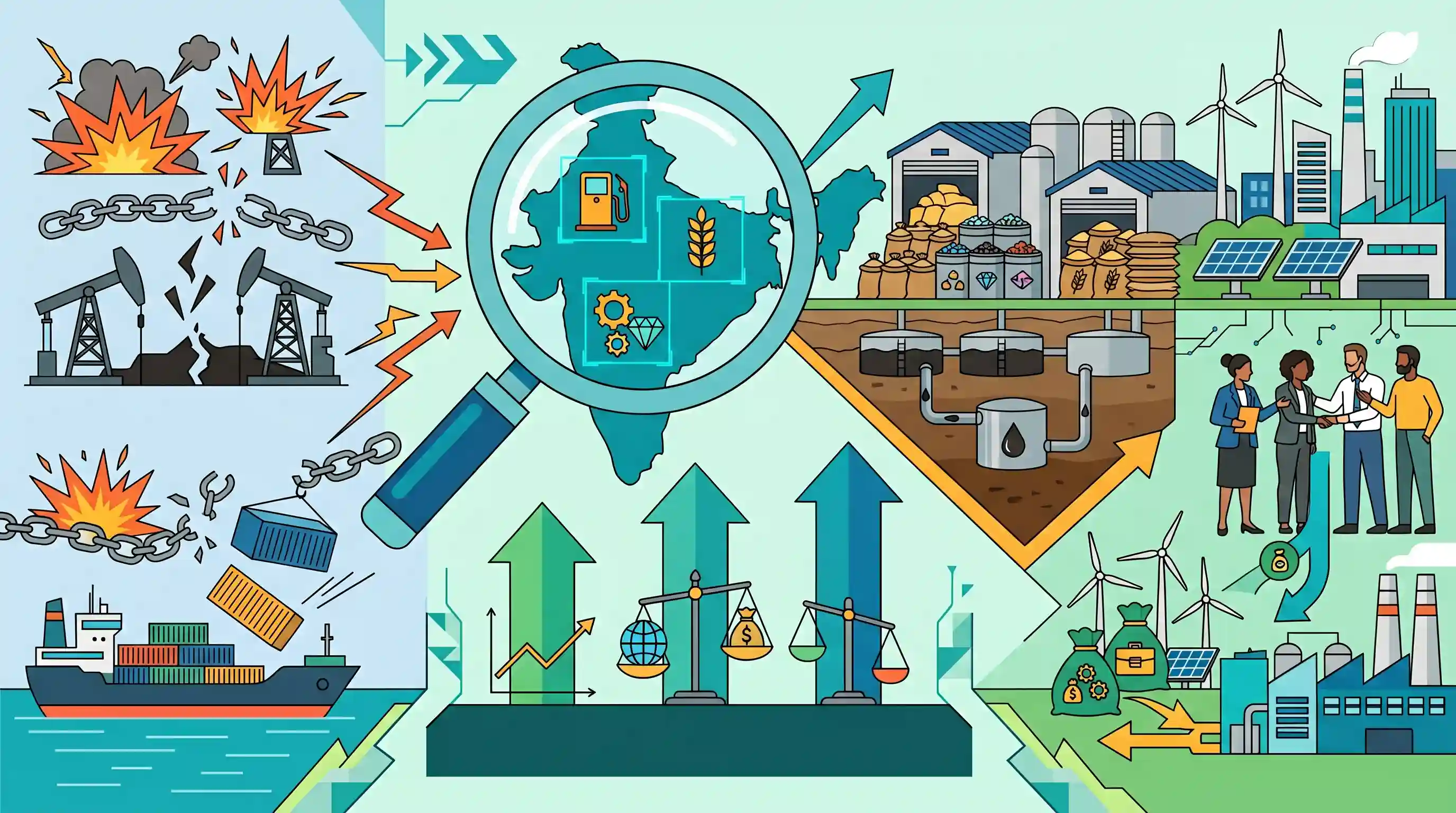
India economic vulnerabilities mapping in energy and food security
Source:The Hindu ↗
Why It Matters
The article details critical macroeconomic indicators (debt-to-GDP, CAD, fiscal deficit) and policy measures (strategic reserves) pertinent to GS3 Economy and GS2 International Relations, offering insights on how India builds resilience against external geopolitical shocks.
Summary
Economic Advisory Council to the Prime Minister (EAC-PM) Chairman S. Mahendra Dev emphasized the necessity of mapping India's economic vulnerabilities in energy, food, and critical minerals amid global supply chain shocks triggered by the West Asia conflict. He recommended expanding strategic petroleum reserves and essential commodity stockpiles. Despite external uncertainties and a depreciating rupee, Dev highlighted India's robust macroeconomic fundamentals—such as a manageable fiscal deficit, stable debt-to-GDP ratio, and controlled Current Account Deficit—while urging the corporate sector to boost private investment.
Key Points
- EAC-PM Chairman S. Mahendra Dev urged mapping vulnerabilities in energy, food, fertilisers, and critical minerals.
- Recommended expanding strategic petroleum reserves and essential commodity stockpiles instead of solely relying on forex and foodgrain stocks.
- Highlighted India's strong macroeconomic indicators, such as a 4.4% fiscal deficit, manageable combined debt-to-GDP ratio (81%), and low CAD.
- Advised the corporate sector to deploy accumulated profits into private investments to sustain the growth story.
- Noted that while the West Asia conflict impacts crude oil and gas imports, India's economic resilience limits the fallout on domestic growth and inflation.
Important Terms
Economic Advisory Council to the Prime Minister (EAC-PM)

An independent, non-constitutional, and non-permanent advisory body that provides neutral economic counsel to the Prime Minister on macroeconomic issues, inflation, and policy interventions. Currently chaired by Prof. S. Mahendra Dev.
UPSC context
Relevant for GS Paper 2 (Statutory/Advisory Bodies) and Paper 3 (Economic Development/Policy-making). Tests understanding of institutional advisory frameworks.
Strategic Petroleum Reserves (SPR)
Emergency crude oil stockpiles stored in underground rock caverns to ensure energy security during global supply disruptions. India's facilities are located at Visakhapatnam, Mangaluru, and Padur, managed by ISPRL.
UPSC context
Crucial for GS Paper 3 (Energy Security/Infrastructure). Tests knowledge of India's buffer against geopolitical shocks and energy sovereignty.
Current Account Deficit (CAD)
The difference between a country's total value of imported goods, services, and transfers versus its exports. It reflects the nation's external competitiveness and reliance on foreign capital.
UPSC context
Core concept for GS Paper 3 (Indian Economy/External Sector). Evaluates understanding of Balance of Payments (BoP) and currency stability.
Debt-to-GDP Ratio
The ratio of a country's total public debt to its Gross Domestic Product, used as a key indicator of fiscal sustainability and the government's ability to repay its obligations.
UPSC context
Essential for GS Paper 3 (Public Finance/Government Budgeting). Tests understanding of fiscal health and debt management strategies.
Fiscal Deficit
The difference between the government's total expenditure and its total receipts (excluding borrowings), indicating the total amount the government needs to borrow to meet its expenses.
UPSC context
Fundamental for GS Paper 3 (Government Budgeting). Tests knowledge of fiscal policy, inflation impacts, and the FRBM Act framework.
Critical Minerals
Metallic or non-metallic elements (e.g., lithium, cobalt) essential for modern technologies like EVs and renewable energy, whose supply chains are vulnerable to disruption and geopolitical risk.
UPSC context
Emerging topic for GS Paper 3 (Environment/Energy/Economy). Tests awareness of mineral security, self-reliance (Atmanirbharta), and global supply chain resilience.
Prelims Trap
The Economic Advisory Council to the PM (EAC-PM) is a statutory body functioning under the NITI Aayog.
EAC-PM is a non-constitutional, non-statutory, independent body. NITI Aayog acts only as its nodal agency for administrative and budgetary purposes, not as its statutory parent.
Static Concepts Connected
What are India's Strategic Petroleum Reserves (SPRs) and who manages them?
- Management: Managed by Indian Strategic Petroleum Reserves Limited (ISPRL), a wholly-owned subsidiary of OIDB under MoPNG.
- Phase-I Locations: Underground rock caverns located at Visakhapatnam, Mangaluru, and Padur hold 5.33 MMT (approx. 9.5 days of crude requirement).
- Phase-II Expansion: Additional commercial-cum-strategic facilities are planned at Chandikhol (Odisha) and Padur (Karnataka) under PPP mode.
What are the FRBM Review Committee's recommendations for the Debt-to-GDP ratio?
- 60% Ceiling: The N.K. Singh Committee recommended a ceiling for general government debt at 60% of GDP by 2023.
- Centre-State Split: The 60% target is asymmetric: 40% for the Central government and 20% for State governments.
- Current Status: India's combined debt-to-GDP remains elevated around 81%, prompting debates on revising FRBM glide paths post-pandemic.
Cross-Topic Patterns
Critical Minerals & Energy Transition
Shocks in West Asia are forcing India to map critical minerals (Lithium, Cobalt) beyond traditional crude, linking energy security directly to the US-led Minerals Security Partnership (MSP).
Forex vs. Physical Stockpiles
While high forex shields against CAD widening, it cannot substitute physical supply constraints. Expanding SPRs bridges the gap between monetary buffers and real-economy energy shocks.

Expect a multi-statement question interlinking EAC-PM's structure, ISPRL caverns, and FRBM's 60% combined debt target.
Linked PYQs · 3
Linked PYQs · 3
- 2017MainsGS2
The question of India's Energy Security constitutes the most important part of India's economic progress. Analyze India's energy policy cooperation with West Asian countries.
- 2018MainsGS3
“Access to affordable, reliable, sustainable and modern energy is the sine qua non to achieve Sustainable Development Goals (SDGs).” Comment on the progress made in India in this regard.
- 2018PrelimsGS1
Consider the following statements: 1. The Fiscal Responsibility and Budget Management (FRBM) Review Committee Report has recommended a debt to GDP ratio of 60% for the general (combined) government by 2023, comprising 40% for the Central Government and 20% for the State Governments. 2. The Central Government has domestic liabilities of 21% of GDP as compared to that of 49% of GDP of the State Governments. 3. As per the Constitution of India, it is mandatory for a State to take the Central Government's consent for raising any loan if the former owes any outstanding liabilities to the latter. Which of the statements given above is/are correct?
