Nutritional Security and Dietary Diversity Policy in India
Source:The Hindu ↗
Why It Matters
The article underscores the critical transition from mere 'food security' (calorie sufficiency via cereals) to 'nutritional security' (dietary diversity), directly intersecting with UPSC GS2 (Poverty/Hunger) and GS3 (Agriculture/PDS/Food Processing). It also highlights structural issues in India's agricultural exports and value addition.
Summary
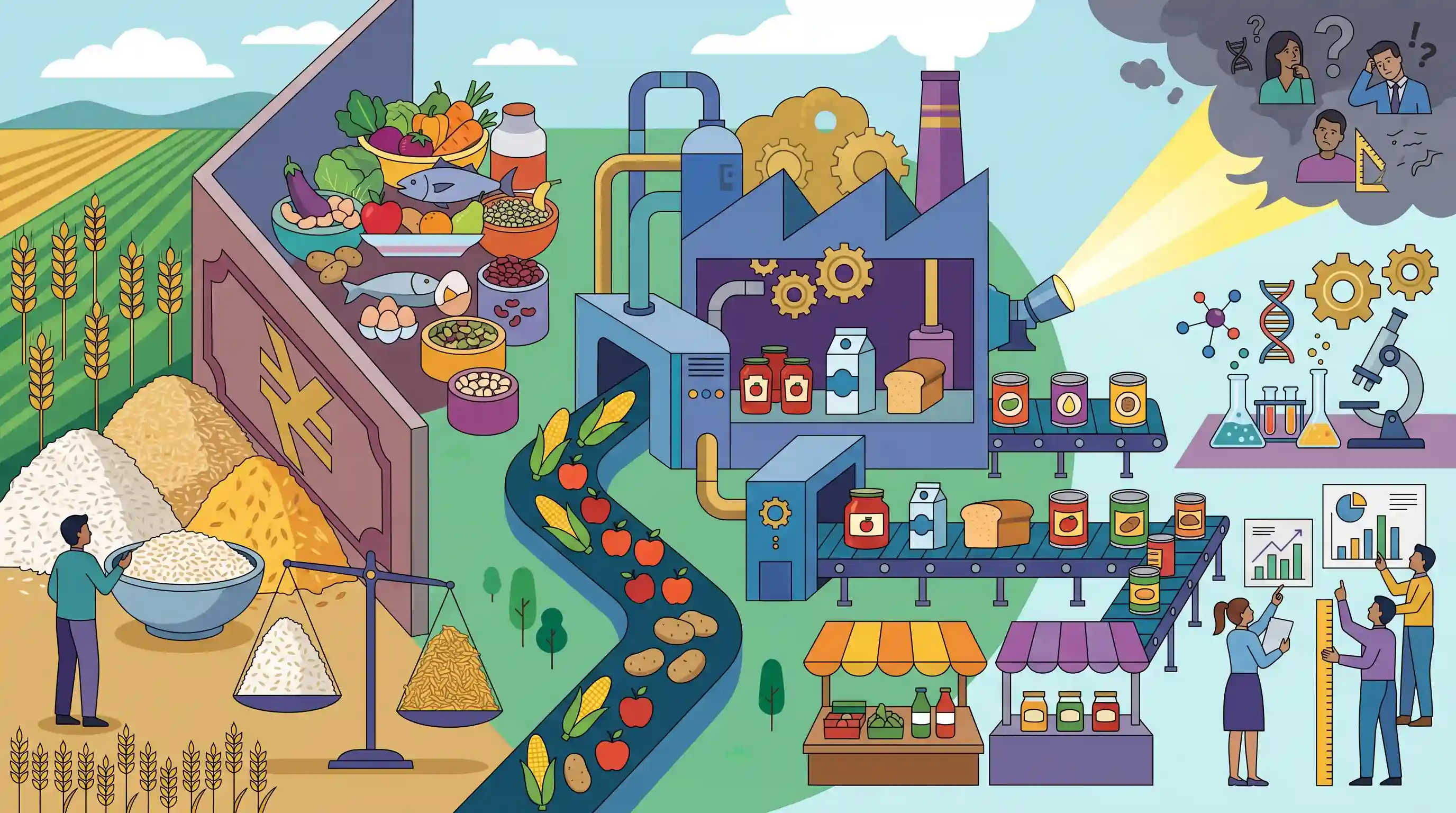
Dr. Soumya Swaminathan emphasized the necessity of shifting India's food and nutritional security paradigm away from a purely cereal-centric approach toward greater dietary diversity. Citing data from the FAO and NIN, she highlighted that many Indians still cannot afford a well-rounded, healthy diet despite sufficient calorie availability. She strongly advocated for boosting domestic food processing and value addition in the agricultural sector, pointing out the economic inefficiency of exporting raw materials while importing processed products. Furthermore, she expressed concern over growing anti-science movements, urging the promotion of scientific temper and literacy to foster evidence-based societal development.
Key Points
- India must transition from a cereal-centric agricultural and dietary approach to diverse nutritional sources (fruits, vegetables, nuts, and animal products) to address malnutrition.
- FAO and NIN data highlight poor dietary diversity, noting that a significant portion of the Indian population cannot afford a healthy diet.
- There is an urgent need to build domestic capacity in food processing; India currently loses economic potential by exporting raw agricultural materials and importing value-added processed goods.
- Combating anti-science movements and enhancing scientific literacy is critical for addressing modern challenges in agriculture and health.
Important Terms
Public Distribution System (PDS)

An Indian food security system under the Ministry of Consumer Affairs that distributes subsidized essential food grains to vulnerable households via a network of Fair Price Shops.
UPSC context
GS Paper 3; tests understanding of food management, buffer stocks, and PDS reforms.
Food and Agriculture Organization (FAO)
A specialized agency of the United Nations (est. 1945) that leads international efforts to defeat hunger and improve global nutrition and food security standards.
UPSC context
GS Paper 2; tests knowledge of international organizations and global food governance.
National Institute of Nutrition (NIN)
India's premier public health and nutrition research center under the Indian Council of Medical Research (ICMR) that sets dietary standards and monitors national nutritional status.
UPSC context
GS Paper 2; tests issues related to hunger, health, and nutritional outcomes.
Scientific Temper
A fundamental duty under Article 51A(h) of the Indian Constitution, referring to an attitude of logical reasoning, rational thinking, and a spirit of inquiry and reform.
UPSC context
GS Paper 2; tests understanding of fundamental duties and societal development.
CSIR-NIIST
A premier constituent laboratory of the Council of Scientific and Industrial Research (CSIR) focused on interdisciplinary R&D in agro-processing, chemical sciences, and sustainable technology.
UPSC context
GS Paper 3; tests knowledge of national R&D institutions and agricultural technology.
Value Addition
The process of increasing the economic worth of agricultural produce through processing, fortification, or specialized packaging to boost export potential and rural livelihoods.
UPSC context
GS Paper 3; tests food processing industry, farm income strategies, and supply chains.
Prelims Trap
India's aggregate cereal surplus ensures comprehensive nutritional security and dietary affordability.
UPSC often sets statements equating food grain surplus with the elimination of hidden hunger. Surplus cereals provide caloric sufficiency, not dietary diversity.
Static Concepts Connected
What distinguishes 'Hidden Hunger' from general undernourishment?
- Undernourishment: Deficient overall caloric intake, typically manifesting as stunted growth, wasting, or being underweight.
- Hidden Hunger: A chronic lack of essential vitamins and minerals (micronutrient deficiency) despite consuming sufficient calories.
- Policy Interventions: Tested frequently via solutions like biofortification (e.g., zinc-rich rice) and the inclusion of millets (Shree Anna).
What are the core components of the Food Processing supply chain?
- Upstream Requirements: Focuses on primary processing, raw material procurement, grading, sorting, and establishing cold-chain infrastructure.
- Downstream Requirements: Involves secondary/tertiary processing, value addition, packaging, branding, and final retail distribution to consumers.
- Economic Gap: India often exports raw goods and imports downstream processed goods, missing out on value addition.
Cross-Topic Patterns
MSP distortion vs. Nutritional Security
The open-ended procurement of rice and wheat structurally disincentivizes the cultivation of pulses and horticulture, deepening India's dietary diversity crisis and reinforcing a cereal-centric PDS.
Scientific Temper as a Fundamental Duty
Combating anti-science movements ties directly to Article 51A(h) (Fundamental Duties). UPSC increasingly tests this in the context of biotechnology and public health interventions.

Expect a 2026 GS3 Mains question integrating MSP reforms, PDS restructuring, and the food processing sector to combat 'hidden hunger'.
Linked PYQs · 4
Linked PYQs · 4
- 2024MainsGS2
Poverty and malnutrition create a vicious cycle, adversely affecting human capital formation. What steps can be taken to break the cycle ?
- 2020MainsGS3
What are the challenges and opportunities of food processing sector in the country? How can income of the farmers be substantially increased by encouraging food processing?
- 2022MainsGS3
Elaborate the scope and significance of the food processing industry in India.
- 2022MainsGS3
What are the major challenges of Public Distribution System (PDS) in India ? How can it be made effective and transparent ?
