European Support for India Permanent Membership in UN Security Council
Source:Indian Express ↗
Why It Matters
The article deals with India's pursuit of a permanent seat in the UN Security Council and shifting diplomatic alignments in Europe, making it directly relevant to India's foreign policy and global governance reforms.
Summary
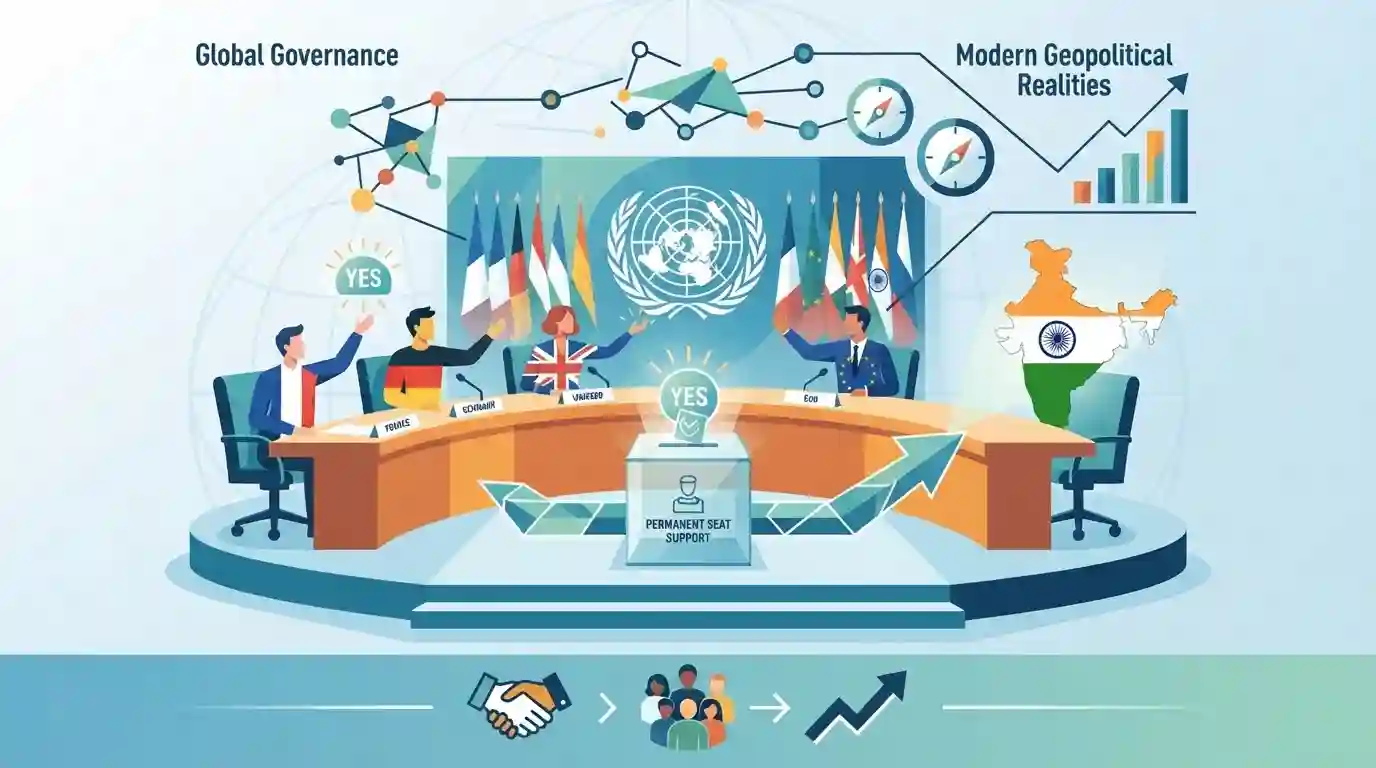
Four European countries have extended their support for India's permanent membership in the United Nations Security Council (UNSC), emphasizing that India's presence at the high table is necessary for effective global governance and reflecting modern geopolitical realities.
Key Points
- Four European countries have backed India's permanent membership in the United Nations Security Council (UNSC), stating that India must be at the table.
- This diplomatic support highlights the growing recognition of India's geopolitical clout, economic weight, and leadership role representing the Global South.
- UNSC reforms have long been stalled, and securing support from European nations marks an important diplomatic milestone for India's multilateral aspirations.
Important Terms
United Nations Security Council

The principal executive organ of the United Nations, tasked with maintaining international peace and security, comprising five permanent members with veto power and ten elected non-permanent members.
UPSC context
UPSC Prelims/Mains - International Relations: Important international institutions, UN reforms, and India's multilateral diplomacy.
G4 Nations
A coalition of four countries—Brazil, Germany, India, and Japan—that mutually support each other's bids for permanent seats on the United Nations Security Council and advocate for comprehensive multilateral reforms.
UPSC context
UPSC Prelims/Mains - International Relations: Global groupings, minilateralism, and India's pursuit of a permanent UNSC seat.
Visegrad Group
A grouping of four Central European nations—Poland, Hungary, the Czech Republic, and Slovakia—that recently extended collective diplomatic support for India's permanent membership bid at the United Nations Security Council.
UPSC context
UPSC Prelims/Mains - International Relations: Regional groupings, European diplomacy, and strategic partnerships supporting India's global aspirations.
Prelims Trap
Formal UNSC reform requires a two-thirds majority vote in the UN General Assembly.
Aspirants often assume a two-thirds UNGA majority is sufficient for UNSC expansion. However, ratification by all five P5 members (who hold absolute veto power) is legally mandatory.
Static Concepts Connected
What is the formal constitutional process for amending the UN Charter to reform the UNSC?
- UNGA Majority: Requires a two-thirds majority vote of the UN General Assembly (UNGA).
- P5 Ratification: Must be ratified by two-thirds of UN member states, including all five permanent members (P5).
- Veto Power: Each P5 member holds absolute veto power over any proposed Charter amendment.
Which major coalitions oppose the G4 model for UNSC expansion, and what is their stance?
- Coffee Club: Comprises middle powers such as Italy, Pakistan, Argentina, and South Korea opposing permanent seat additions.
- Alternative Model: Advocates exclusively for an expanded non-permanent member category to ensure greater periodic rotation.
Cross-Topic Patterns
UNSC reforms & Global South diplomacy
India's G4 membership bid intersects with its role as voice of the Global South, bridging Western partnerships like the Quad with developing world leadership.

UNSC reform mechanics, G4 grouping, and the P5 veto power make high-yield multi-statement questions for Prelims.
Linked PYQs · 1
Linked PYQs · 1
- 2015MainsGS2
Discuss the impediments India is facing in its pursuit of a permanent seat in UN Security Council.
