Sitharaman Demands Differentiated Climate Responsibilities at Munich
Source:The Hindu ↗
Why It Matters
This article is crucial for understanding India's negotiating stance on global climate finance (CBDR and polluter pays principle) and its domestic policy integration (budgeting for Green India Mission and Carbon Capture). These are recurring themes in GS3 (Environment) and GS2 (International Relations).
Summary
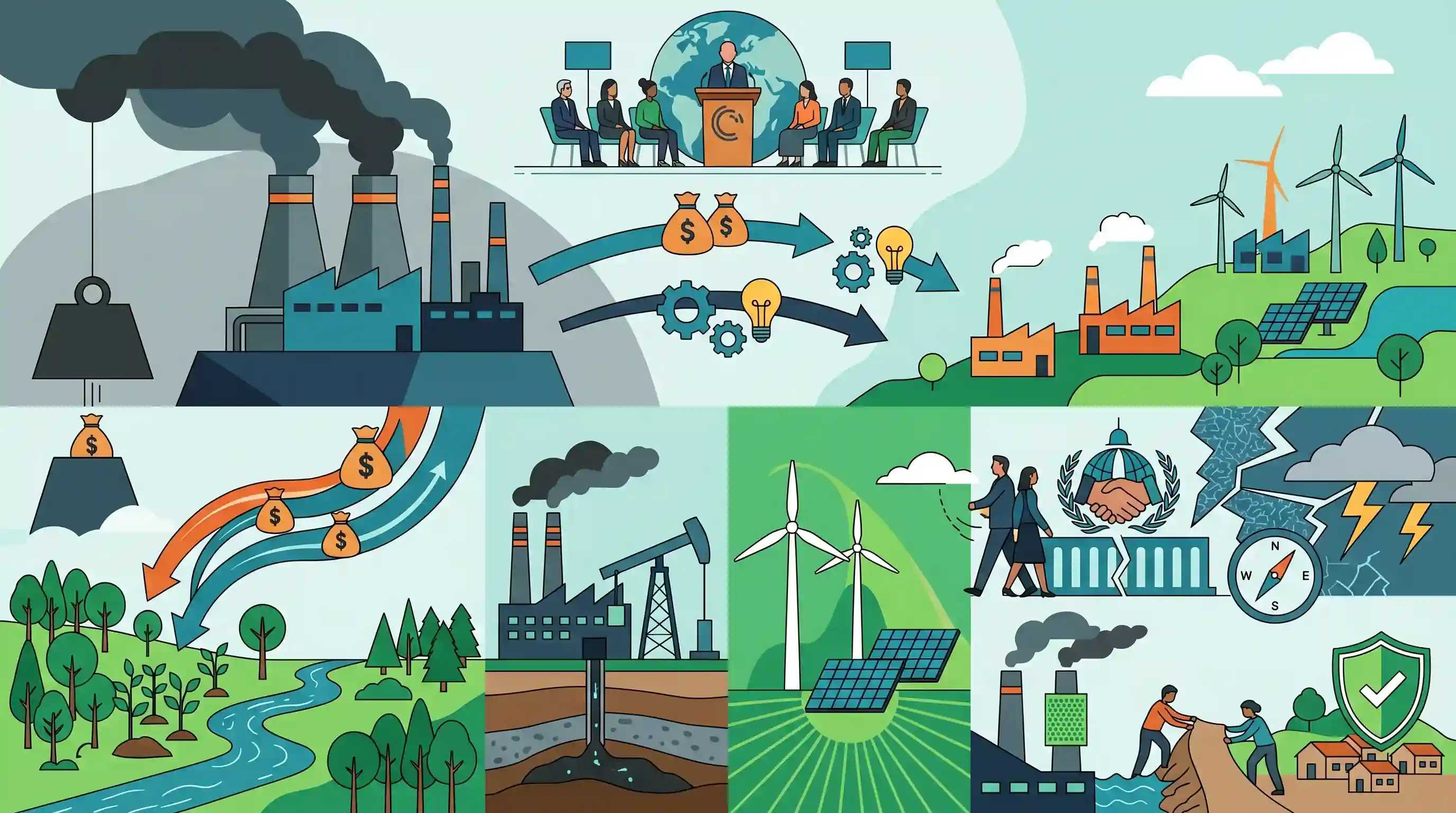
At the Munich Security Dialogue, Finance Minister Nirmala Sitharaman called for 'differentiated climate action responsibilities' rooted in the 'polluter pays' principle. She emphasized that historically industrialized nations must provide greater climate finance and commercially share green technologies with developing countries. Sitharaman also highlighted India's domestic efforts, including dynamic budget allocations for the Green India Mission and investments in carbon capture and renewable energy. Her remarks came amid discussions on the geopolitical challenges of climate security, particularly the anticipated US withdrawal from the Paris Agreement under the incoming Trump administration, underscoring the dual need for emission control and community resilience.
Key Points
- Finance Minister Nirmala Sitharaman advocated for 'differentiated climate action responsibilities' based on the 'polluter pays' principle, arguing that historical polluters should shoulder more of the financial burden.
- She urged advanced economies to facilitate the transfer of clean energy and resilience technologies to developing nations on a commercial basis.
- Sitharaman defended India's domestic climate funding, asserting that budgetary allocations for initiatives like the Green India Mission are dynamic and can be supplemented through supplementary grants.
- She highlighted India's proactive investments in carbon capture strategies and renewable energy as part of the 2026-27 Union Budget.
- The panel discussed geopolitical uncertainties surrounding global climate cooperation, including the expected withdrawal of the US from the Paris Agreement following Donald Trump's return to the presidency.
Important Terms
Common But Differentiated Responsibilities (CBDR)

UNFCCC principle (1992) acknowledging that all states share climate responsibility, but developed nations must lead due to historical emissions and greater economic/technical capacity.
UPSC context
GS-II (IR) & GS-III (Environment). Tests equity in global governance, climate justice, and North-South diplomacy.
Paris Agreement
Legally binding 2015 treaty (COP21) aiming to limit global temperature rise to well below 2°C through "bottom-up" commitments called Nationally Determined Contributions (NDCs).
UPSC context
GS-III (Pollution & Conservation). Tests knowledge of global environmental frameworks and India's climate targets.
Green India Mission (GIM)
One of eight missions under India’s NAPCC, aiming to increase forest cover and enhance ecosystem services to create a 2.5–3.0 billion tonne carbon sink by 2030.
UPSC context
GS-III (Environment/Schemes). Tests domestic climate mitigation strategies and sustainable forest management.
Climate Finance
Financial resources mobilized from public and private sources to support developing nations in climate mitigation and adaptation, often grounded in historical responsibility.
UPSC context
GS-III (Economic Development). Essential for climate negotiation themes like the $100 billion annual target.
Polluter Pays Principle
Environmental law concept mandating that polluters bear the costs of management and remediation. It is central to Indian jurisprudence and the 1992 Rio Declaration.
UPSC context
GS-III (Environment/Law). Tests legal accountability, judicial precedents (e.g., Vellore Citizens case), and economic tools.
Munich Security Dialogue
A premier annual global security forum (held in Germany since 1963) for informal diplomatic discussions on international security policy and conflict resolution.
UPSC context
GS-II (International Relations). Relevant for India's strategic autonomy and evolving role in global security diplomacy.
Prelims Trap
The Paris Agreement discarded the 'Common But Differentiated Responsibilities' (CBDR) principle to enforce uniform emission targets for all nations.
A classic UPSC trap. The Paris Agreement retained CBDR-RC ('in the light of different national circumstances') rather than discarding it. It shifted to bottom-up NDCs instead of Kyoto's strict firewall.
Static Concepts Connected
What are the key distinctions between CBDR and the Polluter Pays Principle?
- Origin: Polluter Pays was popularized by the OECD in 1972; CBDR emerged formally at the 1992 Rio Earth Summit under the UNFCCC.
- CBDR Scope: Acknowledges all states share an obligation to address environmental destruction, but developed nations bear greater responsibility due to historical greenhouse gas emissions.
- Legal Status: Both are legally recognized as part of domestic environmental jurisprudence in India, heavily utilized by the National Green Tribunal (NGT).
What are the core features of the National Mission for a Green India (GIM)?
- NAPCC Umbrella: It is one of the eight core missions under the National Action Plan on Climate Change (NAPCC), launched in 2008.
- Dual Strategy: It focuses simultaneously on climate mitigation (enhancing carbon sinks) and adaptation (supporting livelihoods of vulnerable, forest-dependent communities).
- Target Areas: Originally aimed to increase forest and tree cover on 5 million hectares and improve the quality of forest cover on another 5 million hectares.
Cross-Topic Patterns
CBDR vs. Carbon Border Taxes (CBAM)
The West's push for unilateral carbon taxes (like EU's CBAM) directly conflicts with CBDR, forcing developing nations to pay for emissions without receiving promised climate finance or tech transfer.
Climate Change as a Hard Security Threat
The MSC's shifting focus signals that climate finance and extreme weather are now classified alongside terrorism and nuclear proliferation as core non-traditional global security threats.

Expect a 2026 GS3 Mains question analyzing the 'climate security' paradigm shift, linking US Paris withdrawal to the climate finance gap.
Linked PYQs · 4
Linked PYQs · 4
- 2025MainsGS3
Write a review on India's climate commitments under the Paris Agreement (2015) and mention how these have been further strengthened in COP26 (2021). In this direction, how has the first Nationally Determined Contribution intended by India been updated in 2022?
- 2022MainsGS2
‘Clean energy is the order of the day.’ Describe briefly India's changing policy towards climate change in various international fora in the context of geopolitics.
- 2016PrelimsGS1
Which of the following best describes/describe the aim of 'Green India Mission' of the Government of India? 1. Incorporating environmental benefits and costs into the Union and State Budgets thereby implementing the 'green accounting' 2. Launching the second green revolution to enhance agricultural output so as to ensure food security to one and all in the future 3. Restoring and enhancing forest cover and responding to climate change by a combination of adaptation and mitigation measures Select the correct answer using the code given below.
- 2025PrelimsGS1
With reference to 'Direct Air Capture', an emerging technology, which of the following statements is/are correct? I. It can be used as a way of carbon sequestration. II. It can be a valuable approach for plastic production and in food processing. III. In aviation, it can be a source of carbon for combining with hydrogen to create synthetic low-carbon fuel. Select the correct answer using the code given below.
