India Trade Diplomacy Focusing On EU Deal While US Talks Stall
Source:Indian Express ↗
Why It Matters
India's approach to Free Trade Agreements (FTAs) forms a crucial part of its foreign policy and economic strategy. The exclusion of agriculture from the EU deal underscores the socio-economic importance of the farming sector in India, making it a critical case study for UPSC aspirants studying the intersection of international relations (GS2) and economy/agriculture (GS3).
Summary
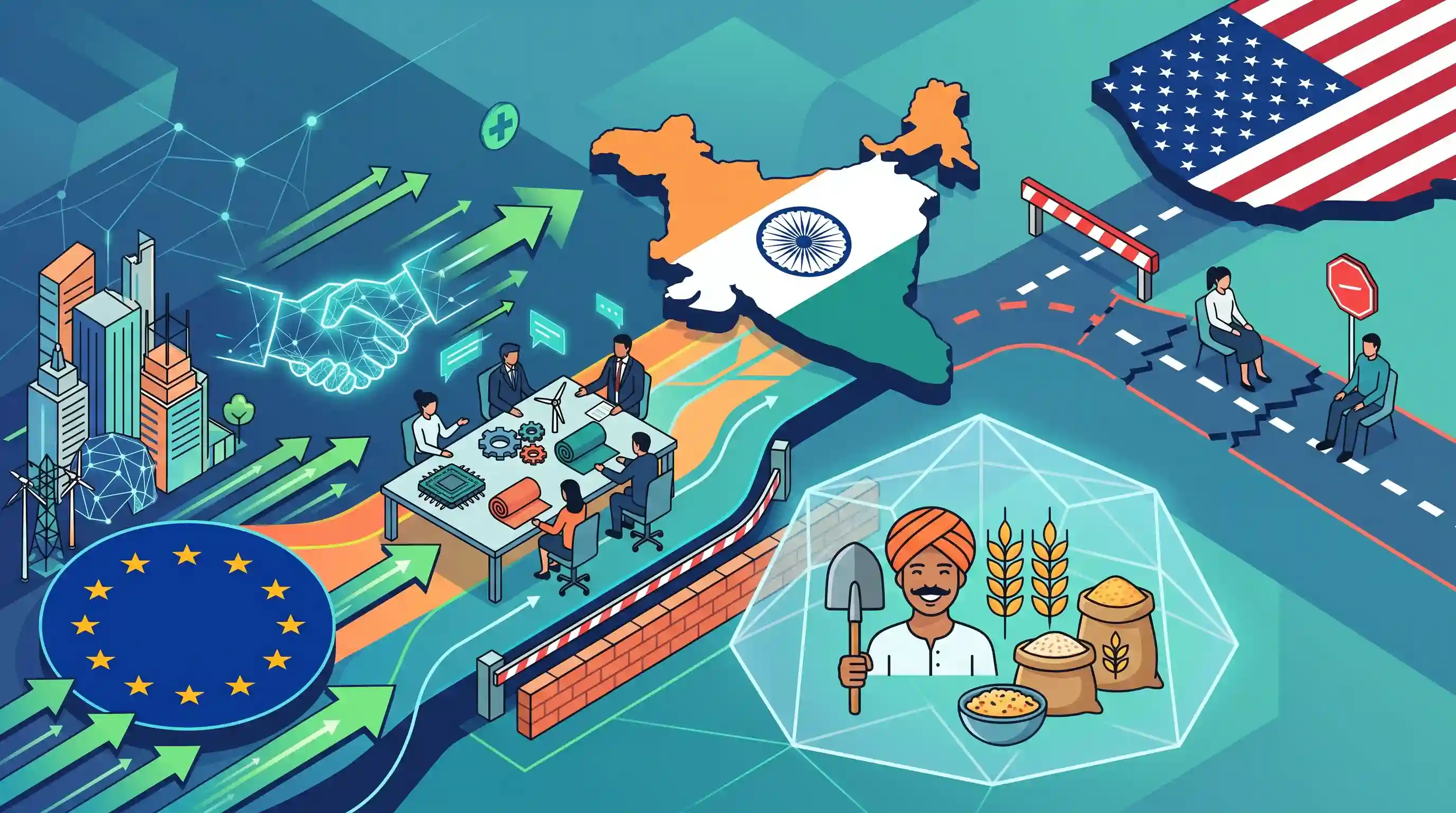
India is accelerating its efforts to finalize a historic Free Trade Agreement (FTA) with the European Union, prioritizing it as talks for a trade pact with the United States remain stalled. A significant feature of the India-EU negotiations is the mutual agreement to keep the agriculture sector off the table, addressing India's domestic sensitivities regarding farmer livelihoods and food security. The development highlights India's recalibrated trade diplomacy, focusing on concluding strategic bilateral economic partnerships while systematically protecting vulnerable domestic sectors from external competition.
Key Points
- India is advancing towards finalizing a major trade agreement with the European Union (EU), which could become its biggest trade deal in history.
- Agricultural products have been explicitly excluded from the India-EU trade agreement, reflecting domestic sensitivities and protection mechanisms for Indian farmers.
- Simultaneously, progress on a comprehensive trade pact with the United States is currently stalled or 'hanging fire', shifting India's immediate trade focus toward the EU.
- The ongoing negotiations highlight India's strategy of pursuing bilateral free trade agreements (FTAs) while safeguarding vulnerable domestic sectors like agriculture.
Important Terms
Free Trade Agreement (FTA)

A formal pact between nations to reduce or eliminate tariffs and trade barriers on goods and services, facilitating easier cross-border economic integration.
UPSC context
GS Paper II & III: International Relations and Indian Economy; tests understanding of trade policy and bilateral economic diplomacy.
Broad-based Trade and Investment Agreement (BTIA)
The specific framework for India-EU trade negotiations (launched 2007) covering goods, services, and investment, recently revived to finalize a comprehensive economic partnership.
UPSC context
GS Paper II: Bilateral Groupings; crucial for understanding India's largest and most complex trade negotiation with its biggest trading bloc.
Sensitive List
A list of products or sectors (like agriculture in India-EU talks) excluded from tariff cuts to protect domestic industries, livelihoods, or food security.
UPSC context
GS Paper III: Indian Economy (Agriculture); tests knowledge of trade-offs between liberalization and domestic food security/farmer protection.
Non-Tariff Barriers (NTBs)
Trade restrictions like quotas, sanitary and phytosanitary (SPS) measures, and technical standards that impede market access beyond simple import duties.
UPSC context
GS Paper III: Indian Economy; tests ability to analyze modern trade challenges where regulations, not tariffs, often block Indian exports.
Reciprocal Tariffs
Matching tariffs imposed by a country in response to duties levied by a trading partner, often used as leverage in trade disputes (e.g., US-India).
UPSC context
GS Paper II: Effect of policies of developed countries; key to understanding stalling US-India trade dynamics and trade wars.
European Union (EU)
A political and economic union of 27 member states located primarily in Europe, acting as a single market and India's significant trading partner.
UPSC context
GS Paper II: International Relations; essential for analyzing India's strategic partnership and collective economic engagement with Europe.
Prelims Trap
"The India-EU FTA proposes deep tariff liberalization across all economic sectors, including agriculture and dairy."
India consistently keeps agriculture and dairy off the table in FTAs with developed nations (EU, UK, Australia) to protect farmers from heavily subsidized imports.
Static Concepts Connected
What differentiates a standard FTA from a CECA/CEPA?
- Standard FTA: Eliminates or significantly reduces customs duties on a substantial majority of traded goods between partner countries.
- CECA/CEPA: More comprehensive, covering trade in services, cross-border investments, intellectual property, and mutual recognition of regulatory standards.
- Key distinction: Neither integrates domestic economic policies nor creates a common external tariff (unlike a Customs Union or Common Market).
Why are agriculture tariffs a persistent hurdle in India's FTAs with the West?
- Asymmetric Subsidies: Developed nations (US/EU) provide massive 'Green Box' domestic support to their farmers, making their agricultural exports artificially cheaper.
- Livelihood Security: India's agricultural sector features millions of marginal farmers whose livelihoods would be devastated by sudden import surges of subsidized dairy, poultry, or crops.
- Jurisdictional limits: FTAs do not cap domestic agricultural subsidies; this can only be negotiated multilaterally at the WTO (Agreement on Agriculture).
Cross-Topic Patterns
TRIPS-Plus vs Generic Pharma
The EU often pushes for 'TRIPS-Plus' provisions like data exclusivity and patent term extensions in FTAs, which inherently clashes with India's Section 3(d) of the Patent Act and its generic pharma industry.
FTA negotiations alongside CBAM friction
While accelerating FTA talks, India concurrently contests the EU's Carbon Border Adjustment Mechanism (CBAM) at the WTO, highlighting a dual-track relationship of bilateral cooperation and multilateral friction over green protectionism.

Expect a multi-statement question in 2026 linking India's exclusion of agriculture in Western FTAs to WTO subsidy classifications.
Linked PYQs · 2
Linked PYQs · 2
- 2017PrelimsGS1
'Broad-based Trade and Investment Agreement (BTIA)' is sometimes seen in the news in the context of negotiations held between India and
- 2023MainsGS3
What are the direct and indirect subsidies provided to farm sector in India? Discuss the issues raised by the World Trade Organization (WTO) in relation to agricultural subsidies.
